



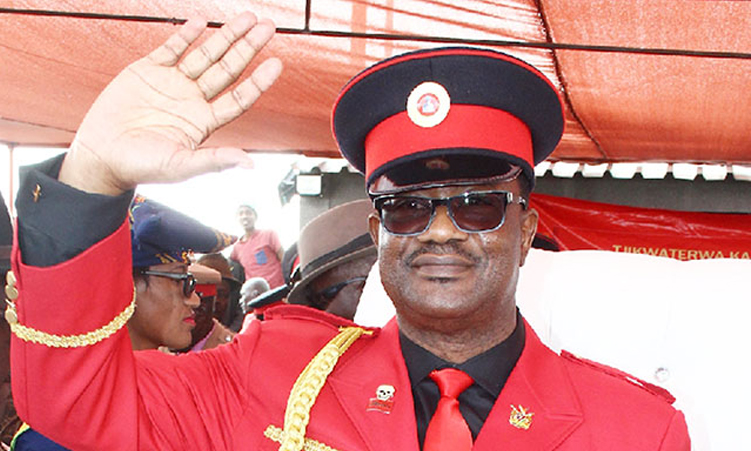
I have been at a loss for words writing a tribute to paramount chief (PC) Vekuii Rukoro.
Omambo jendji rama, as we say in Otjiherero: Words have choked me.
I was hoping the late comrade PC Rukoro would be around for a long time, but unfortunately, he left us prematurely.
He died fighting the so-called joint declaration agreement between the German and Namibian governments. It is fitting to say he died in the line of duty, defending the cause of his people.
I have known Rukoro since the mid-eighties as a Swanu stalwart. He was one of those brilliant emerging leaders of the liberation struggle, who climbed the ladder of the party’s structure and became its president.
As a young politician, Rukoro was uncompromising. He squared against the political giants of the party, including the late Moses Katjiuongua. And in the end, he earned their respect because of his political acuteness.
I developed a close working relationship with Rukoro when he studied towards his master’s degree in law at Georgetown University.
In 1988, my wife and I invited him to speak at the University of Rochester, New York, about apartheid and colonialism in Namibia.
He did not disappoint and he charmed the students, the faculty and the community with his brilliance and charisma.
Rukoro was a product of the Namibian liberation struggle, and as such he felt he belonged to all.
His views transcended any political party’s view.
He was a versatile and intellectual politician. He idealistically believed in and embraced the ever-elusive philosophy of ‘One Namibia, One Nation’.
He was appointed deputy minister of justice in the first Namibian government, and then served his country as attorney general.
In my opinion, and based on conversations with him, he became disillusioned and disappointed with the tribal politics that overshadowed the national interests of all Namibians.
I wasn’t surprised when he agreed to be the Ovaherero paramount chief after the death of chief Kuaima Riruako.
It seems to be the natural destiny of many national politicians who retire to traditional community politics, such as former president Hifikipunye Pohamba, who became a chief of his people.
Rukoro inherited an angry people, who felt marginalised from national politics, and had unfinished business due to the genocide of 1904 to 1908.
These forces set him up to be in opposition with the government.
Rukoro was financially and materially well off, but never got lost in his financial comfort.
He devoted his last seven years to the struggle of the Ovaherero and Nama people for restorative justice with an uncompromising stance for Germany to apologise and pay reparations.
He unequivocally challenged the Namibian government’s cozy relationship with Germany, and as such was a thorn in president Hage Geingob’s side.
In 2017 while speaking at a conference in Berlin, he reminded the audience that the “German government has a chance to negotiate with me. Otherwise, in the future, they will be forced to negotiate with the radicals like him,” pointing at me.
I knew he was referring to the future radical generation that could take the law into their own hands.
And he was correct, because the German and Namibian governments’ stubbornness has and is radicalising the Ovaherero and Nama youth.
I don’t know how the broader Ovaherero community will view Rukoro’s reign many years from now.
Although a lawyer by profession he was short-tempered and had little appetite for inter-tribal squabbles. This is why he created an alternative emblem of the ongeama (lion), separate from the ohorongo (kudu) of the Maharero royal clan.
When we met in New York in 2018, I asked him why he created the emblem and alternate dates to commemorate Otjiserandu.
He said: “There are political forces that are hell-bent on destroying and sowing disunity among the Ovaherero people, including plots to kill me. Therefore, I wanted to avoid bloodshed, and that’s the reason why I created ongeama.”
He courageously sued and faced down the German government in courts in the United States and battled them all the way to the Supreme Court.
Although the suit did not succeed in bringing Germany to trial for the genocides, it galvanised international awareness and support for our struggle for restorative justice.
In that regard, the court case serves as one of the important building blocks in our struggle.
Rukoro was a fighter, a proud Herero and Namibian man.
He cared very much about his people and remained loyal to their cause until death.
He was also a traditional family man, and amid of our struggle he found love again with his widow, Dinah Rukoro.
We are grateful to his family for sharing him and his leadership and devotion with us for the time he served the Ovaherero people and Namibia at large.
Rest in peace, comrade Vekuii Rukoro.
In an age of information overload, Sunrise is The Namibian’s morning briefing, delivered at 6h00 from Monday to Friday. It offers a curated rundown of the most important stories from the past 24 hours – occasionally with a light, witty touch. It’s an essential way to stay informed. Subscribe and join our newsletter community.

The Namibian uses AI tools to assist with improved quality, accuracy and efficiency, while maintaining editorial oversight and journalistic integrity.
Stay informed with The Namibian – your source for credible journalism. Get in-depth reporting and opinions for
only N$85 a month. Invest in journalism, invest in democracy –
Subscribe Now!