


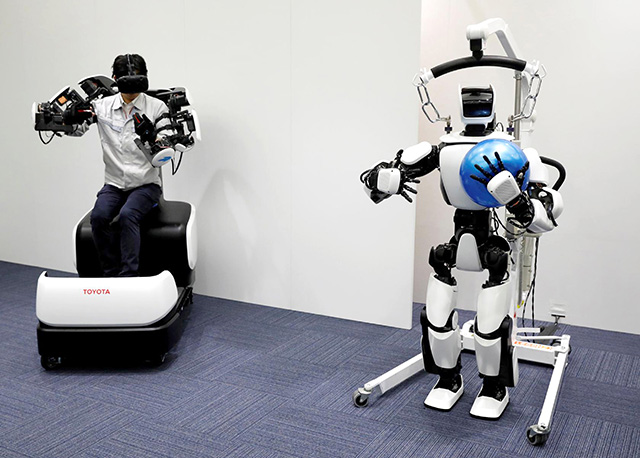
Toyota is readying various robots for next year’s Tokyo Olympics, including one that brings back javelins and other objects, a screen-on-wheels designed for ‘virtual’ attendance and those in the likeness of the Olympic and Paralympic mascots.
The mascot robots’ eyes change to the images of stars and hearts. The engineer in charge, Tomohisa Moridaira, suggested various possibilities, such as having the mascot robot hold the Olympic torch using magnets.
Another robot, T-TR1, is a moving human-size display designed to represent people who can’t be there.
Toyota has also upped its game with a hi-tech way to fetch javelins and hammers: Pint-sized, self-driving artificial intelligence (AI) robot cars.
The next-generation field support robot is a miniature shuttle bus-shaped contraption based on its ‘e-Palette’ ride-sharing vehicle under development, to be used at the Tokyo Games.
The vehicle, roughly the size of a toddler’s ride-on toy car, can travel at a maximum speed of 20km/h and sports three cameras and one lidar sensor which enable it to ‘see’ its surroundings.
Draped around the top of its body is a band of LED lights which illuminate when the vehicle uses AI to follow event officials towards the equipment hurled by athletes onto the pitch during shot put, discus throw, hammer throw and javelin events.
After the equipment, which can weigh as much as eight kilograms for hammers, is loaded into the vehicle by the official, a press of a button located towards its front sends the car zipping back to athletes for later use.
“Humans are better suited to picking up heavy equipment from the field, but for quickly transporting them to their respective return depots, that’s a job that’s best performed by robots,” Takeshi Kuwabara, a project planning manager who oversaw the robot’s development, told reporters.
“Our aim was to leverage the strengths of both humans and robots.”
The trend of using miniature cars to fetch equipment at Olympics throwing events goes back to the 2008 Beijing Games, where firey-red, rocket-shaped cars scurried along the green to collect hammers, javelins and discuses.
At the 2012 Games in London, BMW developed and operated a fleet of blue and orange miniature Mini Coopers to collect the discarded equipment, while pint-sized green pick-up trucks performed the task at the Rio Games in 2016.
A major sponsor of the Tokyo Games, Toyota also plans to dispatch virtual reality enabled humanoid and mobile telepresence robots which will enable spectators who cannot attend the games in person to experience events and meet athletes remotely.
A fleet of robots on wheels developed by the automaker which can perform household tasks for elderly people and hospital patients will also guide guests to wheelchair seats and serve refreshments at events.
Toyota plans to use the games to showcase its new vehicle technologies ranging from fuel-cell buses to on-demand, self-driving taxis, as it competes with industry rivals and tech firms to develop affordable autonomous cars and electric vehicles (EVs), along with on-demand transportation services.
– Nampa-AP; Nampa-Reuters
In an age of information overload, Sunrise is The Namibian’s morning briefing, delivered at 6h00 from Monday to Friday. It offers a curated rundown of the most important stories from the past 24 hours – occasionally with a light, witty touch. It’s an essential way to stay informed. Subscribe and join our newsletter community.

The Namibian uses AI tools to assist with improved quality, accuracy and efficiency, while maintaining editorial oversight and journalistic integrity.
Stay informed with The Namibian – your source for credible journalism. Get in-depth reporting and opinions for
only N$85 a month. Invest in journalism, invest in democracy –
Subscribe Now!