



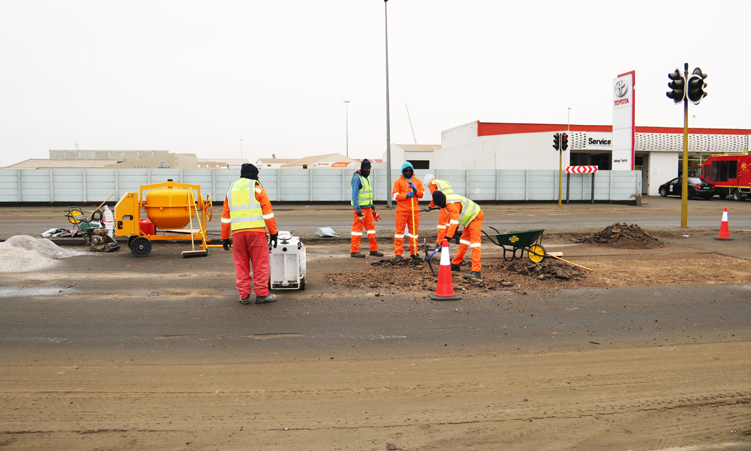
Local authorities across Namibia say funding from the Road Fund Administration (RFA) is insufficient to maintain urban roads, leaving municipalities unable to keep up with worsening potholes, rehabilitation demands, and the impact of heavy rains.
Rundu Town Council chief executive Olavi Nathanael says the municipality is facing major funding and capacity constraints as it prepares for its N$24-million road maintenance budget in the next financial year.
“Proper road maintenance equipment and capacity remains a big challenge, not only for Rundu but for most local authorities across the country,” Nathanael says.
“The RFA and the government should invest more to acquire modern road maintenance equipment for all local authorities that are not financially stable.”
He says persistent under funding forces councils to divert resources from other service areas, slowing down planned road works and delaying upgrades. Grootfontein chief executive Indileni Lungameni says his town requires about N$12 million for road maintenance. The town has, however, received only N$3.5 million to maintain a 62km network.
“Blading gravel roads alone costs more than N$1 million, and the rest goes to patching up potholes and slurrying a few selected roads with high traffic volume. “With an annual rainfall averaging 550mm, Grootfontein is one of the wettest towns in Namibia, hence N$3.5 million is a drop in the ocean,” he says.
Lungameni says the town needs additional manpower and equipment.
“Having signed an agreement with the RFA, we aim to capitalise from the partnership by signing an agreement to upgrade specific gravel roads to bitumen standard to take pressure off existing surfaced roads,” he says.
Swakopmund spokesperson Linda Mupupa says the town receives N$5 to N$6 million annually, an amount that falls short of growing needs.
“The council annually makes budgetary provision for the maintenance of existing road infrastructure and for upgrading existing roads to surfaced standards. We therefore do not rely entirely on the funds provided by the RFA. However, this is a slow process, because funds must be distributed across several other infrastructure needs,” she says.
Mupupa says competition among local authorities slows down additional allocations.
“Because Swakopmund is competing with other local authorities, the allocation of additional funds is often a waiting game,” she says.
The town has submitted proposals to the RFA and Roads Authority (RA) for possible support.
ROADS BOOST ECONOMY
Windhoek spokesperson Lydia Amutenya says the capital has requested about N$513 million for road maintenance in the 2026/27 financial year. Heavy rains earlier this year increased road damage, and the current funding for 2025/26 is inadequate, she says.
“Ensuring that our roads remain in optimal condition is essential for economic activity, mobility, and public safety. Achieving this requires sustained and adequate funding support from the RFA,” she says.
The city is awaiting confirmation of additional support.
The Namibia Association of Local Authority Officials (Nalao) has long warned that the current arrangement involving that the RFA provides funds and the RA manages projects limits transparency and capacity building.
In a 2022 submission, Nalao president Moses Matyayi said RFA funding covers only 4% to 5% of local authorities’ road needs. Nalao recommends a minimum of N$570 million annually for urban roads.
RFA chief executive Ali Ipinge says the administration evaluates funding requests based on justified needs. He says consultations have revealed national requirements of N$8.2 billion, while the RFA expects to generate N$4.2 billion.
“Annually we ask each approved local authority to make a funding request, but not just to say we need N$10 million, they need to justify why, including a basic assessment of their needs,” Ipinge says.
He says the RFA evaluates submissions and determines allocations through road user charges.
PRIORITIES
“This means we can provide N$4.2 billion. Certain interventions will not be implemented the following financial year. We have to see how to prioritise the basket of interventions,” Ipinge says.
In an opinion piece, Ipinge defends the RFA’s management, saying the administration maintains strict governance, produces audited financial statements, and is pursuing long-term interventions to reduce maintenance backlogs from N$4.5 billion to N$0.5 billion by 2029.
In an age of information overload, Sunrise is The Namibian’s morning briefing, delivered at 6h00 from Monday to Friday. It offers a curated rundown of the most important stories from the past 24 hours – occasionally with a light, witty touch. It’s an essential way to stay informed. Subscribe and join our newsletter community.

The Namibian uses AI tools to assist with improved quality, accuracy and efficiency, while maintaining editorial oversight and journalistic integrity.
Stay informed with The Namibian – your source for credible journalism. Get in-depth reporting and opinions for
only N$85 a month. Invest in journalism, invest in democracy –
Subscribe Now!