Young mothers at Gobabis drink all day to relieve hunger pangs
Fransina is struggling to balance on her feet as she shouts: “We are suffering!”
Her shouting draws the attention of observers nearby. But Fransina doesn’t care who hears her.
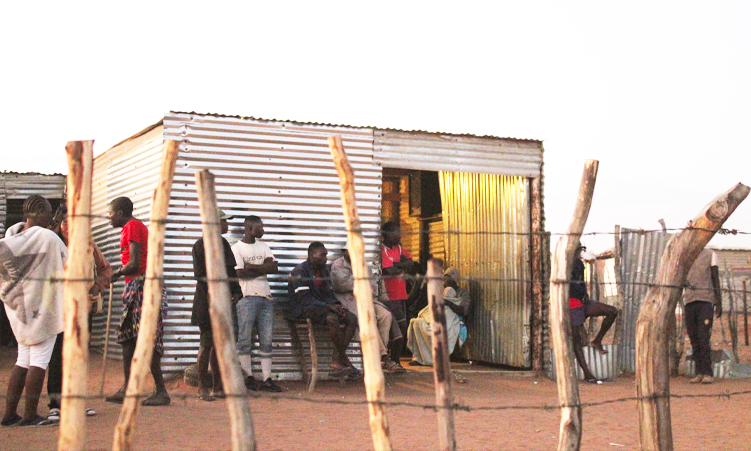
Not far from her is one of the busy ‘tombo huise’ (tombo houses), as they call them at Gobabis’ Kanaan B settlement.
Fransina and other unemployed mothers in their early 20s up to early 40s come here as early as 06h00 and leave well after midnight.
Tomorrow they will repeat the cycle, losing track of time as the alcohol flows.
The authorities at Gobabis say alcohol is a major challenge, causing child neglect, crime, domestic violence and poor productivity.
Kanaan, named after the Biblical ‘promised land of milk and honey’, is a far cry from this.
The informal settlement has no running water, no electricity, and no toilets – or food. But social workers say tombo houses are in abundance.
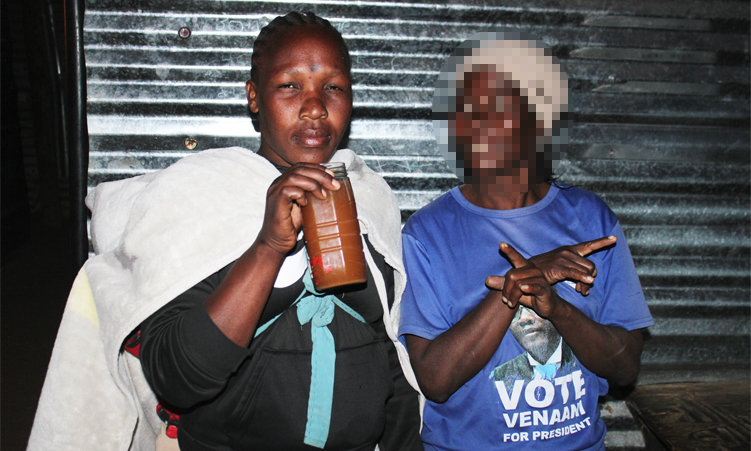
“Tombo is all we have. What else can we eat? It fills our tummies,” Fransina says, her eyes blood-shot.
Her friend, Memory Kamutjemo (32), who is carrying a sleepy baby on her back, agrees.
“It (tombo) really makes us full,” Kamutjemo says.
Another young unemployed mother, Katrina Kaenda (24), is sipping from a glass of tombo as she explains what keeps her returning to the place.
She says the traditional homemade brew is the only thing she has to keep the hunger at bay.
“Tombo makes us full,” she echoes what Fransina and Kamutjemo say.
The only time she leaves the tombo house, Kaenda says, is at around 22h00 when it is closing time.
“I come here every day and wait for someone to buy for me so I can drink and fill my stomach,” she says.
A small glass of tombo costs N$3, while a bigger one costs about N$5.
The place is crowded with young men and women drinking to pass the time – among them pregnant women and others with babies strapped on their backs.
They say the drink, made from water, sorghum and sugar, is like food.
Kaenda says without money, eating regularly is hard.
‘WHAT HARAMBEE FOOD?’
Riaan Aoxamub (34), another patron, says many families at Kanaan C are struggling to get by.
He says his household last received a 10kg bag of rice through the government’s Harambee food parcel assistance programme in April.
Since then, he has survived on odd jobs, such as cleaning yards, to earn money for food.
“The government must at least give us maize meal every month. We are struggling,” he says.
‘THEY DON’T HAVE A CHOICE’
Frieda Moses (46) says she often sees young mothers arrive at shebeens early in the morning and leave only when the drinking spots close at night.
She believes hunger is what keeps them there.
“They don’t have a choice but to drink tombo,” she says.
Marta Afrikaans (25) says: “Yes, tombo makes you full, but I don’t drink it every day, because I don’t always have money to buy it.”
She says the food assistance the community got months ago was not enough to sustain families for long.
Martha Afrikaner (29) says she used to drink tombo, but stopped after the Ministry of Gender Equality and Child Welfare allegedly threatened to take her children away over neglect.
‘DRINKING WITH CHILDREN’
A bartender who spoke to The Namibian says they do not sell alcohol to children, but they often see parents drinking while their children are with them at tombo houses.
“When the children come here alone, they only buy food. Alcohol is expensive,” he says.
Kanaan B resident Markus Aoxamub (58) says growing up, adults did not drink in front of their children, but this has changed.
He says some children even skip school for bars.
“Back in the day, you only drank one bottle a day. These days children go to bars to drink or are even sent there by their parents,” Aoxamub says.
The tombo problem at Kanaan is part of a much bigger issue confronting the Omaheke region.
The region has faced severe cases of child malnutrition and hunger over the past three years.
The Namibian reported in 2024 that about 800 deaths were recorded between 2022 and 2024, while over 30 000 cases were recorded during the same period.
Local nutritionist Esther Katjioungua says poverty, frustration, food insecurity and poor family structures contribute to alcohol abuse, creating a cycle that makes recovery difficult.
“These people have an alcohol problem. Their bodies are used to drinking the traditional home brew,” she says, adding that there is indeed a perception that tombo fills an empty stomach.
‘REGULATE BARS’
Meanwhile, Omaheke governor Pijoo Nganate wants bottle stores to close by 18h00 and bars to stop operating at 22h00 to reduce alcohol abuse and boost productivity in the region.
He says some residents go as far as drinking on credit when they have no money.
Nganate last month said alcohol abuse is the biggest problem facing the region, fuelling domestic violence, assault, gender-based-violence, dealing in cannabis, and causing child neglect.
“These things should be attended to, and I want the police to reinforce the patrolling of suburbs, especially in townships where they operate beyond operating hours,” he said.
He said it also causes noise pollution and infringes on schoolgoing children’s study time.
During the 2025/26 financial year, Nganate said the region recorded 85 cases of child neglect and 18 cases of dealing in cannabis.
“If we curb alcohol abuse, we can become more productive, reduce levels of poverty and child neglect, and save our money better,” he said.
“We want to set up a peaceful community, because if the bar next door is making noise, how do we sleep?” he asked.
Gobabis mayor Elwin Gariseb says limiting bars’ operating hours may not be realistic because there are so many at the town.
“I don’t know if it will be doable. The police have tried to close down illegal shebeens but have not been successful,” he says.
Gariseb says the police identified 58 illegal shebeens during operations last year.
*Not her real name