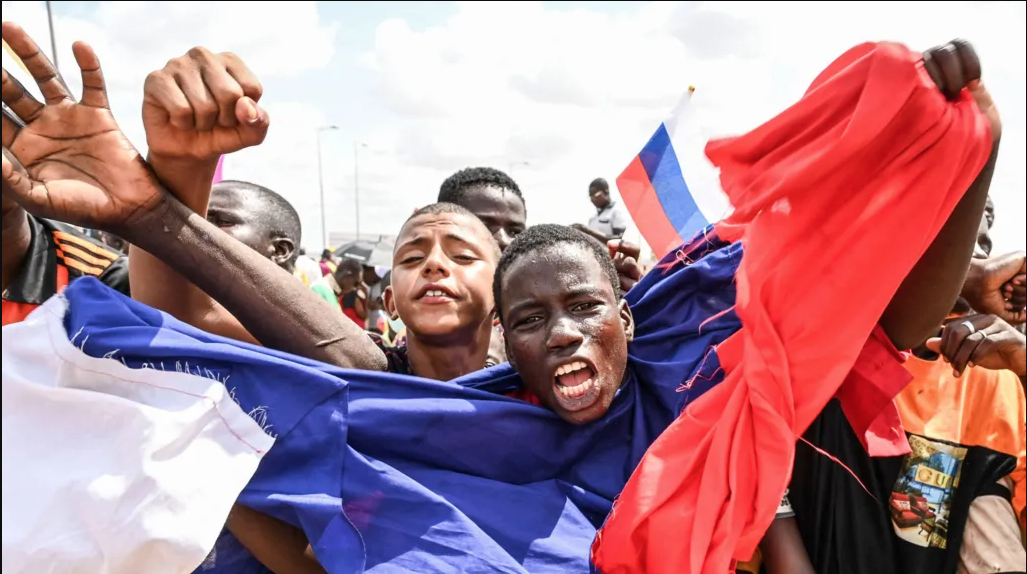
The US has declared a stark policy shift towards three West African countries which are battling Islamist insurgents and whose military governments have broken defence ties with France and turned towards Russia.
The state department announced that Nick Checker, head of its Bureau of African Affairs, would visit Mali’s capital Bamako to convey the United States’ “respect for Mali’s sovereignty” and chart a “new course” in relations, moving “past policy missteps”.
It adds that the US also looks forward to co-operating with Mali’s allies, neighbouring Burkina Faso and Niger, “on shared security and economic interests”.
Absent from the agenda is the longstanding American concern for democracy and human rights. The Biden administration had halted military co-operation after coups deposed the elected civilian presidents of all three countries between 2020 and 2023, with Niger’s Mohamed Bazoum still locked up in his own residence.
The US statement makes explicit a radical change in policy that had become increasingly evident over the 12 months since Donald Trump returned to the White House.
The shift started with the shuttering of USAID – a key provider of development support to the region – days after the president was sworn in for a new term.
This was followed by repeated signals of a much narrower focus on security and mineral resources, with both development and governance sidelined.
The announcement of Checker’s visit goes further in openly declaring respect for Mali’s sovereignty. The message will resonate in Bamako and allied capitals, where military leaders have built their appeal by striking pan-Africanist themes and rejecting former colonial power France.
Burkina Faso’s military leader, Capt Ibrahim Traoré, presents himself as a standard-bearer in resisting “imperialism” and “neo-colonialism”. Through vigorous social media promotion, he has gained huge support for this stance and personal popularity among young people across the continent and beyond.
The Trump administration has made plain that it is unconcerned by the regimes’ rejection of the European-style constitutional model of elected civilian government.
Massad Boulos, senior adviser for Africa at the state department and a Trump confidant, last year told the French newspaper Le Monde: “Democracy is always appreciated, but our policy is not to interfere in the internal affairs of other countries. People are free to choose whatever system is appropriate for them.”
This attitude marks a stark change.
ADVERTISEMENT
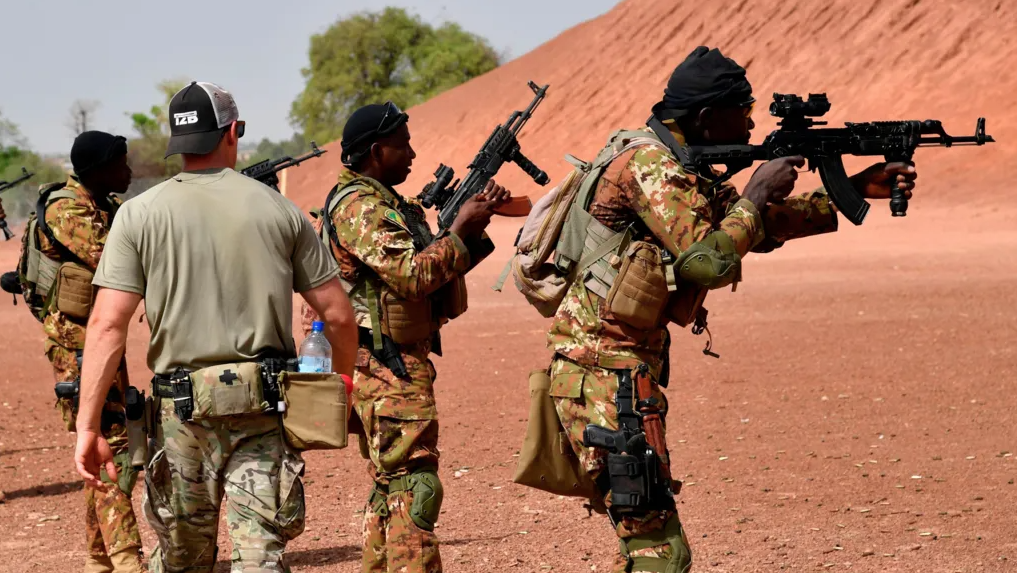
During the Biden era Gen Michael Langley, head of the US military’s Africa Command (Africom) from 2022 to 2025, stressed the importance of good governance and environmental issues, as complements to military support.
However last year, following Trump’s return to the presidency, he said that supporting the fight against terrorism was now the main focus.
And that certainly seems to be the priority in West Africa, a message reiterated by Rudolph Attalah, a senior counter-terrorism official, on a visit to Bamako last year.
Then last month Africom’s deputy head, Gen John Brennan, confirmed that the US was continuing to actively support the three military-run countries in their struggle against jihadist groups, and Islamic State in particular.
The motives for Trump’s shift in approach seem to be threefold.
The US, like Europe, remains seriously concerned about the long-term security threat posed by the jihadist groups now operating across the Sahel – the semi-arid stretch of land south of the Sahara Desert. According to some definitions, the region now accounts for half of all the world’s terrorism deaths.
Although almost all the casualties are local, there is concern in the US that the governments’ loss of control of much of their territory could allow the emergence of safe havens for jihadist groups to develop further and expand.
Diplomats and analysts routinely now describe the region as the “epicentre of global terrorism”, which could present a long-term international threat.
In the “tri-border region”, where Mali, Burkina and Niger converge, the West African offshoot of Islamic State (Islamic State in the Greater Sahara, ISGS) is particularly active.
A fresh reminder of the scale of threat that it poses came only last week with an attack on the airport in Niamey, Niger’s capital.
ADVERTISEMENT
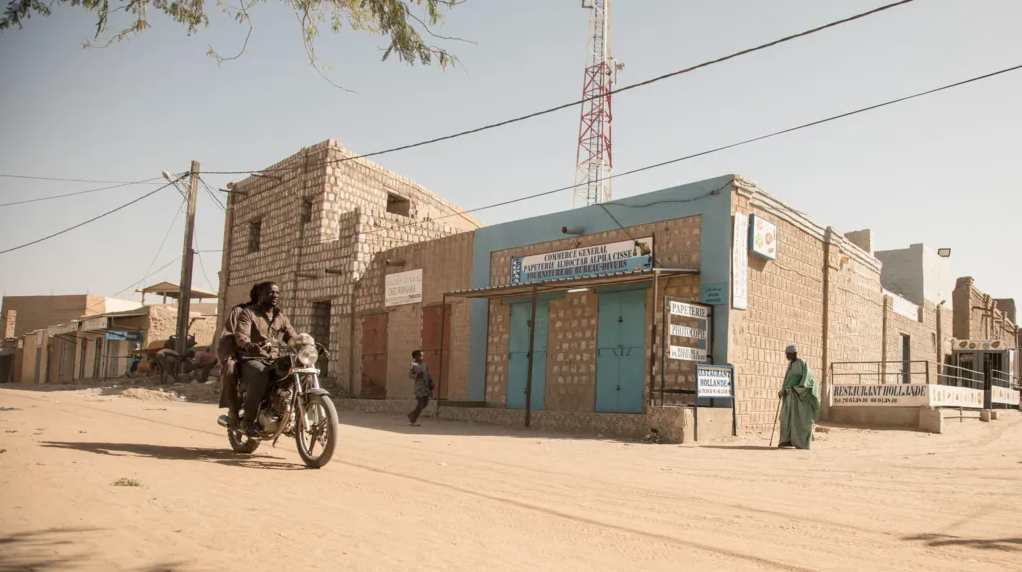
The jihadist activity is also a threat to the Sahel’s export of valuable or strategically important minerals: the region is a major producer of gold and Mali also produces lithium – a key ingredient in rechargeable batteries and also used in some medication – while Niger has significant uranium reserves.
Niger’s military government has seized control of the country’s main uranium mine from the longstanding French operator, Orano, and is now lining up Russia as its new partner in the sector.
The Trump administration also appears concerned not to leave Russia to play the role of sole external defence partner of the three countries.
Unlike the West African regional bloc Ecowas, France, the EU and the Biden administration, today’s White House does not regard the Russian military presence as a threat to regional stability or human rights. Russia has deployed about 1,000 security contractors in Mali, with smaller contingents of mercenaries or regular troops in Burkina Faso and Niger.
There have been numerous allegations of abuses committed by the Russians, in particular in Mali.
When Attalah visited Bamako, he signalled that Washington was quite relaxed about Moscow’s military involvement.
It seems that Washington does not want to leave the field open for exclusively Russian influence and does now want to balance that with its own security partnership.
Still, this will be on terms that will not unsettle Trump’s political base, to whom he has repeatedly promised an end to US involvement in “forever wars” overseas. This is not about troops on the ground – save, perhaps, for occasional training teams.
Africom’s Brennan says the US is providing Mali, Burkina and Niger with intelligence support and hints at the potential supply of weapons.
But Washington is not seeking to redeploy active forces or reopen the large drone base it built in Agadez, Niger, where it had around 800 troops. The junta expelled them after the Biden administration pressed for a roadmap to restore democracy.
Following the spate of coups, Ecowas tried to pressure the military leaders into promising firm dates for new elections.
But in response Niger, Burkina and Mali withdrew from the bloc last year and they are now focused on building up their own confederation, the Alliance of Sahel States (AES).
Because they are no longer members, Ecowas has no responsibility for addressing their internal governance values.
And this has freed its dozen remaining member states to themselves just try to rebuild practical co-operation with the three countries in the fight against Islamist groups.
This is a major priority for governments across the region, at a time when militants have been infiltrating over the borders, to stage attacks or hide in the north of countries such as Benin, Nigeria and Togo, Ghana and Ivory Coast.
As the region faces this daunting challenge, US intelligence on key targets, and perhaps extra weapons too, may help deliver some quick wins against the militants.
But – as France’s decade-long deployment of thousands of troops and air power to the Sahel showed – high-tech military means alone cannot restore peace, unless the complex social and economic stresses in this desperately poor region of the world are also addressed. – BBC
In an age of information overload, Sunrise is The Namibian’s morning briefing, delivered at 6h00 from Monday to Friday. It offers a curated rundown of the most important stories from the past 24 hours – occasionally with a light, witty touch. It’s an essential way to stay informed. Subscribe and join our newsletter community.

The Namibian uses AI tools to assist with improved quality, accuracy and efficiency, while maintaining editorial oversight and journalistic integrity.
Stay informed with The Namibian – your source for credible journalism. Get in-depth reporting and opinions for
only N$85 a month. Invest in journalism, invest in democracy –
Subscribe Now!