






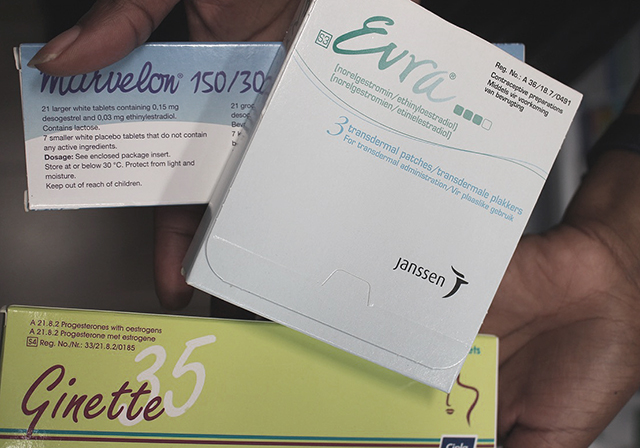
LIKE most teenage girls, Tuli Pamwe* (23) was introduced to birth control pills to combat her facial acne and like most young girls, she also thought it was her best most reliable method to avoid pregnancy.
Dr Farai Bento, an obstetrician-gynaecologist with a private practice in Windhoek says that globally, most women use the combined oral contraceptive, informally known as the pill, because it is widely known. He said that it is a suitable birth control method because it has a very short half-life and allows a women’s family planning options to remain flexible.
He also explained that there are many circumstances in which the pill might not be the best method and thus, alternatives are suggested.
“The pill helps with acne, facial hair, and premenstrual syndrome, and it reduces the risk of ovarian cysts,” he explained. “But the pill is contra-indicated in patients with heart conditions, liver tumours or where there may be abnormal uterine bleeding.”
Bento also explained that some women experience side effects from the oestrogen hormone in the pill, which would require them to seek a non-hormonal method.
Pamwe experience on the pill is one such circumstance. After a few years on the pill, she started experiencing an all too common side effect: nausea. Her doctor encouraged her to switch to a different form of birth control, and this was when she was introduced to the patch and then the intrauterine device (IUD).
“I needed a reliable and non-hormonal contraceptive method,” she said.
Pamwe’s nausea was caused by the high level of the oestrogen hormone contained in the birth control pill, and for that reason, the copper, non-hormonal IUD was recommended to her.
The IUD is a small, T-shaped device that is placed inside the uterus. The Planned Parenthood Federation of America explains that the device prevents pregnancy by changing the way sperm cells move so that they can’t get to an egg. IUD’s can be hormonal or non-hormonal, to accommodate women like Pamwe, with a sensitivity to high levels of oestrogen.
Pamwe said that despite the excruciating pain of the device’s insertion, one of the main advantages of this method is its durability. Depending on the type, an IUD can last from three to 12 years before being replaced. She said that the insertion process is similar to getting a Pap smear.
Aside from the pain, Pamwe explains that the process is relatively expensive.
“I could only afford it through my medical aid,” she said. “[But even then] your doctor needs to write a letter to your medical aid provider explaining why the expense should be approved. “
Dr Bento corroborated Tuli’s experience. He said that when it comes to the more expensive alternative birth control methods, such as the implant and the IUD, requesting medical aid coverage would need to be motivated by a doctor.
“For the injection and the pill, it is not necessary to have written motivation,” he said. “For the IUD and implant, for example the, medical aid will cover it, especially if there is a reason why. It would just need to be motivated, and there needs to be authorisation.”
Oumatjie Hango (24) recently opted for the Implanon NXT implant after previously being on the birth control pill. Hango said that she decided to make the change because she was not happy with the side effects she experienced while on the pill, namely the intense mood swings, excessive weight gain and a biweekly allergic reaction she’d have to the pill.
“I’d take the pill and then suddenly hives would appear on my skin; my throat would feel closed up; and my whole body would itch,” she detailed. “It didn’t last long, but it was uncomfortable.”
Compared to the pill, Hango said the implant has not affected her mood and also eased the chronic pain from her menstrual cycle. However, she has experienced subtle weight gain and occasional headaches.
“My periods are non-existent, [and] so are my chronic period pains,” she said.
She also said that getting the implant was an easy process. After getting a prescription from her doctor, she obtained the implant from a pharmacy, and her doctor inserted it the next day. It only took three minutes.
Hango is on the PSEMAS high option and only had to pay N$250 out of pocket to cover the cost of the device.
Although these lesser known forms of birth control have limits of affordability, accessibility and availability, Dr Bento believes that it is mainly a lack of insight that constrains many women from exploring those options.
“The main reason other methods may not be used as much is about women not knowing,” he said. “The processes are not necessarily very long, and medical aid can cover the costs.”
Bento further explained that in most cases, these alternative methods are only discussed when a woman herself asks about them. Methods might also be discussed postpartum, after a miscarriage or as part of post-abortal care, he added.
“Usually six weeks after delivery women come in for a check-up, and this is when we discuss family planning methods going forward,” he said.
Pamwe and Hango are both satisfied with their decision to utilise these lesser-known birth control methods, and both women would cautiously recommend making use of these methods.
“The insertion of the IUD is incredibly painful. I nearly cried,” Pamwe exclaimed. “It was painful but worth it”
* This name has been changed to protect the identity of the woman.