



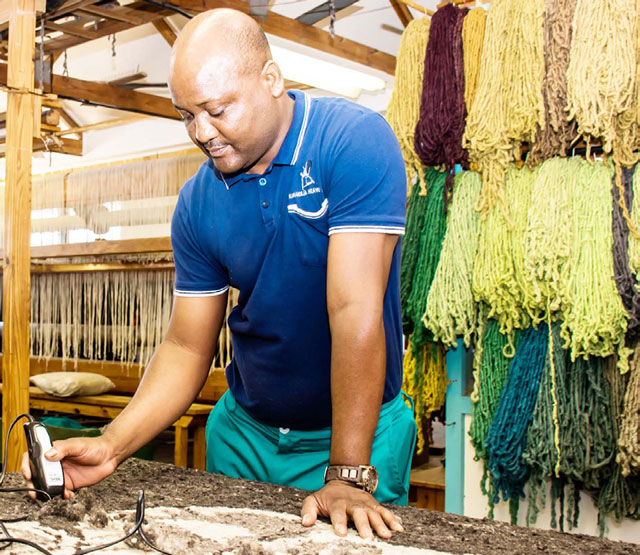
HANDMADE material is always associated with quality, as it requires mastercrafting and has the personal touch of the maker.
This is the explanation Moses Helao gives when asked why he focuses on hand-crafted material instead of machine-made products.
The 48-year-old is the owner of Karakulia Weavers, a Namibian medium manufacturer of handmade rugs and carpets that uses wool from sheep farmers in the south at its workshop at Swakopmund.
He explained that his customers come from all over the world for the quality of his hand-made rugs and carpets.
“We want to keep them handmade, as [all] around the world people do not want to use their hands any more. So people come here not because of the price, but the quality,” he said.
Large printed rugs can take up to seven days to weave by hand, while machines can take around two hours, but the quality is not the same, he believes. Helao indicated that the quality of his hand-made products is what makes his company stand out from those using weaving machines.
Commenting on how the implementation of the African continental free trade area (AfCFTA) has impinged on his business, he said, as a manufacturer, he was not consulted on the agreement the country undertook and how it might affect his company. Bemoaning the powers that be, Helao stated that the authorities have limited know-how when it comes to the manufacturing sector, despite the sector’s potential for solving the country’s unemployment woes.
However, he stated that he is not afraid of the competition that might arise from intra-continental trading, as customers will always prefer high quality products and Karakulia Weavers plans to maintain its superior standards. He said all his customers are from outside Africa, and he is looking forward to tapping into the African market, depending on how the free trade initiative goes.
He said that his rugs and carpets are made by adding value to Namibian wool, which itself is a 100% Namibian raw material, that is transported from the //Karas region.
Helao also blasted the Namibian tendency to work in isolation, driven by a reluctance to uplift each other. This comes as all his products are being sold in his workshop no retailers in the country sell them, he says, as the willingness is not there.
He also called on ‘Team Namibia’, as an organisation that facilitates local products to get on to the local retailers’ shelves, to engage more with their members beyond Windhoek. Helao urged the organisation to be more active around the country as manufacturing takes place all over the country, not only in the capital.
He indicated that, despite his business encompassing manufacturing, adding value and exporting, his company gets no preferencial access to much needed incentives such as reduced land costs, tax breaks, or any reduction in the cost of utilities (electricity and water) to stimulate local production.
He indicated that certain machines used in the carpet making process, such as cuddling machines, use substantial quantities electricity, which is quite expensive.
Only companies that fall within the Export Processing Zone are afforded such benefits, and most of them are foreign-owned and in the mining sector, he said.
Helao explained that since he took over Karakulia Weavers from his previous bosses who suffered a bankruptcy in 2011, he has not found any schools in the country that train weavers and carpet and rug makers. The company has had to train their own workers, an exercise which is quite costly and time-consuming, he added. He said the company has had to find ways to be cost-efficient while offering their two years of on-the-job training, while at the same time ensuring that their trainees acquire the needed skills. Helao said two years ago he contacted various vocational schools, offering to run weaving courses which his company was ready to provide the practice material for but, until today, no-one had taken him up his proposal.
The company has 10 employees, with many around 50 years of age. Helao is worried that he will eventually need to recruit younger artisans to maintain his workforce, who will require skilled mentors and a substantial time-investment to train, both of which are in short supply.
Currently, there are four weaving companies in the country.
Helao also called for more small and medium enterprise funding to be made available, as at present funding institutions ask businesses to pledge unattainable sums of collateral and security. He pointed out that most of the innovators and entrepreneurs requesting funding are young entrepreneurs, with limited financial resources, or graduates who have not accumulated enough capital yet.
He said a new funding approach is needed to encourage innovation and value addition in the country.
‘Team Namibia’ account director Bärbel Kirchner indicated that their mandate is to increase awareness of the need for, and value in, the consumption of local goods and services, through various marketing initiatives.
She said that given their budget constraints, “we need to be very strategic and targeted in our activities”.
This means that its stakeholder’s exposure, and the success in spreading the message of support for local businesses, have increased drastically thanks to digital platforms.
Kirchner added that the restricted marketing budget also calls for an initial focus on the domestic market, before considering the expansion of marketing efforts into the regional and international market places.
“As a member-based organisation, and not financed by the government, we cannot spread ourselves too thinly,” she said.
Kirchner pointed out that authorities and organisations such as the ministry of trade, the Namibia Trade Forum and the Manufacturing Association of Namibia are mandated to look at trade-related policies, infrastructural environment andcosts and incentives put in place by the government to benefit the manufacturing industry.
In an age of information overload, Sunrise is The Namibian’s morning briefing, delivered at 6h00 from Monday to Friday. It offers a curated rundown of the most important stories from the past 24 hours – occasionally with a light, witty touch. It’s an essential way to stay informed. Subscribe and join our newsletter community.

The Namibian uses AI tools to assist with improved quality, accuracy and efficiency, while maintaining editorial oversight and journalistic integrity.
Stay informed with The Namibian – your source for credible journalism. Get in-depth reporting and opinions for
only N$85 a month. Invest in journalism, invest in democracy –
Subscribe Now!