





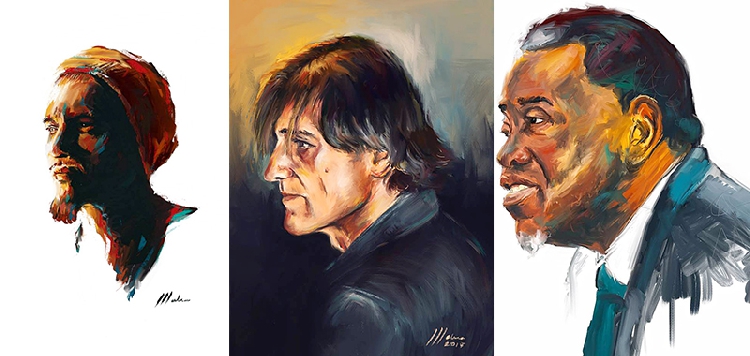
“I want my work to speak for itself.” So says striking visual artist, Nambowa Malua. Well known in trendy art circles today, Malua’s artistic journey started a long time ago, as a youngster who was born in the small northern town of Okalongo.
Shortly after Malua was born in 1988, his parents moved to Angola where the artist was raised for much of his life, and where he attended primary school. As a young teen, Malua tagged along with his father, who moved to Pietermaritzburg, South Africa to attend university. The move proved to be pivotal for Malua who remembers the time as difficult because of the change in language but it provided an opportunity to polish his English.
“By coincidence, one of my bigger brothers applied to the same university as my dad, and took up visual arts. He influenced me and taught me how to see and how to draw from a very young age. Somehow, somewhere, I already had the natural ability, but he found a way to channel it into a passion,” the artist said, adding that he did it with some kind of ease. “My brother saw that, and he always mentored me from a young age. I drew quite a lot, in class I just drew, I don’t know how I managed to pass.”
Malua returned to Angola where he attended high school before coming to Namibia, where he studied visual arts at the University of Namibia. This provided the foundation for the artist’s future work as a graphic designer and illustrator for various advertising companies.
“I decided it’s time to see what it’s like to be a full-time artist, or at least do more art and try to see how I can make time for graphic designing. I still do a lot of freelance graphic design work, such as the album art for Elemotho, which was quite a good experience and which lead to an exhibition of the same name, ‘Beautiful World’. Basically that’s my journey,” Malua said.
Speaking on the challenges of being an artist in Namibia, he said the juvenility of the industry is one of the hardest things to deal with.
“It’s young, it’s very unexplored in an African context, or Namibian context – to be an artist in Namibia, to capture what Namibia is, the spirit of Namibia as an artist. The industry is small, it takes a lot to be able to survive as an artist. One has to do a lot of odd jobs to protect your dreams or passions as an artist,” Malua elaborated.
He mentioned that visual artists have to find some kind of niche to survive in Namibia. “Some artists prefer to do work by commission, some prefer to be illustrators and do corporate work, and a few of us chose the journey of exhibiting which is quite good. But it requires a lot of time, prep work, thinking and a little bit of philosophy now and then, because you want to communicate ideas or themes,” he said.
Those who are familiar with Malua’s work know a large part of his art revolves around his images of well-known people. He maintains that this was not smart publicity stunt, but tather about celebrating the go-getters in our communities.
“It’s a way of celebrating people who are giving out a lot of positive energy, people who are doing something, and it’s good to celebrate those people.
It’s not only famous people. I also draw interesting characters, people with awesome personalities, people with good spirits. Most of the time, I prefer to draw or paint people I talk to, people I know. They might seem famous to some people, but I know most of them – I have interacted, talked to or hung out with them.
When it comes down to inspiration, the artist said almost everyone goes through a creative or mental block, however you just have to have the ability to identify your sources of inspiration.
“Most of the time, I like to believe that these things are always there and they just require you to see them. Inspiration is always there, we just have to have that willingness or ability to see them, to expose ourselves to these inspirations,” he said.
“I work majorly with human beings as my subject matter. I like human faces, human bodies, I like the human spirit. I always try to look for moods, spirits and interaction – how these people are dancing through life. I try to look for something different, something extraordinary. Those subtle poses, those subtle smiles are very expressive sometimes – distinct movements and distinct states of being.”
Malua mentioned that in his free time, he always aims to keep himself distracted whether it is by reading, watching movies or jamming on the guitar with his friends.
“There’s always this thin line between visual arts and the art of sound or music. Somehow when you are able to communicate visually, it seems very easy to just pick up and instrument. I love music. I like to go out a lot – going out and talking to people is also a very good source of inspiration, meeting interesting subject matter.
The artist, who gets bored easily, said he can’t just sit around and do nothing, unless he is meditating. “One of the most challenging things in life is to be thoughtless, and it’s also very important for the brain. Meditation taught me lessons about life and letting go,” he said.
Malua incorporates aspects of reality with abstract art, and this, he says, creates tension in his work.
“I try to bring in some unknown element, yet recognisable. I do work with faces and always try to bring about some resemblance. I can get quite abstract. I wouldn’t consider myself a hyper realistic artist, more expressive,” he explained.
Malua aims to provide a platform for his audience to be themselves and feel at home in his art. “As artists, we are the gateway of these alternative universes where people want to go to,” he said. “That’s why people pay for art, or music and concerts.” He says viewers are moved into a different space and a different time. They not only escape, but sometimes they feel this is where they belong. “I want people to get some positivity, inspiration or even scare them sometimes – towards change. I just want to them to get something.”