





There’s a tiger in the Omba Gallery and it is either reappearing or fading away. The leg on the left is not quite corporeal while the right one is solid enough to cast a shadow and it stares unfathomably at whoever has come to see Daniela Magg’s exhibition.
It reminds one of a scene from Ang Lee’s ‘Life of Pi’ (2012) but even that association is as prone to dissolving as the chunks of world that have vanished in Magg’s canvases.
In ‘The World is Your Canvas, Paint Your Own Picture’, Daniela Magg makes surrealism come to life.
Making use of upturned wine glasses, shards of mirror, pieces of wood, lengths of material and barbed wire, Magg literally elevates her work while painting on items like cupboard doors and framing her work with discarded pieces of wood still stung by rusty nails.
The effect is charming and reinforces the idea that the world is, indeed, a canvas and that anything can be assimilated into art.
In ‘Oblivion’ a mixed media painting of a road leading to an orange with its centre cut away in the middle of the desert behind a no-entry sign made of real wood and barbed wire, Magg introduces three of her motifs.
The orange that is repeated in ‘A Light is Always in Sight’ in which it stands in for a large moon and in ‘A Road Unanswered’ in which one shines like a street light. Barbed wire can be found in ‘Lonely Beach’ and ‘A Road Unanswered’ and her third motif, her missing chunks of the world, can be seen in ‘Finding My Way Home’, ‘Lonely Beach’ and ‘Tiger’s Eye’.
Though Magg’s certainly has individual style, the Salvador Dali influence in her work is easily observable.
Her unnamed and desolate landscapes and her thin bare trees are reminiscent of Dali’s ‘The Persistence of Memory’ (1931). And a lemon melting into a tar road in a piece titled ‘Melting Lemon on Milano’s Hot Street’ recalls Dali’s melting clocks in the same piece.
As far as influences go, Dali is certainly a good one and the collection seems to progress in the spirit of surrealism in as much as Magg’s seems to be expressing her unconscious mind by pulling her dreams, ideas and thoughts into some sort of reality, which must be puzzled over by the viewer.
Nothing is obvious or easy.
Pieces are missing; a large fork is strewn over a picnic blanket as an upturned wine glass grows a dead tree and, in another painting, a rubber duck zooms across a railway track in a dry and desolate landscape.
In “Valence”, Magg’s most conventional painting in the collection, a dark, somewhat angelic figure zooms over an abandoned landscape and, as the name implies, is intrinsically attractive despite its darkness.
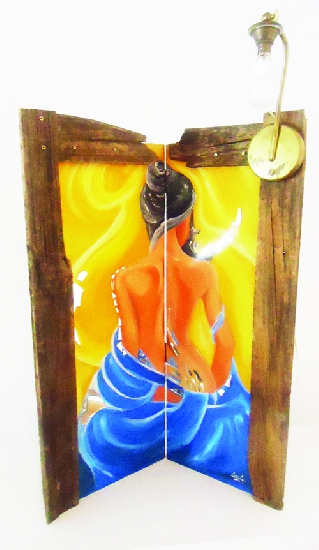
Relatively conventional paintings embellished with found wood frames are ‘Uncovered’ and ‘Angel Wings’, which depict a woman with her back to the viewer clothed in blue undulating like the ocean. She is highlighted by pieces of broken mirror and an elegant old light fixture illuminates the entire canvas to appealing effect.
The same woman is seemingly repeated in ‘Angel Wings’ except her blue garments come to life with rolling blue material and she is surrounded by pink and tiny flakes of metal which create the suggestion of wings.
An interesting and somewhat odd item in an exhibition that strikes as being entirely capricious is ‘Finding My Way Home’. A piece, which mimics the vanished world motif of ‘A Tiger’s Eye’ and depicts an erased ladder without rungs that leads to a Namibian flag balanced on the top rung with the sun cut out and about to reach the edge of a waterfall.
Here Magg clearly expresses some sort of danger or trepidation and some odd feeling toward her country but like all her exhibited work it requires rumination.
View this exhibition until 10 November for a glimpse into the mind of Daniela Magg. It is a demanding but surprisingly calming showcase of things half remembered, cracked, turned upside down and then captured. On cupboards.
– Mail me at martha@namibian.com.na or tweet me on marth__vader