






• JULIE SNOREKEnvironmental justice activism is to this age what the workers’ movement was for the industrial age – one of the most influential social movements of its time.
Yet, despite its consistent progress since the 1970s, environmental justice protests seem to get lost in the morass of information on broader environmental issues.
In contrast, labour conflicts, including strikes and lock-outs, carry such gravity that the International Labour Organisation tracks these on a systematic basis. As more communities are refusing to allow the destruction and contamination of their land, water, soil and air, these, in turn, deserve to be counted.
The Environmental Justice Atlas (EJAtlas), an inventory of social conflicts around environmental issues, fills that gap.
It is funded by two successive European research projects, through a collective effort of scientists and activists. It records the failures and successes of the worldwide movement for environmental justice.
The project is directed and coordinated by Leah Temper, Daniela Del Bene and Joan Martínez-Alier at the Institute of Environmental Science and Technology at the Autonomous University of Barcelona.
It has collected and categorised about 2 500 ecological distribution conflicts. These focus on who gains and who loses in development processes, arguing that these movements play a fundamental role in redefining and promoting sustainability.
In honour of World Environment Day, on 5 June, some of the highlights of the most pertinent findings, stemming from the 10 most critical categories of environmental distribution conflicts facing the world today are shown. These are listed in order of most-catalogued cases in the EJAtlas. But due to the nature of the project, this is not indicative of its global significance.
The top 10 environmental conflicts:
Booming palm oil production is behind a land-grabbing surge for plantations, which threatens communities. Palm oil is now in half of all packaged products sold in the supermarket.
These plantations replace food crops, deprive farmers from their land, increase slave labour, cause environmental destruction like deforestation, water pollution, infertile soil and fires. Grassroots activist networks achieved temporary suspensions of further expansion of what they call green deserts in Honduras, Colombia, México, Indonesia and Myanmar.
Renewables are necessary in a post-carbon world, but mega dams like Narmada in India and mega wind projects in Mexico, Kenya, India are triggering conflicts.
Methane emissions and cost overruns are hidden behind a twisted sustainability discourse to justify a new wave of dams, especially in the Himalayas, Amazon basin, Balkans and Africa. In response, some rural communities are creating cooperative wind energy models as alternatives to the corporate schemes. These in turn reshape global production and consumption patterns.
Also, communities expose the injustice of large-scale dam projects and redefine their own energy transformations.
New technologies, highly polluting chemicals and massive amounts of water accompany mega-mining expansion in Latin America and Western Africa. Examples of this can be seen in bauxite or iron in Guinea, gold in Burkina Faso, Senegal and Ghana.
Resistance in Latin America and Africa is strong. Often, there is high participation and leadership of women. Affected communities are developing new local initiatives that are more sustainable.
The fossil fuel industry, faced with declining stocks, depends on unconventional means and locations of extraction. These extend to oil sand drilling and fracking to Arctic drilling and deep water petroleum sources. It has caused contamination of fresh water supplies, devastation of marine systems, seismic activity and global warming.
This gave rise to a Blockadia movement of direct action. Blockadia connects the various struggles to highlight the global and local threats posed by oil, coal and gas extraction. Massive oppositions have resulted in moratoria on offshore drilling, litigation over continued oil exploration, bans on fracking, the removal of gas pipelines, and the halting of oil and gas operations.
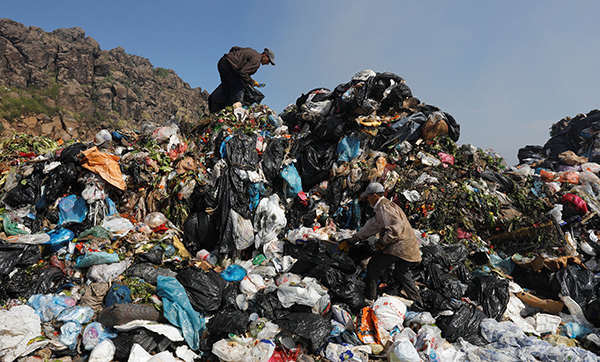
Alliances of grassroots organisations are protecting the health and livelihoods of those living near waste sites by facing down a multi-billion dollar waste industry. Gaia, the Global Alliance for Incinerator Alternatives, unites communities resisting incinerators.
The Basel Action Network tries to halt the flow of hazardous waste like e-waste from being shipped from high-consumption countries to the Global South. The Global Alliance of Waste Pickers defends the informal recycling sector in more than 28 countries.
In Delhi, middle class residents and informal recyclers joined together to oppose the privatisation of waste management and the resulting introduction of incineration.
Illegal sand mining has 10 times more economic value than all wildlife crime. The causes of the surge in demand for sand are attributed to a number of reasons. They range from booming building industry to land expansion to mining of ilmenite or zircon at beaches.
India is a particular hotbed of sand mining conflicts, from beach sand mining in the south to riverbed sand mining in the Himalayas.
Hundreds have been killed by various branches of the sand mafia, including activists and investigative journalists.

