For many Namibians, the thrill of the scenes behind the National Theatre of Namibia’s (NTN) velvety red curtains, seen from the embrace of its low blue seats, is a rare treat.
That is if, despite challenges of access or lack of exposure, they ever get to see a production at the national theatre at all.
Theatre, like many of the arts, has to be experienced to be appreciated. One has to know it exists, learn its particular dialects and immerse in all it conjures in order to absorb the empathy and information inherent in the wonders of the stage.
For the English second language pupils crowding into a recent production of ‘Bang Bang’ on a weekday morning, the stage is a school. The City of Windhoek has collaborated with the NTN to transport more than 1 700 Grade 8 pupils from high schools such as Khomastura, Dawid Bezuidenhout and Rosewood Academy to see their prescribed text come to life.
‘Bang Bang’, written by Chris Djuma (South Africa) and directed by local theatremaker Veronique Kuchekana-Chirau, invites them into a world the pupils know well. As the sounds of a school playground swell, the actors skillfully capturing the cliques and chaos of an average recess, the familiar scene descends into disaster.
“Bang, bang!”.
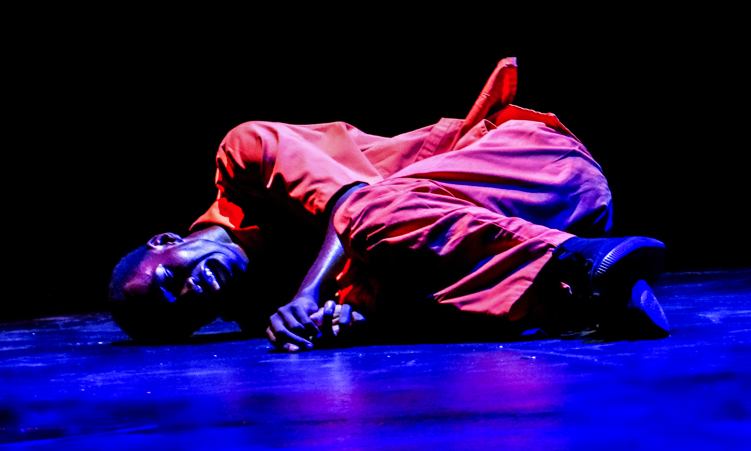
Robert, our protagonist played by Michael Nakale, has discharged a firearm in a moment of bullying and retaliatory violence. He kills several of his fellow pupils and, once a judge sentences him to prison, the ghosts of those he murdered haunt him and share their own stories of despair.
While school shootings aren’t a particularly Namibian phenomenon, the bullying, family pressure, weight of expectations, trauma-based fear, as well as the feelings of isolation and hopelessness that lead to the tragedy are all too familiar. As each of Robert’s victims speak, the challenges facing Namibia’s youth are voiced in poignant stories of criminal violence, rape, teen pregnancy and the parentification of children.
‘Bang Bang’ features the engaging ensemble of Brandon de Wet, Georgina Namises, Uajorokisa Culenda, Lekenanda Eliakim (Be-Fresh), Otja Kooper, Naledi Nakuta, Albertina Musilika and Sandile Mondlane. Scenes are elevated through music direction by Nyasha Kuchekana-Chirau and creative stage direction by Fellemon Ndongo, which quickly transforms moods and scenes from a schoolyard to a funeral to a prison cell.
After the production, a high-energy interactive session that defines words, emotions and analyses key elements of the play helps pupils relate what they saw on stage to their prescribed text, while offering real-world advice regarding the featured issues.
To do this, Kuchekana-Chirau uses what she calls the ‘Kilanova Method’ to enhance her brand of educational theatre.
“I was in a classroom in a government school at Mariental, where I could see that some of my peers were struggling to understand what our teachers were teaching. But there was no way for them to express what they were finding difficult and this is what educational theatre allows,” she says.
“It allows the child to engage and to be a part of the conversation and decision-making as well. But, to do so, we have to get to their way of seeing and understanding the world,” she adds.
“I always like to explain it like this. I was raised by my grandmother at Mariental, and she would always say: ‘Stop being at that stop street. I know what happens at that stop street.’ And I would laugh, because I would think: Yeah, mommy, when you were young, certain things happened there.”
But things change. Sites of mischief or danger relocate, evolve or seem to disappear entirely, only for new challenges to sprout in societies, at stop streets, in school yards or online.
“What happened at the stop street in my grandmother’s time is completely different to what’s happening now,” Kuchekana-Chirau says.
“And, in order for us to understand that, we need to play. We need to engage with children and go into those landscapes with them. We need to explore from their perspective and understand what they see. That’s why you saw us bringing in trends from platforms like TikTok,” she says.
“I remember one of the children saying: ‘ ‘Ching Ching’ only came out last week. How do you guys already have it?’ And it’s because we are that relevant when it comes to educational theatre. You need to remain on the ball. You need to know what is happening in order for you to assist the child.”
Kuchekana-Chirau co-founded the learning programme with her partner, Nyasha, in 2018 and regularly collaborates with schools, private venues and public institutions to create theatre pieces and workshops that clarify various texts, issues, consequences and concepts.
“Reading a text alone will not necessarily allow the child to comprehend its themes, the use of language, the environment, imagery or subtext in theatre,” she says.
“What we do at Born A Star Academy is we take prescribed work and create games around it. The Kilanova methodology is created by me. We do different workshops with children and use various production methodologies in order for us to tackle whatever issue the school is having.”
According to Kuchekana-Chirau, the Kilanova Method is designed to foster resilience, emotional intelligence, critical thinking, imagination and expression. These five elements are at the heart of the methodology and drive her educational theatre development.
Witnessing the effect of Kuchekana-Chirau’s approach in the production of ‘Bang Bang’ is a sight for sore eyes.
A supposedly taciturn, phone-obsessed generation comes to life. They laugh, dance in their seats and respond enthusiastically to questions. They nod in understanding and volunteer to go on stage to act out complex feelings for their peers before confidently offering advice to their classmates.
This is the power of theatre. And as the NTN continues to bus in pupils from Windhoek and Okahandja, often introducing them to a space that may ignite their empathy, creativity and love of the arts, one can’t help but cheer.
Six shows and more than 1 700 pupils later, NTN spokesperson Desiree Mentor hopes they can do it all again next year.
“We really encourage corporates or anyone out there to come on board to help extend this programme to the regions. Fortunately, we have partnered with the Namibian Broadcasting Corporation to record this production, which will make it possible for children in other parts of Namibia to view this theatre piece,” Mentor says.
“The pupils are busy with exams right now, so we really hope there has been enough impact and that they will do well with the text.”
Beyond ‘Bang Bang’, Kuchekana-Chirau continues to champion theatre as a powerful, influential yet relatively unsung educational tool.
“Theatre allows us as a society to learn both emotionally and intellectually. It is a mirror to society,” she says.
“The minute we allow theatre to enter not only the national theatre, but our communities, our churches and community halls, we can begin the difficult conversations of gender-based violence, mental health and suicide, all the important issues we need to tackle as a nation.”
– martha@namibian.com.na; Martha Mukaiwa on Twitter and Instagram; marthamukaiwa.com