




Luise HoffmannTHIS evergreen shrub or small tree is quite common all over the drier western parts of Namibia.
Preferring rocky or gravelly locations, it is absent from the deep sandy regions in the northeast. It is related to the shepherd’s tree (Boscia albitrunca), but differs from this tree most noticeably by its flowers, which have a characteristic unpleasant foetid odour.
The berries of the smelly shepherds’ tree are hairy, while those of the shepherds’ tree are bare.
Names: G. Stinkbusch, Nonibusch: E. Stink bush; A. Noeniebos, stinkbos; H. omungundi; Foetida has the same root as English “foetid”, because the flowers and the freshly cut wood of this shrub or tree have a foetid odour. The genus is named Boscia in honour of the French scientist, Louis Bosc (1759 – 1828)
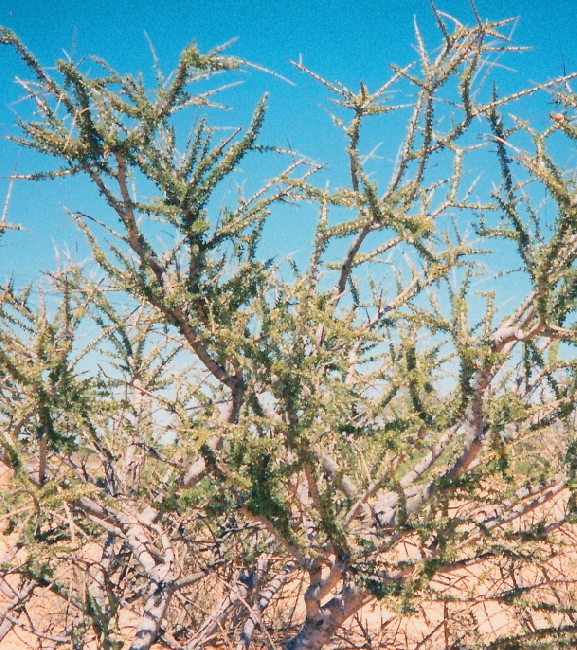
The smelly shepherd’s tree is an evergreen shrub or small tree of up to four metres. The trunk is whitish to pale pink with fissures exposing a rough dark bark while young branchlets are grey with a plumcoloured underlayer. Young branches may have a spiny tip and the branches in general have an angular growth form.
The leaves are much smaller than those of the shepherd’s tree, measuring only about 5 – 10 x 3 – 4 mm. They are stiff, entire, olivegreen on both surfaces and have a very short leaf stalk. They are densely arranged around the branches or clustered on dwarf shoots. In the dry season they often appear to be almost black if viewed from a distance.
The habit of the smelly shepherd’s tree varies widely. In the northern half of Namibia it is much less common than the shepherd’s tree and may be a similar looking tree or an angularly branched sparse shrub. To the west of the Brandberg I have seen it form low spreading islands only about 60 cm high, while south of Mariental it is often a more visible tree than the shepherd’s tree, which tends to spread low over rocks on koppies rather than to grow into the shady trees known from e.g. the OkahandjaHochfeld area.
Small greenish yellow flowers cluster the branches mainly from September to November but may be found as late as April. They develop into hairy, pale yellow to brown berries of 10 mm in diameter. The berries are sweet and eaten by birds and people. Damara dikdiks and eat the young shoots, while giraffe eat the fruit.
On account of its small, somewhat succulent leaves and its deep root system the smelly shepherd’s tree is well adapted to its arid environment. Reportedly it is well utilised by goats while it does not seem to agree as well with cattle and as little as 0,5 kg of its leaves may kill a sheep.
The pound branches and leaves, boil them and apply the cooled decoction to patients suffering from ear ache, preferably using the feather of a hornbill for that purpose. Other indigenous people chew the leaves to soothe an aching stomach.
Without fruit the smelly shepherds tree is practically indistinguishable from Maerua parvifolia, which however has cylindrical fruit, up to 6 cm long and constricted between the seeds similar to, but shorter than, the beadlike fruit of the Ringwood tree (Maerua schinzii).
In an age of information overload, Sunrise is The Namibian’s morning briefing, delivered at 6h00 from Monday to Friday. It offers a curated rundown of the most important stories from the past 24 hours – occasionally with a light, witty touch. It’s an essential way to stay informed. Subscribe and join our newsletter community.

The Namibian uses AI tools to assist with improved quality, accuracy and efficiency, while maintaining editorial oversight and journalistic integrity.
Stay informed with The Namibian – your source for credible journalism. Get in-depth reporting and opinions for
only N$85 a month. Invest in journalism, invest in democracy –
Subscribe Now!