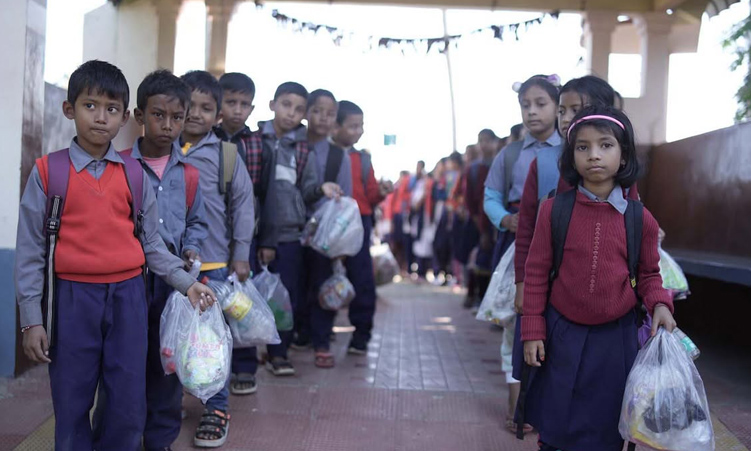
On a misty Thursday morning in the village of Pamohi in the northeast Indian state of Assam, children walk to school carrying two bags. One holds their books; the other contains 25 cleaned and sorted plastic bags and bottles.
For these students, the latter is currency – their school, the Akshar Forum, a 100-student institution established in 2016, accepts plastic as tuition fees.
When the kids arrive at school, they queue patiently, chattering among themselves as they wait their turn to deposit their weekly ‘fees’.
“I wonder why, across Pamohi, people still don’t segregate their waste,” Piyush Kalita (15) muses. “If only we figured out how to dispose of plastic properly, life would be very different.”
Kalita is right. Assam currently faces a huge plastic waste disposal problem.
Its capital, Guwahati, produces 500 metric tonnes of waste every day, of which less than a third is processed. The rest suppurates in landfills, leaching toxins and microplastics into the environment – or worse, is burned by those with few other options to generate warmth during the harsh winters.
Parmita Sarma, who co-founded Akshar Forum in 2016 with Mazin Mukhtar, an aeronautics engineer who gave up his job to work with disadvantaged families in the United States before returning to India, came up with a solution to the region’s plastic crisis.
“Instead of waiving the tuition fee in our school, we decided to take it in the form of plastic waste,” she says.
The world over, there are projects that assign value to plastic, creating a financial incentive for communities to collect and keep the material out of the environment.
Social enterprise Plastic Bank, which launched in Haiti and now also has branches across Indonesia, the Philippines, Brazil, Egypt, Thailand and Cameroon, incentivises communities to collect plastic from ecologically-fragile zones in return for tokens that can be cashed in for money or food.
They then sell recycled plastic to be used in packaging.
New Jersey-based recycling business Terracycle helps schools raise funds by getting students to collect and recycle waste. And in Lagos, Nigeria, Morit International School accepts plastic bottles in lieu of tuition fees from underprivileged students.
However, plastics are practically indestructible, and the United Nations Environment Programme (Unep) estimates that 300 million tonnes of plastic waste is generated annually. What’s more, says the Unep, only 9% of the plastic waste ever generated has been recycled to date, and only 14% is collected for recycling now.
The long-term sustainability of projects that monetise plastic, therefore, depends on how efficiently they are able to recycle and reuse it.
Some reports suggest that Morit International School is literally drowning in the ‘fees’ it has collected.
Enter bottle bricks, or – as Akshar students call them – eco bricks. The school converts the waste it collects into these low-tech items, which then serve as replacements for conventional bricks.
A major plus is that they can easily be made by the students. In Akshar Forum’s garden, students press clean plastic bags, chip packets and more into PET bottles using sticks in an airy bamboo shed.
“We use these eco bricks to make paths, boundaries around trees and even fences,” Kalita says, adding that the students enjoy making them while learning about different grades of plastic and how to work with them.
In a workshop next door Kalita and other older students recycle thicker plastics like bottle caps into planters, table tops and more.
All their recycling machines are based on designs developed by Precious Plastic, an online, open source plastic recycling forum. Presently, school principal Akanchha Dubey estimates that they collect over 9kg of plastic as fees every month, from which students are able to make about 50 bricks.
“The idea is that plastic is precious, if we find a good way to monetise it,” Akshar co-founder Sarma says. “But that’s not where we are now, as we don’t really have a steady market for them.”
On the bright side, the process is teaching students about recycling plastic and its environmental cost. “I can’t get over how many bags we’re able to fill in a single plastic bottle,” Kalita exclaims. “At least by doing this we’re preventing some of it from being burned.”
Now others are following suit. Akshar’s students train local schools to make eco bricks, and Kalita was recently part of a team that travelled to Ladakh, 1 609km away, to teach students in a Himalayan school how to repurpose their plastic waste.
The Assam government is likewise promoting the use of eco bricks, and has built a model anganwadi (government-run childcare centre) with 14 000 plastic bottles.
Their plan to build 100 such structures across the state could give plastic recycling a larger push than Akshar’s effort.
– Reasons to be Cheerful
- The full article can be found at https://reasonstobecheerful.world/india-school-fees-plastic-bags/
In an age of information overload, Sunrise is The Namibian’s morning briefing, delivered at 6h00 from Monday to Friday. It offers a curated rundown of the most important stories from the past 24 hours – occasionally with a light, witty touch. It’s an essential way to stay informed. Subscribe and join our newsletter community.

The Namibian uses AI tools to assist with improved quality, accuracy and efficiency, while maintaining editorial oversight and journalistic integrity.
Stay informed with The Namibian – your source for credible journalism. Get in-depth reporting and opinions for
only N$85 a month. Invest in journalism, invest in democracy –
Subscribe Now!