



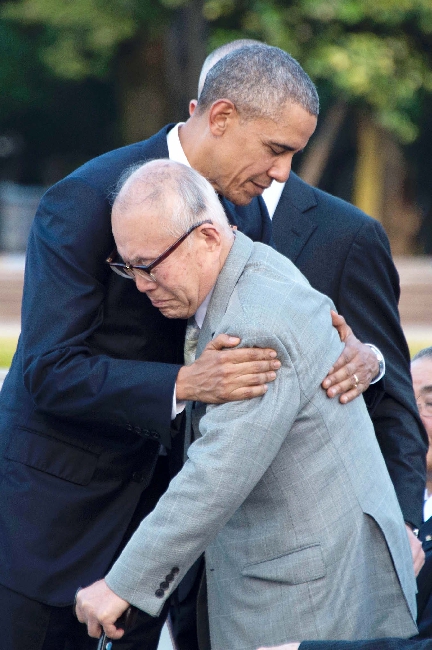
Barack Obama last week became the first serving US president to visit Hiroshima since the World War II atomic bombing in August 1945.
At least 140 000 people died in Hiroshima and another 74 000 three days later in a second bombing in Nagasaki. During the visit, he paid moving tribute to victims of the world’s first nuclear attack in a farranging and historic speech at the Hiroshima Peace Memorial.
At least 140 000 people died in Hiroshima and another 74 000 three days later in a second bombing in Nagasaki. During the visit, he paid moving tribute to victims of the world’s first nuclear attack in a farranging and historic speech at the Hiroshima Peace Memorial.
Seventyone years ago, on a bright, cloudless morning, death fell from the sky and the world was changed. A flash of light and a wall of fire destroyed a city and demonstrated that mankind possessed the means to destroy itself.
Why do we come to this place, to Hiroshima? We come to ponder a terrible force unleashed in a not so distant past. We come to mourn the dead, including over 100 000 in Japanese men, women and children; thousands of Koreans; a dozen Americans held prisoner. Their souls speak to us. They ask us to look inward, to take stock of who we are and what we might become.
It is not the fact of war that sets Hiroshima apart. Artefacts tell us that violent conflict appeared with the very first man.
Our early ancestors, having learned to make blades from flint and spears from wood, used these tools not just for hunting, but against their own kind.
On every continent, the history of civilisation is filled with war, whether driven by scarcity of grain or hunger for gold; compelled by nationalist fervour or religious zeal. Empires have risen and fallen. Peoples have been subjugated and liberated. And at each juncture, innocents have suffered, a countless toll, their names forgotten by time.
The World War that reached its brutal end in Hiroshima and Nagasaki was fought among the wealthiest and most powerful of nations.
Their civilisations had given the world great cities and magnificent art. Their thinkers had advanced ideas of justice and harmony and truth. And yet, the war grew out of the same base instinct for domination or conquest that had caused conflicts among the simplest tribes; an old pattern amplified by new capabilities and without new constraints.
In the span of a few years, some 60 million people would die – men, women, children no different than us, shot, beaten, marched, bombed, jailed, starved, gassed to death.
There are many sites around the world that chronicle this war – memorials that tell stories of courage and heroism; graves and empty camps that echo of unspeakable depravity.
Yet in the image of a mushroom cloud that rose into these skies, we are most starkly reminded of humanity’s core contradiction; how the very spark that marks us as a species – our thoughts, our imagination, our language, our toolmaking, our ability to set ourselves apart from nature and bend it to our will – those very things also give us the capacity for unmatched destruction.
How often does material advancement or social innovation blind us to this truth. How easily we learn to justify violence in the name of some higher cause. Every great religion promises a pathway to love and peace and righteousness, and yet no religion has been spared from believers who have claimed their faith as a licence to kill.
Nations arise, telling a story that binds people together in sacrifice and cooperation, allowing for remarkable feats, but those same stories have so often been used to oppress and dehumanise those who are different.
Science allows us to communicate across the seas and fly above the clouds; to cure disease and understand the cosmos. But those same discoveries can be turned into evermore efficient killing machines.
The wars of the modern age teach this truth. Hiroshima teaches this truth. Technological progress without an equivalent progress in human institutions can doom us. The scientific revolution that led to the splitting of an atom requires a moral revolution, as well.
That is why we come to this place. We stand here, in the middle of this city, and force ourselves to imagine the moment the bomb fell. We force ourselves to feel the dread of children confused by what they see. We listen to a silent cry. We remember all the innocents killed across the arc of that terrible war, and the wars that came before, and the wars that would follow.
Mere words cannot give voice to such suffering, but we have a shared responsibility to look directly into the eye of history and ask what we must do differently to curb such suffering again.
Someday the voices of the hibakusha will no longer be with us to bear witness. But the memory of the morning of 6 August 1945 must never fade. That memory allows us to fight complacency. It fuels our moral imagination. It allows us to change.
Oppressed peoples and nations won liberation. An international community established institutions and treaties that worked to avoid war and aspire to restrict and roll back, and ultimately eliminate the existence of nuclear weapons.
Still, every act of aggression between nations; every act of terror and corruption and cruelty and oppression that we see around the world shows our work is never done.
We may not be able to eliminate man’s capacity to do evil, so nations – and the alliances that we’ve formed – must possess the means to defend ourselves. But among those nations like my own that hold nuclear stockpiles, we must have the courage to escape the logic of fear, and pursue a world without them.
In an age of information overload, Sunrise is The Namibian’s morning briefing, delivered at 6h00 from Monday to Friday. It offers a curated rundown of the most important stories from the past 24 hours – occasionally with a light, witty touch. It’s an essential way to stay informed. Subscribe and join our newsletter community.

The Namibian uses AI tools to assist with improved quality, accuracy and efficiency, while maintaining editorial oversight and journalistic integrity.
Stay informed with The Namibian – your source for credible journalism. Get in-depth reporting and opinions for
only N$85 a month. Invest in journalism, invest in democracy –
Subscribe Now!