




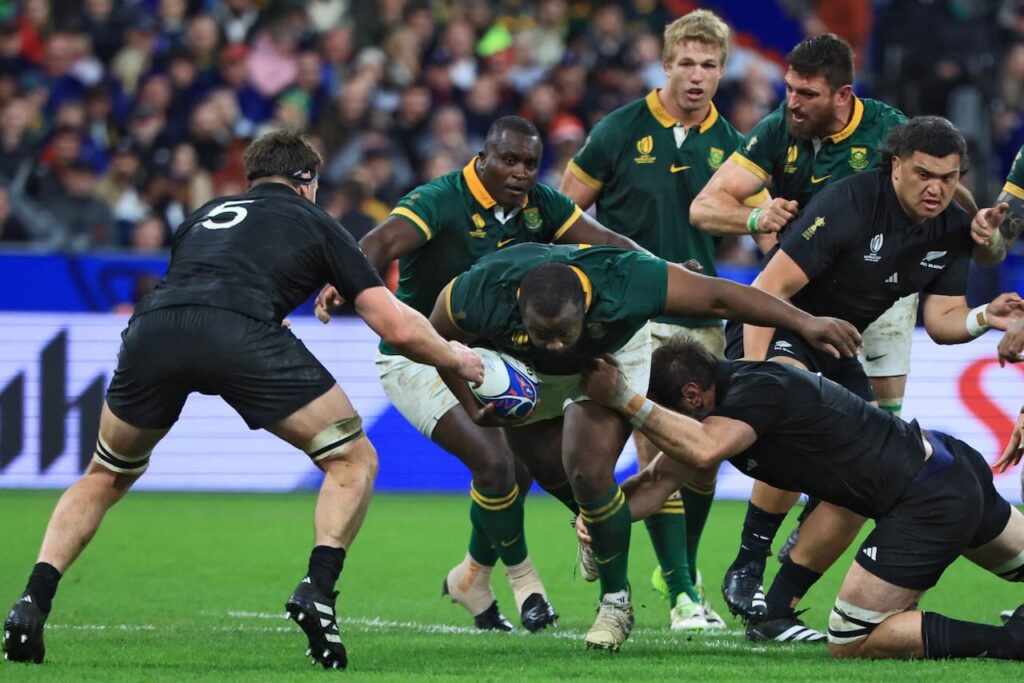
The just-ended Rugby World Cup in France was won by the narrowest of margins by one of Africa’s greatest exports – South Africa’s Springbok rugby team.
Now there is a reflection on those few inches between victory and defeat – of one nation rejoicing and another in mourning.
In those final moments, those across the continent and world, including many in Namibia who support Bok rugby, endured heart-stopping moments as New Zealand’s All Blacks surged for the line.
Is there any better sport team in the world than those All Blacks?
Because of their consistency and ability to dominate their sport – with an overall winning percentage that continues to hover in the mid-70% range – the All Blacks are deservedly seen as among, if not, the best team across sporting codes.
But how? How did this Springbok team do it? How did they hold on for three weeks in a row by a single point, beating France 29-28, England 16-15, and New Zealand 12-11 over successive weekends?
This was bitter and hard; this was an act of will made flesh and bone; this was a metaphor for life and how we should never give up – even when everything says we should.
South Africa’s captain, Siya Kolisi, who lifted the William Webb Ellis trophy for consecutive tournaments after the Boks also won in 2019 in Japan, spoke after the match of the All Blacks taking his side to a “dark place”, but praised the Springboks for finding a way to win a record fourth title.
For a nation that continues to be bent low by a myriad of problems – just like in Namibia – the dark places are felt acutely in South Africa.
And yet, every four years, this Springbok team takes it upon itself to bring a flicker of hope that in continued sporting excellence lies the ability to transform challenges into triumph.
In doing so, through the composition of the team, led by a black captain, they continue to show that a nation struggling with as a simple a task as keeping the lights on, can find inspiration in having a winning culture on the sport fields of the world.
For those who have been following rugby for decades, the first two Rugby World Cups – played in 1987 and 1997 – were conspicuous because of the absence of the Springboks.
At that stage, South Africa was a nation divided by race, with the hated apartheid regime resulting in the neighbouring country’s sporting isolation.
Obviously as a pariah of the world, South Africa didn’t compete.
There is conjecture, even now, about how the Springboks would have done had they been able to play.
In 1995, South Africa had that feeling that it was destiny. They faced the All Blacks in the final.
I would argue the greatest All Black team to ever lose a final.
But they lost.
In 2007 there was an easier route with upsets, especially the All Blacks losing against France in the quarter-finals, conjuring a scenario where the Boks faced a team they demolished in the group stages – England – and beating them to win that tournament.
It hurt South Africans when people said the Springboks were unworthy winners.
In 2019 the world wrote off the Springboks.
How could the Boks challenge an England team that destroyed the All Blacks in the semi-final a week before?
But win they did, putting England to sword to claim a third world crown.
Fast forward to 2023, and no one, and I mean no no one, would have said this Bok team would make the final.
Too many great teams were in their way.
Ireland claimed victory in their group. France were brilliant in the quarter-final, but lost.
The next week South Africa faced England amid gloom and rainfall.
A look at the combined world team, announced after Saturday’s final, shows what the Boks were up against in this tournament.
The team consists of four All Blacks, five Frenchman, five Irish players, and only one Springbok.
So how did this Bok team take the All Blacks to wire over the weekend and hold out for the win against all odds?
Perhaps the lesson is that the sum of the parts is greater than the whole.
And when, on a big screen in Windhoek on Saturday, we watched as red-carded All Black captain Sam Cane sat on the sidelines amid agony and despair as the final whistle shrieked, we saw someone who understood how difficult it is to beat this Bok side.
They would not be denied. They would not be stopped.
As a country, they are fragile.
But every time the nation seems to be at its worse, these Springboks say: Hell no, there is a better way, we have you, South Africa, you can still rise to be the best!