THE NAMIBIA University of Science and Technology (Nust) with financial aid from the Technical University of Munich are setting up the Solar Power Plant Living Laboratory research centre.
The project supports sustainable energy and entrepreneurship development in the Global South, and comprises nine universities in total.
Africa is represented by five countries, namely Ghana, Uganda, Kenya, Ethiopia and Namibia.
Latin America, India and Indonesia make up the rest of the participants, who will also take part in student exchange programmes.
Each of the universities will be setting up similar facilities to train PhD and master’s students in renewable energy and entrepreneurship.
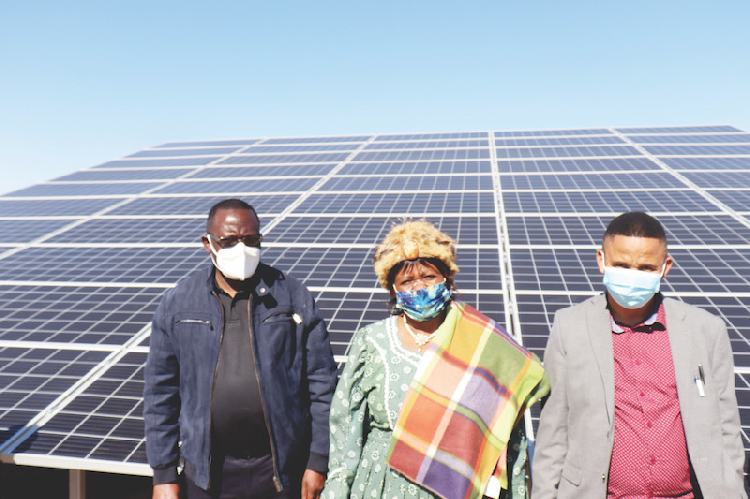
The Nust project will focus on solar energy, with the aim of providing electricity and an irrigation system to !Karuxas, which is located 7 km outside of Groot Aub.
“The future is in the energy of the sun, and land is our asset. If we don’t put them to use, we will remain as we are,” James Katende says.
Katende is a professor and lecturer in renewable energy systems at Nust, and has drafted the project’s blueprint in 2019 with the /Khomanin Traditional Authority and Pete Adams, the rural constituency councillor.
The project only managed to kick off in 2020.
Upon completion, the solar panels’ lifespan would be between 25 and 30 years.
Katende says the project aims to reduce human influence to a minimum and expand in size without negatively impacting people’s livelihoods.
Teofilus Shiimi, an agricultural economist at Nust, says the budget for the infrastructure development amounts to N$894 000, however, the infrastructure installation is not complete yet.
Phase 2 will be a distribution network that would be extended to various households.
A budget of N$150 000 was allocated to this phase of the project.
Additional funding would be required for operational and maintenance costs.
“We are looking upon Nust, the community and everyone else to come together and come up with a management and governance structure,” Shiimi says.
He says the aim is to facilitate entrepreneurial activities in the community.
“That is the notion we are building on. We will train them and facilitate the projects they come up with. But they are the drivers of the project,” he says.
Chief Juliane Gawa!nas of the /Khomanin Traditional Authority acknowledges the importance of the project.
She says Covid-19 has affected the employment rate of residents, and that the projects would not only benefit the current group of community members, but also their children and grandchildren.
“If our hopes are realised, the project would grow to a large-scale project where we can sell products to generate an income for the community.”
She says traditional authorities are the eyes and the ears of the government, and the community needs to help create developmental projects such as this one.
Piet Adams, the LPM councillor for Windhoek Rural, says bad news is received on a daily basis and interventions like these are uplifting.
“Bringing electrification to the rural poor, is one such positive news,” Adams says.
Lukas Gaseb (53), a farmer at !Karuxas, says the project is a great advantage for the residents.
“I am so grateful to Nust for this solar power project. We were struggling with candles, but now we have electricity, and we are very happy,” he says.
“We can create jobs for the youth when the agriculture programme starts producing,” he says.