




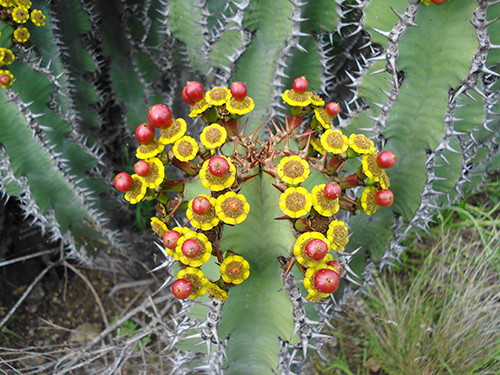
•LUISE HOFFMANNWIDELY distributed on rocky hill slopes and outcrops, this plant resembles a giant cactus with constricted branches armed with thorny ridges.
It occurs in the dry western parts of Namibia all along the escarpment from about Noordoewer up to the Kunene River, forming impenetrable thickets in some places.
Names: A. gifboom, noorsdoring; G. Kandelaberwolfsmilch; H. eyao N/D. //khaob.s The name euphorbia is derived from Greek for “well fed”, while “virosa” means ‘with poisonous sap’.
The woody trunk of the candelabra euphorbia, spirally angled like a piece of rope and usually hidden by its numerous branches, may reach a height of 30 cm but mostly remains underground. The candelabra-like, succulent, erect branches – curving outwards and upwards – arise from the centre of the plant and seem to squat on the stony ground. They may reach a height and a diameter of 3m.
The angular branches have 5 to 8 grooves separated by ridges on which the strong, paired spines grow, glossy red when young, turning a dull grey with age. The branches are constricted into segments at irregular intervals, have a diameter of 5 – 10 cm and occasionally sprout secondary branches near the tip. Rudimentary leaves, up to 3 mm long, drop off early.
The candelabra euphorbia has an unusual floral arrangement, called cyathium, typical of the Euphorbia family. The inflorescence has no petals but consists of a ring of bracts usually enclosing one female and several male flowers. The flowers develop out of whitish ‘eyes’ situated between the pairs of spines on the top segment of each branch. The fruit is a three-lobed, ball-shaped capsule typical of most Euphorbias.
Remarks: As indicated by the Afrikaans name “gifboom” or ‘poison tree’, the candelabra euphorbia is regarded as the most poisonous member of the Euphorbia family. The milky, resinous latex causes the skin to burn and blister and may cause blindness when accidentally rubbed into the eyes. Very sticky and not soluble in water, the sap is not easily removed from the skin even by rubbing with sand or washing with water. Even the vapour of the latex near a damaged plant may cause a burning sensation in the eyes and throat. However, in spite of these poisonous properties black rhino browse the tips of the branches without ill effect.
The candelabra euphorbia is related to the castor oil plant (Ricinus communis), which also has poisonous properties, and to the rubber tree Hevea brasiliensis. Kurt Dinter, the German botanist honoured by many botanical names in Namibia, painfully collected a bucket full of the poisonous latex in the hope of having discovered a substance as useful and as valuable as that of the rubber tree. However, the only use scientists could find for it was as bird lime.
Very similar to the candelabra euphorbia, the slender euphorbia (Euphorbia avasmontana) has a more easterly distribution and is an altogether more slender plant. The grooves between the thorny ridges are less deep, the branches less clearly constricted and the spines shorter. It has three horizontal ‘eyes’ out of which the flowers develop while the candelabra euphorbia has only one such eye.
In an age of information overload, Sunrise is The Namibian’s morning briefing, delivered at 6h00 from Monday to Friday. It offers a curated rundown of the most important stories from the past 24 hours – occasionally with a light, witty touch. It’s an essential way to stay informed. Subscribe and join our newsletter community.

The Namibian uses AI tools to assist with improved quality, accuracy and efficiency, while maintaining editorial oversight and journalistic integrity.
Stay informed with The Namibian – your source for credible journalism. Get in-depth reporting and opinions for
only N$85 a month. Invest in journalism, invest in democracy –
Subscribe Now!