



WHEN The Namibian ran the story of a Keetmanshoop man who had a 1,65 metre tapeworm in his stomach, most people believed that it was due to black magic.
The story that was published on Monday this week, said 34-year-old Jonas Kanute discharged the tapeworm after receiving treatment from a clinic at the town.
According to the story, Kanute started complaining about stomachache after eating ‘matangara’ (offal). The story further said that Kanute’s stomach also started swelling, prompting family members to make him drink cooking oil and milk to induce vomiting.
A number of comments on The Namibian’s Facebook page show that there is a deep misunderstanding of what is or what causes tapeworms.
In actual fact, having tapeworms has nothing to do with witchcraft or any form of curse.
WHAT ARE TAPEWORMS?
Tapeworms are flat segmented worms that live in the intestines of some animals.
Animals can become infected with these parasites when grazing in pastures or drinking contaminated water.
Eating undercooked meat from infected animals is the main cause of tapeworm infection in human beings. Although tapeworms in humans usually cause few symptoms and are easily treated, they can sometimes cause serious, life-threatening problems.
That is why it is important to recognise the symptoms and know how to protect yourself and your family.
TAPEWORM CAUSES
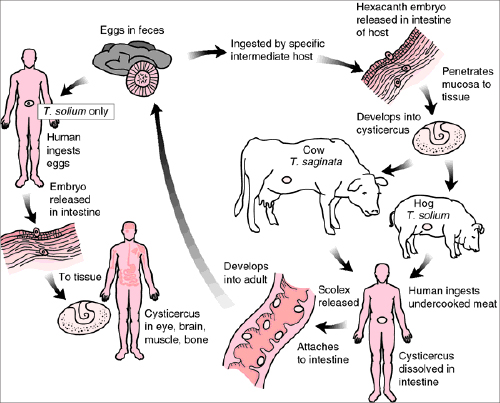
Six types of tapeworm are known to infect people. They are usually identified by the animals they come from – for example Taenia saginata is from beef, while Taenia solium comes from pork, and Diphyllobothrium latum comes from fish.
Tapeworms have a three-stage life cycle: egg; an immature stage called a larva; and an adult stage at which the worm can produce more eggs.
Because larvae can get into the muscles of their hosts, infection can occur when you eat raw or undercooked meat of an infected animal.
It is also possible to contract pork tapeworms from foods prepared by an infected person.
Because tapeworm eggs are passed with bowel movements, a person who does not wash hands properly after responding to the call of nature and then prepares food, can contaminate the food.
However, often having tapeworms does not cause symptoms.
The only sign of tapeworm infection may be segments of the worms, possibly moving, in a bowel movement.
In rare cases, tapeworms can lead to serious complications, including blocking the intestine. If pork tapeworm eggs are accidentally swallowed, they can migrate to other parts of the body and cause damage to the liver, eyes, heart and brain. These infections can be life-threatening.
TREATMENT FOR TAPEWORMS
If you suspect you have tapeworms, you should consult your doctor. Because there are different types of worms and tapeworms that can infect people, diagnosing a tapeworm infection may require a stool sample to identify the type of worm.
If worms are not detected in the stool, your doctor may order a blood test to check for antibodies produced to fight tapeworm infection. For serious cases, your doctor may use imaging tests such as computed tomography (CT) or magnetic resonance imaging (MRI) to inspect for damage outside the digestive tract.
In an age of information overload, Sunrise is The Namibian’s morning briefing, delivered at 6h00 from Monday to Friday. It offers a curated rundown of the most important stories from the past 24 hours – occasionally with a light, witty touch. It’s an essential way to stay informed. Subscribe and join our newsletter community.

The Namibian uses AI tools to assist with improved quality, accuracy and efficiency, while maintaining editorial oversight and journalistic integrity.
Stay informed with The Namibian – your source for credible journalism. Get in-depth reporting and opinions for
only N$85 a month. Invest in journalism, invest in democracy –
Subscribe Now!