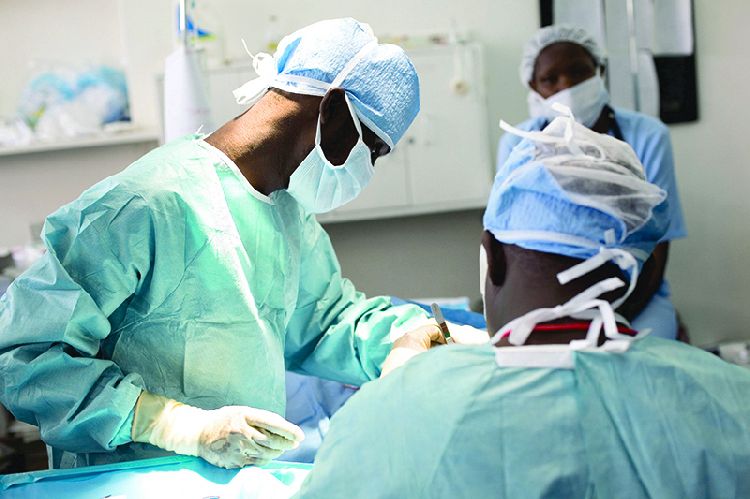





The Cancer Association of Namibia (CAN) is spearheading efforts to establish the country’s first stem cell and bone marrow transplant programme.
This milestone, in collaboration with Dr Kudakwashe Simba, the Namibia Oncology Centre, the Namibia Blood Transfusion Service, and the Ministry of Health and Social Services, could save the lives of patients battling rare blood and bone marrow disorders.
Currently, Namibians requiring bone marrow transplants must travel abroad, primarily to South Africa, where the cost of such procedures can exceed N$1.5 million, placing immense strain on families and the public health system.
CAN chief executive Rolf Hansen says the partnership aims to build local capacity so that patients can access life-saving treatment without leaving the country.
“Together with Dr Simba and our partners, we’ve successfully performed autologous [self] stem cell transfers in Namibia. The next step is to establish the infrastructure for donor stem cell and bone marrow transplants locally,” he says.
Hansen says the initiative includes developing a national bone marrow registry, setting up a stem cell harvesting unit, and training Namibian specialists to perform the complex procedures.
“At the moment, we rely on the South African Bone Marrow Registry (SABMR),” he says.
“Namibians can register through sabmr.co.za, but matching and sequencing remain costly.
Establishing a local registry would make it easier, faster, and more affordable to find compatible donors for Namibian patients.”
Helena Shimbulu (24), a third-year occupational therapy student at the University of Namibia, was diagnosed with severe aplastic anaemia, a rare and life-threatening disorder in which the bone marrow stops producing enough blood cells.
Her only hope is a bone marrow transplant scheduled to take place in South Africa this month.
Shimbulu’s younger brother has been identified as a partial match, and while the Public Service Medical Aid Scheme (Psemas) is covering the cost of the operation, the family still needs around N$200 000 for living expenses during her two-and-a-half-month stay in Cape Town.
“We are booked at Constantiaberg Medical Clinic, but the cost of living is high,” Shimbulu’s mother, Paulina Mbinge, says.
“We are appealing for help to cover accommodation, food, and transport while we are there.”
Hansen says Shimbulu’s case is one of many that highlight the importance of building Namibia’s own transplant capacity.
“We have the knowledge and the talent,” he says.
“Now it’s about strengthening the system so that families like Helena’s don’t have to seek help across borders.”
Simba, Namibia’s only haematologist, confirms that significant groundwork is already being done.
“We have the diagnostic tools needed to detect bone marrow failure early.
Full blood count machines are available even at rural hospitals,” he says.
“The challenge lies in awareness and training. Doctors must learn to identify when a patient’s symptoms could indicate bone marrow failure.”
Simba says education and capacity building are at the centre of this collaborative effort.
“We are working to train doctors and medical students to develop a high index of suspicion.
You can only see what you are looking for,” he says.
“Once the foundation is in place, we’ll be able to perform donor transplants locally, hopefully by next year.”
For now, Hansen says CAN and its partners are working tirelessly to turn this vision into reality.
“This is more than a medical milestone. It’s about giving Namibians hope that life-saving care can be found right here at home,” he says.
In an age of information overload, Sunrise is The Namibian’s morning briefing, delivered at 6h00 from Monday to Friday. It offers a curated rundown of the most important stories from the past 24 hours – occasionally with a light, witty touch. It’s an essential way to stay informed. Subscribe and join our newsletter community.

The Namibian uses AI tools to assist with improved quality, accuracy and efficiency, while maintaining editorial oversight and journalistic integrity.
Stay informed with The Namibian – your source for credible journalism. Get in-depth reporting and opinions for
only N$85 a month. Invest in journalism, invest in democracy –
Subscribe Now!