



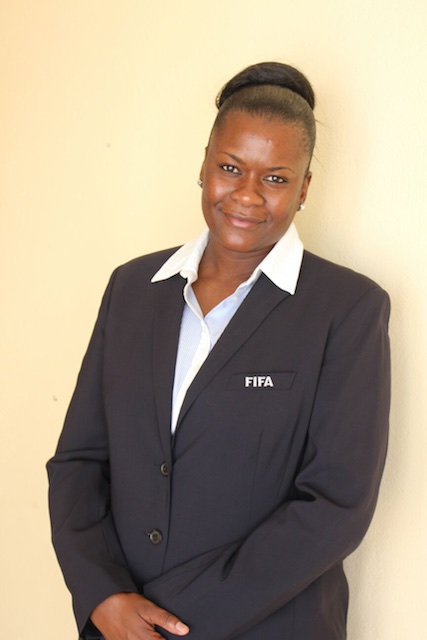
JACQUI Shipanga’s passion for women’s football has seen the game growing tremendously in Namibia over the past decade, while she has also become one of the highest qualified Fifa women’s instructors in Africa.
Her commitment and dedication to achieve a dream in a male-dominated sport and society was already evident from a young age when she grew up in Okahandja.
“I was the only sister among four brothers, so I must say I was a tom boy from a young age. I loved watching tennis on TV and I adored the rivalries between Martina Navratilova and Chris Evert and later between Jennifer Capriati, Steffi Graf and Gabriela Sabatini,” she said.
There wasn’t much chance of tennis though and she ended up playing football.
“I used to walk in the streets of Okahandja with my broken wooden racket looking for an opponent to play against, but the facilities were only accessible to the elite. Furthermore, my brothers used to grab my tennis ball and turn it into a football, so I didn’t have much of a choice and ended up playing football,” she said.
The young Jacqui’s dreams were, however, much bigger and she subsequently started her own football team.
“I needed to have influence and be accepted, so I saved all my money just to buy a ball. When you owned a ball in the Eighties you were powerful, so the next step was to start a team and that is how my first team, Don Bosco 11, started. Being a girl did not deter me, I had the support of my family and friends and I didn’t pay any attention to people who had negative comments,” she said.
“That is how I fell in love with football and I knew then that one day I would earn a living through sport,” she added.
Shipanga later moved to Windhoek and Augustineum Secondary School and continued playing soccer for the first female club in Namibia, Future Girls. After school she enrolled for a Teaching Diploma at the Windhoek College of Education where her love for soccer soon found fruition.
“My lecturers encouraged me to excel in sport, but more importantly to start a women’s soccer team, the Ama-Teachers, just to provide some competition for the best team in the country at that stage, Unam Bokkies.”
“They were captained by my biggest rival, Jackey Gertze, but she shared the same dream and became my best friend. She sacrificed her own future for the development of women’s football – she quit her studies to become a teacher and volunteered for four years at the NFA to promote and build this dream.”
Shipanga soon made her mark as an imposing central defender and won her first cap for the Brave Gladiators in 1996. By 1999 she was appointed captain and her highlight as a player came later that year when she won the Player of the Tournament award at a regional SADC tournament in Swaziland.
She went on to complete a degree in education at Unam where she won the Sportswoman of the Year award for three years in a row as well the best student in her final year.
She was determined to further her education and with the financial support of her father she completed an International Masters degree in Management, Law and Humanities of Sport at Neuchatel University in Switzerland in 2006.
In the meantime, Shipanga had also acquired some coaching qualifications and by 2006 she was offered an opportunity by the NFA to coach Namibia’s women’s team at the u20 Zone Six Games. The following year she was appointed as Gabriel Freyer’s assistant to the senior Brave Gladiators team, which excelled by reaching its first ever final in the Cosafa Cup, before losing to South Africa.
When Fifa hosted a female coaching course in Namibia in 2008 she suitably impressed the instructors who included Fifa’s senior manager for women’s football, Mayi Cruz Blanco and Banyana’s current coach Vera Pauw and they recommended that Shipanga become the first black female instructor in Africa.
Fifa also started investing in women’s football in Namibia, along with other sponsors like Unicef and GIZ, and through Shipanga and Gertze’s (who had since become the NFA’s director of women’s football) hard work they expanded women’s football structures in Namibia.
They started the internationally renowned youth development programme, Galz & Goals, while leagues and structures, as well as national youth teams were also established.
Both Shipanga and Gertze were recognised at national level, winning the Administrator of the Year award at the Namibia Sport Awards over the next few years, while the Gals and Goals project received international acclaim, winning the ‘Sporting Federation of the Year’ award at the Beyond Sports Summit in Chicago in 2010.
As a coach, her greatest moment came at the Africa Women’s Championships that Namibia hosted in 2014 when the Brave Gladiators beat Zambia.
“It was Namibia’s first win at this level, at a packed Sam Nujoma Stadium. Our level of play improved against the Ivory Coast and Nigeria and we were just unlucky not to score enough goals, but we matched them and that was an unforgettable experience, for the players, the technical staff and the fans.”
Over the years, she has coached more than 400 youth coaches in the Galz and Goals programme and it is the satisfaction of seeing them grow into successful adults that motivates Shipanga.
“When you see players that you met at the age of 12 or 13 becoming responsible young adults, taking care of their families and being the agents of change by determining their own futures, then I am happy,” she said.
“Academics, independent, reliable and employable international players – these are the trophies we can show to the nation, because coaching women is not only about how to kick a ball, but about how to use opportunities through football to become an achiever and to better your life,” she added.
One on one with Jacqui Shipanga
In Okahandja, on 3 January 1976.
Mandume and Namutoni Primary Schools, Maria Bron and Nau-Aib Junior Secondary School, and Okahandja and Augustineum Secondary Schools.
Tertiary education:
Teaching diploma (WCE), Education degree (Unam) and Masters degree in Management, Law and Humanities of Sport (Neuchatel University, Switzerland).