• HENNY SEIBEBIn its formative years, Namibia was regarded as a country with the highest levels of inequality with a gini co-efficient of 0.70, a high unemployment rate and massive poverty. Despite these massive social challenges, the World Bank classified Namibia as an upper-middle income country in 2009.
Herbert Jauch states in ‘Poverty, Unemployment and Inequality in Namibia’ that government implemented market-oriented economic policies, coupled with moderate social reforms but without a systematic programme of redistribution. As a result, the country’s achievements, in terms of overcoming poverty, unemployment and inequality, were limited.
Thus the rural population, vulnerable workers and informal economy workers experienced only few material improvements.
Civil society responded to this myriad of challenges by reconstituting itself in distinct ways. Survivalist community-based organisations, networks and associations sprung up in poor and marginalised communities to simply survive the daily ravages of the free-market economy. The concept of civic participation in governance is arguably a fundamental pillar in the promotion and protection of democratic governance. However, due to donor withdrawal because of the new upper-middle income country status, lack of domestic funding, continued victimisation and government sabotage of programmes, many civil society organisations have been unable to sustain themselves. This has had detrimental consequences, not only in terms of governance and service delivery but in the rising levels of kleptocracy and patronage.
The discourse of liberation nationalism and entitlement to rule forever affirms a vision of the political community in Namibia that is homogenising, and normatively privileges Swapo as the sole legitimate representative of this nation.
This framing essentially reinforces the notion of the ‘party-state’, undermining key principles of liberal-democratic governance. It is precisely against this background that social movements logically offer room for popular protest against kleptocracy and oligarchy. The liberal-democratic conception of democracy established in the constitution is in constant conflict with the liberation nationalism of the ruling party. In practise, these confluence of liberation nationalism in a liberal democratic context gives some arrogance to Swapo elite, which it uses to legitimate exclusionary draconian practices such as the dictatorship of the proletariat and democratic centralism. In a new democratic dispensation, Swapo refuses to shake off its Soviet-era politics of dogmatism, authoritarianism, and statism. This approach is in direct contrast to the notion of the general will of the people.
In his book, ‘Politics’, Andrey Heywood defines social movements as a “common behaviour” in which the motivating force towards socio-economic correction of the present conditions, accrued from historic realities, is channeled within a loose organisational framework. Commitment and political activism, rather than a card-carrying membership is a critical determinant.
Basically, social movements aspire to a broadening of the political, popular empowerment, and the re-appropriation of civil society, away from the control of the state. A movement is different from spontaneous mass action, an uprising or rebellion, in that it implies a level of intended and planned action in pursuit of a recognised social goal. Thus, social movements can be easily triggered by a documentary on environment, news item on corruption, gender-based violence, suppressive laws or economic exclusion.
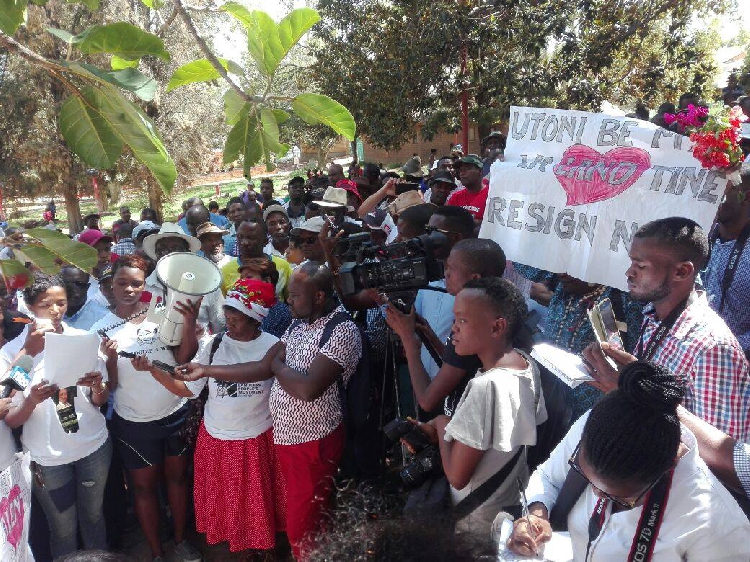
While Swapo was concerned with the creation of the supremacy of party-state, a new phenomenon emerged in 2014 and 2016, which re-asserted the importance of civil societies: The rise of new types of radical land-issue based social movements – the Affirmative Repositioning (AR) and Landless Peoples’ Movement (LPM). AR primarily organises on the urban periphery for plots while LPM concerns itself with ancestral land claims, land restitution and agrarian reform. The natural response by the ruling party was that it confused these social movements with political parties, competing for the soul of the electorate. Perhaps, the fear in the hearts of Swapo foot soldiers is the new organising and mobilising methods of these social movements in that they convene mass meetings similar in fashion to the ruling party at stadiums with same capacities and pulling crowd.
These social movements have taken the meaning of organising for tomorrow, today, to a new level. In fact, organising has been made easier by the social media and talking truth to the power, a lesson, ruling party still has to master. Hollow and stale rhetoric and character assassination are no longer impressive and relevant.
The benefits of social movements are that it may lead to greater transparency, responsiveness, reforms, compromises and consensus for the common good of all. These movements have commonly attracted the young, the better-educated and politically conscious. Simply put, social movements’ inspiration and ideological stance is skewed to the radical left, which calls for the end of class-based politics, and challenges old doctrines, methods and organisation and leadership style by infusing a radical critique.
In Namibia, Swapo, as a dominant party exerts major influence on the body politic. What its political bureau confirms becomes law. It controls all levers of the state – including certain sectors of the civil society. It creates deep state and decides on every aspect of our daily lives through policies and regulations. Its propaganda machinery and encrypted messages of threats and reprisals is arrogantly flashed at every opportunity. State-funded media is heavily controlled from the centre and censored.
Political pluralism and alternative views are rejected with the organising of so-called party ‘star rallies’ whereby party leaders use such platforms to talk empty rhetoric and issue direct threats to imagined enemies. The post-1990 environment of access to state power has caused the former liberation movement to lose its sense of historic mission.
Today, it is difficult to discern between what the party proposes at its decision-making structures and what is communicated in its hollow slogans, and empty promises. This is the stage where polarisation between the ruling party and its many constituencies develops.
A conflict ensues in which the party leadership is intolerant with any new thinking and alternative solutions wanting to challenge the status quo. In the most recent past, the party apparatchiks have been strong on its members belonging to social movements. In some extreme instances, it has led to expulsions and formation of new political parties. Patronage, elite competition for power, access to state coffers and the control of the natural resources seems to have besieged the ruling party. Ethnicity and tribalism dominate state talks and are an integral part of political king-making as marginalisation and exclusion deepens.
The former liberation movement uses selective history politics, mythologies and ultra-falsehoods to maintain followership and grip on state power.
Former liberation movements in their strategic and tactical error, refer to new social movements as ultra-leftist, ultra-radical, anti-developmental, and positioned against “peace and stability”. However, global lessons instruct a different discourse: That both in theory and practice, social movements offer a new and exciting dimension towards social and political re-imagination of truth, as a hegemonic force for sustained peace, stability and human development. The Arab Spring offers a recent lesson about the fatalistic contradiction: That African states are neo-liberal in economic policies and authoritarian in governance.
– Henny H Seibeb is a researcher at The Ideas Centre.
The opinions expressed in this article are the author’s own and do not necessarily reflect the views of this newspaper.
In an age of information overload, Sunrise is The Namibian’s morning briefing, delivered at 6h00 from Monday to Friday. It offers a curated rundown of the most important stories from the past 24 hours – occasionally with a light, witty touch. It’s an essential way to stay informed. Subscribe and join our newsletter community.

The Namibian uses AI tools to assist with improved quality, accuracy and efficiency, while maintaining editorial oversight and journalistic integrity.
Stay informed with The Namibian – your source for credible journalism. Get in-depth reporting and opinions for
only N$85 a month. Invest in journalism, invest in democracy –
Subscribe Now!