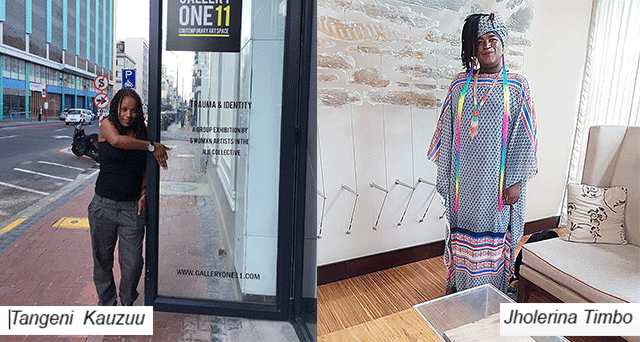
To Jholerina Timbo, the ultimate transgender future is where inclusion and tolerance exist. There is no othering, no stigma or discrimination.
There is equal and respectful access to health services and the law is extended to include gender identity and sexual orientation.
Timbo is one of five featured voices in poet, activist and documentarian Tangeni Kauzuu’s ‘So Over The Rainbow – Young, Black and Trans in Namibia’. A 20-minute documentary which premiered at the Goethe-Institut and Swakopmund Pride last year, recently showed at Cape Town’s Gallery One 11 and aims to foster visibility and awareness around Namibia’s transgender community.
The term transgender denoting individuals whose gender identity and/or gender expression differs from what is typically associated with the sex they were assigned at birth. Singular in its candid declaration of transgender identity by a receptionist, a case worker, a Namibian police force detective as well as Wings to Transcend’s executive director and programme officer, the film is both educative and a form of activism.
“My initial hope for the documentary before I even selected a target group was to show fellow activists and peers how easy it is to make even the smallest difference in the community,” says Kauzuu, who identifies as gender non-conforming. “I want to show them that telling our own stories stops them from being misconstrued to fit anyone’s agenda and frees us from hate and hurt.”
Posing a series of questions about issues of identity, transphobia, social and economic challenges, the law and how Namibian society can assist in improving the lives of transgender people, the documentary is a chronicle of struggle, perseverance and truth in a society where transgender identity is woefully misunderstood.
“Society thinks we are gays and lesbians,” says transgender detective Aio Areseb. “They don’t really understand that we don’t assign to our born sex and the gender roles. They just look at us as gay and lesbian and that’s frustrating because most of the time we are being misgendered because of that conception.”
Drawing a distinction between transgender men and women and people who are gay or lesbian, Timbo, who leads the Namibian transgender rights organisation Wings to Transcend, expounds on why this differentiation is important.
“Homosexuality was depathologised while trans hasn’t been yet, causing defragmentation within the movement,” she says. “Another issue is whose agenda is at the fore. Issues of sexual orientation, gender identity and expression are different and no one wants to be left behind.”
A victim of the same discrimination faced by OutRight Namibia’s Celine Eises Watson who decries the stereotype of transgender people being promiscuous, Wings to Transcend programme officer Verquisha Bock, who chronicles mistreatment at clinics, and Areseb, who laments the cost and availability of surgeons and hormones essential to transitioning, Timbo says the challenges are myriad.
“The reality is that we are violated in this country. We are physically, emotionally and psychologically abused and in many instances remain silent as gender-based violence campaigns exclude us; police make fun of and dehumanise us so we don’t seek assistance. The health care fraternity stigmatises and discriminates against us so we don’t seek medical help,” says Timbo.
“Wherever we go, we are met with hostility and inhuman, degrading treatment as there are no gender sensitive and inclusive services. Verbal abuse is the order of the day and people think it’s funny or a joke, but this is my reality and my life. Everything is aligned to bodily anatomy in Namibia which is something we all don’t conform to.
The levels of violence stem from exclusion in laws and policies to service providers’ prejudice and personal opinions dictating how to treat trans people because of what they are wearing, etc. I am more than my clothes. I am human.”
Like Society for Family Health case worker Kevin Uiseb who believes much of the stigma surrounding the transgender community stems from a lack of understanding, knowledge and the idea that transgender people simply hate their bodies or want surgery, Timbo agrees that part of the antidote is conversation.
“The best way to advocate is by allowing people to see your humanity, the intersectionality of issues and challenges by sharing your lived experiences and allowing people to journey with you,” says Timbo. “Society can be allies and support systems only if they understand your humanity and truth. Hence they will affirm you and support you.”
Featuring in the movie to share her experience and give hope to transgender people with a similar rural upbringing, Timbo believes Kauzuu’s film, the first of many as the documentarian continues to sharpen her filmmaking and editing skills, is situated firmly within African oral traditions.
“In African cultures in history, our ancestors used to share knowledge through storytelling. Me sharing my story brings light to issues many wouldn’t even consider and as human beings, we are interconnected and interlinked as we also belong to families, communities and societies,” she says.
“By sharing my story, I am trying to change minds and hearts to believe that above all else, we are human beings. My gender identity, my sexual orientation and all else come secondary.”
In an age of information overload, Sunrise is The Namibian’s morning briefing, delivered at 6h00 from Monday to Friday. It offers a curated rundown of the most important stories from the past 24 hours – occasionally with a light, witty touch. It’s an essential way to stay informed. Subscribe and join our newsletter community.

The Namibian uses AI tools to assist with improved quality, accuracy and efficiency, while maintaining editorial oversight and journalistic integrity.
Stay informed with The Namibian – your source for credible journalism. Get in-depth reporting and opinions for
only N$85 a month. Invest in journalism, invest in democracy –
Subscribe Now!