



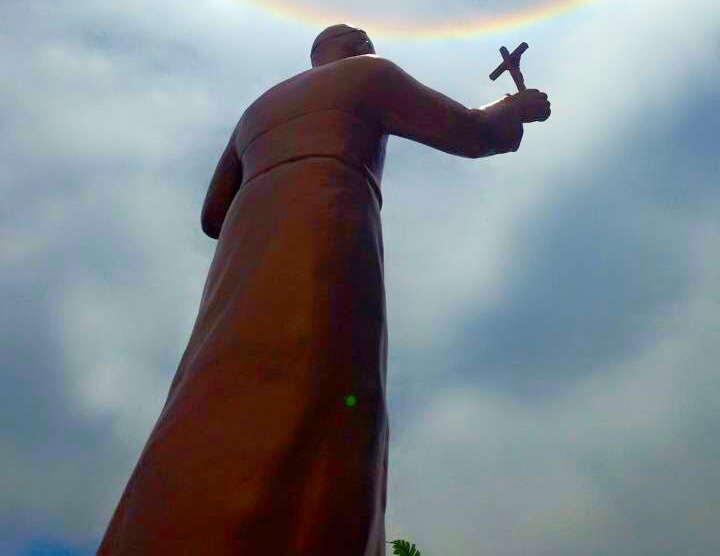
ANY CABRERA and MARCOS ALEMANArchbishop Oscar Romero was beatified by Roman Catholic officials on 23 May in an emotional ceremony elevating the once-controversial cleric to the ranks of the blessed 35 years after his assassination.
Underneath a rainbow halo ringing the sun, Cardinal Angelo Amato, the prefect of the Vatican’s saint-making office, called on the crowd of some 260 000-plus to rejoice in a “feast of peace, fraternity and forgiveness”.
“Romero’s spirit remains alive and gives comfort to the marginalised people of the world,” Cardinal Amato said. “His preference for the poor was not ideological, but evangelical. His charity extended to his persecutors.”
Beatification is the first step toward possible canonisation, although many of those who packed the Salvadoran capital’s Saviour of the World Plaza and the surrounding streets already credit Romero with miracles and refer to him as ‘Saint Romero of the Americas’.
Worshippers from across the nation, many from the countryside, held up poster-size images of Romero and carried white and yellow flags of the Vatican.
“They can kill the prophet, but not the voice of justice,” intoned pilgrims from the Our Lady of the Assumption parish in a San Salvador suburb.
“His words will remain for eternity,” said Marlene Sanchez (26).
In life, Romero was loved by the poor, whom he defended passionately, and loathed by conservatives who considered him too close to left-leaning movements in the tumultuous years ahead of El Salvador’s 1980-92 civil war.
The archbishop was shot through the heart by a sniper while celebrating Mass in a cancer hospital chapel on 24 March 1980. The day before, he had delivered a strongly worded admonition to the US-backed military to stop abusing civilians. Those words were read aloud Saturday: “I beg you, I beseech you, I order you, in the name of God, cease the repression.”
The trigger man has never been identified, and no one has been prosecuted for the killing. Alleged paramilitary death squad leader Roberto d’Aubuisson, who was named by a UN truth commission after the war’s end as the mastermind of the assassination, died in 1992 having maintained his innocence to the end.
Romero’s beatification was held up for years by church politics until then-Pope Benedict XVI “unblocked” the case in late 2012, after it was determined he had not been an adherent of revolutionary liberation theology as many claimed. Earlier this year, Pope Francis declared that Romero was martyred out of hatred of his faith, clearing the way for beatification.
US President Barack Obama, who visited Romero’s tomb in 2011, called him “an inspiration for people in El Salvador and across the Americas”.
“He was a wise pastor and a courageous man who persevered in the face of opposition from extremes on both sides,” Obama said. “He fearlessly confronted the evils he saw, guided by the needs of his beloved pueblo, the poor and oppressed people of El Salvador.”
Also on 23 May, tens of thousands of people gathered in the central Kenyan town of Nyeri to attend the beatification ceremony of Sister Irene Stefani, an Italian nun who worked for many years in Kenya.
Stefani, who belonged to the Consolata Missionary Sisters, first came to Kenya in 1915 and died there in 1930 at the age of 39, according to a website dedicated to her beatification.
In her case, beatification comes after official verification of a 1989 miracle in Mozambique – a country Stefani never visited – that was attributed to her.
The miracle reportedly happened when a group of about 270 people in danger of death prayed to Sister Irene “and the little water in the baptismal font, measuring between four and six litres, was multiplied to enable them to drink and wash for four days, before help arrived from outside”, Kenya’s Daily Nation newspaper reported, citing a priest in charge of Nairobi’s Consolata Shrine.
In an age of information overload, Sunrise is The Namibian’s morning briefing, delivered at 6h00 from Monday to Friday. It offers a curated rundown of the most important stories from the past 24 hours – occasionally with a light, witty touch. It’s an essential way to stay informed. Subscribe and join our newsletter community.

The Namibian uses AI tools to assist with improved quality, accuracy and efficiency, while maintaining editorial oversight and journalistic integrity.
Stay informed with The Namibian – your source for credible journalism. Get in-depth reporting and opinions for
only N$85 a month. Invest in journalism, invest in democracy –
Subscribe Now!