





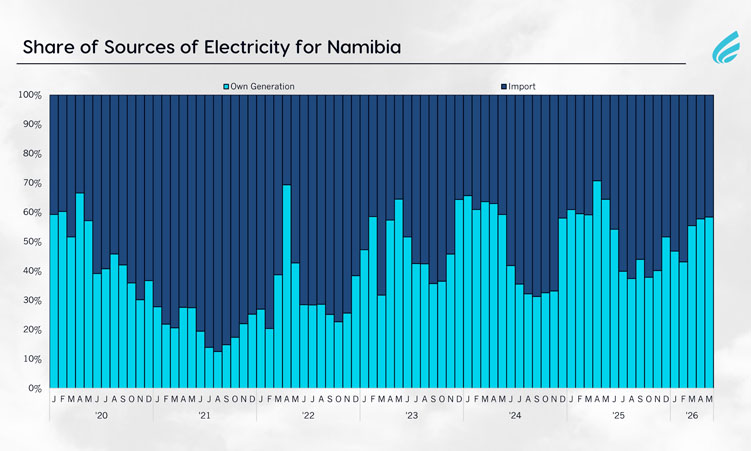
Namibia has always been a net electricity importer, mainly from South Africa, with the local generation share largely determined by Ruacana.
Namibia produced 51.6% of its own electricity in 2025 and 52.2% in the first five months of this year, just above the long-run January to May average of 50.1%.
That average can be misleading, as in the past five years alone, Namibia’s average local generation ranged from 25% in 2021 to a recent high of 62.9% in 2025.
Ruacana has no reservoir of its own, so it generates only when there is water coming down the Kunene River, and roughly 87% of that river’s catchment lies in Angola. Namibian rainfall is close to irrelevant to it. Angolan rain falls between November and April and reaches the station with a lag, which is why the chart peaks every year between February and May and then declines through winter.
The size of that peak depends on how wet the Angolan season was.
In 2021, own generation averaged 20.9% for the year and fell to 13% in August, with Ruacana’s July output down 85.7% year on year after a poor Angolan rainy season.
In April 2023, after heavy rain in the catchment, Kunene flow passed the 290 m³/s needed for full load, Ruacana ran at a maximum of 347MW around the clock, and NamPower briefly met more than 95% of national demand.
El Niño is considered to be the standard drought signal for southern Africa, and forecasters are now near-certain that one will run through late 2026 and into 2027, likely a strong one. Namibia sits inside that footprint, and so does Angola.
The 2026/27 rainy season is the one that fills the Gove and Calueque dams and sets what Ruacana can do next year, so the concern is real. A dry Angolan summer would show up in this chart through 2027.
El Niño maps onto Angolan drought more loosely than that suggests. Only two of the eight droughts identified in the Angolan highlands since 1981 fell exclusively in El Niño years.
The 1999 to 2000 drought ran through a strong La Niña, and 2021, the weakest year in this chart, followed a moderate La Niña.
Ruacana depends on rain over one plateau in central Angola, and the El Niño Southern Oscillation (Enso) forecast signal has not historically been as reliable a guide to conditions in Angola as it has been in Namibia.
Gove Dam, located 430km upstream, has a storage capacity of 2 600Mm³, which is close to half of the Kunene River’s mean annual flow. It was built specifically to regulate water flow to the Ruacana hydropower station.
Calueque Dam provides an additional 475Mm³ of storage closer to the Namibian border. Entering a dry year with both reservoirs near full capacity provides a buffer against reduced river flows, whereas starting with depleted storage levels can significantly increase supply risks, as seen in 2021.
However, both dams also support irrigation in Angola, and Namibia’s access to the stored water is governed by a 1969 bilateral agreement.
As a result, electricity generation at Ruacana ultimately depends not only on rainfall over Angola’s Bié Plateau but also on water management decisions made at these upstream dams.
– Deon Gous is an equity analyst.