




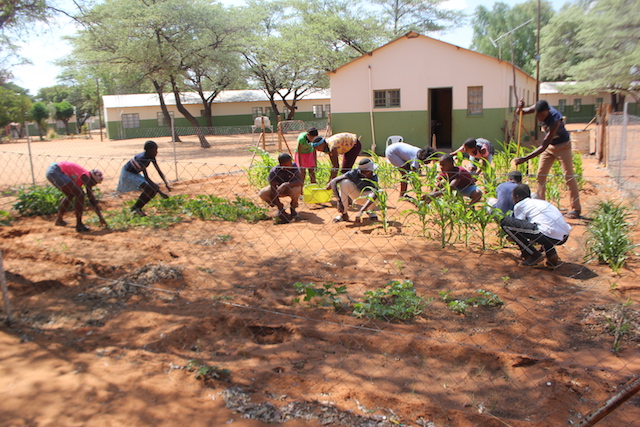
SAN pupils in the Omaheke region seem to be dropping out of primary and secondary schools at an alarming rate.
investigated the reasons for this trend.
The Wennie du Plessis Secondary School, Project Combined School, Gqaina and Hippo primary schools were visited, which cater to San pupils. Carien van Zyl started working as a teacher in 1994 at Gqaina Primary School in the Omaheke region, and became the school’s principal in 2008.
She says 359 pupils are currently enrolled at the school, of whom 168 are San pupils. Gqaina is located on Du Plessis Farm in the Okurukambe constituency some 85 km north-west of Gobabis.
Van Zyl says the girls at the school outperform the boys, because they seem to be more dedicated.
When the school started in 1982, only about 70 San pupils were enrolled.
“As the years progressed, more and more kids were brought to school,” she says.
“There are several challenges San pupils face at home. Due to work-related matters, some of the pupils drop out of school.
“For example: A parent would work at a particular farm and then relocate to another place, or simply leave a job, which has a great impact on the pupils,” she says. Not all parents are financially able to provide in their children’s basic needs.
The exposure to alcohol and the type of friends they associate with also contribute to dropping out of school, Van Zyl says.
Some of the San pupils have a very close family bond, not wanting to be separated from their loved ones and would opt to stay home, she says.
Van Zyl says a lack of parental involvement and communication barriers between parents and schools also contribute to the dropout rate. Lastly, some pupils drop out of school due to their age.
Hippo Primary School, a semi-private school with a hostel outside Gobabis, was built for San pupils about 26 years ago. School principal Zirk Vermeulen says the school accommodates children of all ethnic groups. With regards to dropout rates, he says parents perceive education differently.
“There were bright San pupils at the school 10 years ago, who were given bursaries by the school to continue with secondary school, but they never completed school and dropped out. The reasons are only known to them, or maybe there was just a lack of interest,” Vermeulen says. Only a few parents are involved in their children’s education, he says.
He says San pupils should have role models to look up to for encouragement. Some years ago, the school was among the best-performing schools in the country in English and mathematics.
The Project Combined School at Gobabis caters for pupils from grades 1 to 10. Principal Tezee Katjiuanjo says the school caters to pupils from different backgrounds, including the most vulnerable. He says the school does not focus on the appearance of the pupils, but on their schoolwork.
“Our school is a project that was established to herd low-income, non-working, marginalised, street-roaming children and those of absent parents,” Katjiuanjo says.
The school also caters to those living with physical and sensory impairment.
“As staff we were well prepared, mentally and psychologically, and consequently hit the ground running,” he says.
The school has dealt with the bullying of San pupils and ran a successful awareness campaign against this, he says.
Katjiuanjo says 1 757 children are enrolled at the school, of which 170 are San pupils – 90 girls and 80 boys.
“At the start of 2020 we ran a survey to look at the domestic situation of those kids, and covered around 200 households that would give us a backbone and database to arrange our operations in support of those kids, including some of them living without parents and who are confined to work on the farms,” Katjiuanjo says.
The school started with some 45 San pupils,which has grown to 170.
“We are happy with their progress at academic and sport level, and their interests are the mainstay of our life-skills and child-welfare office at school,” he says.
“San children are by nature very self-contained and reserved, and teachers are always sensitised to be patient and act right when handling them,” Katjiuanjo says. Despite their challenges, the school has seen success with San pupils, he says. He says a hostel at the school would help to curb the dropout rate, which is a crisis.
Magreth Rukira, principal of Wennie du Plessis Secondary School at Gobabis, says most of the pupils at the school, including San pupils, do not drop out when they reach the secondary stage of their education. The primary school dropout rate is much higher, she says.
In an age of information overload, Sunrise is The Namibian’s morning briefing, delivered at 6h00 from Monday to Friday. It offers a curated rundown of the most important stories from the past 24 hours – occasionally with a light, witty touch. It’s an essential way to stay informed. Subscribe and join our newsletter community.

The Namibian uses AI tools to assist with improved quality, accuracy and efficiency, while maintaining editorial oversight and journalistic integrity.
Stay informed with The Namibian – your source for credible journalism. Get in-depth reporting and opinions for
only N$85 a month. Invest in journalism, invest in democracy –
Subscribe Now!