





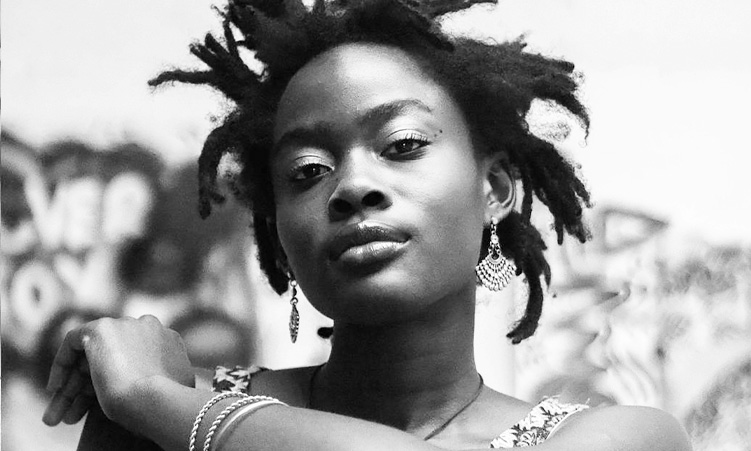
Mixed media artist Rachel Sakeus is set to make her city of gold debut as ‘Ombepo’, her latest collection, exhibits as part of Goethe-Institute Johannesburg’s commemoration of the International Day Against Homophobia, Biphobia, Intersexism and Transphobia (Idahobit).
Idahobit is observed annually on 17 May and is a global moment of the lesbian, gay, bisexual, transgender, queer/questioning, intersex and other (LGBTQI+) community’s solidarity, visibility, collective action and awareness. This year’s Idahobit theme is ‘At the Heart of Democracy’.
Goethe-Institut Johannesburg will present ‘A Pan-African Celebration of Queer Art, Language and Resistance’ curated by award-winning filmmaker Renaldo Schwarp on 21 May.
Within this programme of visual art, performance, documentary, drag artistry, dialogue and workshops celebrating queer creativity, Sakeus will showcase a series of photographic self-portraits. The artist’s frank, sometimes nude, self-documentation speaks to her queer identity, Aawambo heritage and the work of living authentically in a country where the human rights and freedoms of LGBTQI+ people are still being negotiated.
Self-portraits taken in Sakeus’ mother’s wedding dress, in traditional attire and within the transcendent realms of cultural dance honour the artist’s heritage and also guard against LGBTQI+ erasure.
“Taking self-portraits is a way to write myself into the narrative,” says Sakeus. “I don’t want people to say queer people don’t exist or have never existed. When I’m gone, 10, 20 or 1 000 years from now, I want them to see Rachel existed and was doing this work.”
In a portrait of Sakeus titled ‘Meme Caro on her Wedding’, the artist mines the past to consider what the future may or may not look like for a queer person in Namibia. Namibian law does not provide for same-sex marriage and the country recently enacted the Marriage Act 14 of 2024 which defines marriage as a union between people of the opposite sex.
“I used to love my mother’s wedding dress. I’d wear it when she wasn’t there. It makes jingling noises and it has pearls,” says Sakeus who poses in the garment in a photograph.
“My mom was around my age when she got married. This image makes me think about my relationship with her which has gotten better. It also makes me wonder whether I’ll ever be able to put on a wedding dress in Namibia, that’s if I marry a woman. Will we ever be able to get married?”
In an image titled ‘I will always miss you’, Sakeus seemingly breaks down in front of a bedroom mirror. Nude and bent over in despair, Sakeus captures a moment in which the weight of a queer friend’s self-inflicted death and the murder of Sexy Fredericks, a transgender woman killed in Windhoek in 2024 amid a spate of local hate crimes, comes to a head.
“There is so much pain and fear when you hear these stories,” says Sakeus. “When I took these photos, I was trying to process those emotions.”
In overlapping images of Sakeus dancing and in a photograph titled ‘My chest will never shy away from sinners’, the artist is topless. In these portraits, nudity is a natural state. Sakeus argues that nudity and bare breasts aren’t inherently sexual.
Instead, it can be the way one traditionally wears their cultural attire and a norm before colonial ideals and ideology introduced alternate modes of dress.
As Sakeus dances, the artist performs twin rites of culture and recovery.
“Dancing is healing. For me, it’s always been something that I’ve done when I’m going through sh*t in life. I put on my earphones and I’ll dance for hours,” says Sakeus who revels in traditional Aawambo and Ovaherero dance. “Sometimes, I cannot express myself through words, so dancing is me telling my story. I open up through movement.”
As dance heals Sakeus, so does the act of taking self-portraits.
“People try to make you hate yourself. But when I look at these photos, I’m saying I’m not gonna do that. I’m not going to hate my voice or my being,” says Sakeus. “I think all queer people should take pictures of themselves and celebrate themselves.”
Reflecting on what it means to be exhibiting in Johannesburg for Idahobit, Sakeus is ready for the next chapter.
“To me, it’s coming out. It’s coming out in many ways,” says Sakeus. “It’s putting my work in the places I want to be in and showing up in the spaces I want to be heard in, by people who will listen.”
– martha@namibian.com.na; Martha Mukaiwa on Twitter and Instagram; marthamukaiwa.com