




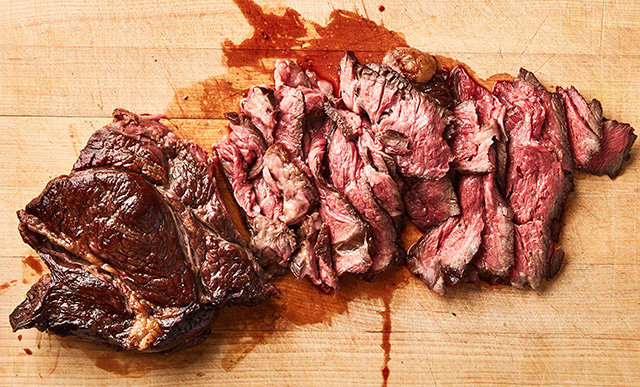
For many chefs, cooks and braai masters, finding the technique to cook or grill the perfect steak is the holy grail of all culinary endeavours. It presents a task not unlike coming to grips with the Holy Ghost.
They spend much time experimenting with various heat sources, grilling techniques, cooking times, and external and internal temperatures to find that sweet spot where everything comes together, and the steak is just perfect.
And finding the sweet spot in a consistent manner is even more difficult.
There are so many variables to take into account and control for the outcome to be perfect: The type of steak used; the thickness of the cut; the quality of the meat; the treatment of the meat; the type of heat source used; the technique used for cooking the steak; the cooking and resting time; the type and timing of the seasoning, and so forth.
When we grill steak (or other cuts of meat or vegetables), we strive for a nice dark exterior caused by the Maillard reaction and caramelisation, while having an interior that is cooked edge to edge, and to a temperature that ensures that it is juicy and tender.
Herein lies the challenge: Cooking the perfect steak requires two different temperatures, one for the outside and another for the inside.
Thus, we should look at the exterior and interior as two separate projects.
The general rule of thumb for cooking meat states that thicker cuts of meat require cooking at lower temperatures, while thinner cuts require much higher heat. This is because thinner cuts cook so much quicker.
If we were to cook thick cuts at high temperature, we run the risk of burning the exterior whilst leaving the interior undercooked or raw. If we cook the thinner cut over low heat, we will not develop that delicious caramelised crust on the exterior. In fact, the meat will end up boiled or steamed; dull in taste and grey in colour.
To sear a steak does very little to ‘seal in the juices’ – as we are often made to believe – but is essential for developing flavour and texture.
To get the perfect interior, we need lower heat. The best way to achieve this is to cook the meat sous vide. I have discussed this method for cooking food in previous columns, so I am not going to repeat the details here.
But there is no caramelisation and no Maillard reactions when food is cooked sous vide. This has to be added later, after the food is cooked, by means of a process called ‘reverse-searing’.
But how does searing work?
First, the temperature of the surface of the steak is raised. Then, once the temperature is sufficiently raised, the moisture on the surface of the steak has to evaporate. This happens when the temperature reaches at least 100°C, ie the point at which water starts to boil.
The Maillard reaction truly starts at a much higher temperature (150°C) when the surface of the meat has dried sufficiently to allow for the caramelisation to take place.
To achieve a great sear, one has to start with a dry steak, ie one with as little surface moisture as possible. A good way to start is by placing the steak, uncovered, on a drying rack set over a baking sheet, and leaving it in the refrigerator for 12 to 24 hours. That ought to dry the surface of your steak before it is cooked.
If you do not have a sous vide set-up and you are going to cook your meat in the oven, it is best to place the meat on a rack set over a sheet into the oven and to cook at low heat (93°C to 135°C) until the inside of the meat registers an internal temperature of about 10°C below what is required (see recipe). The meat is then removed and seared in a very hot pan lined with just a little oil over a very hot grill. If you are cooking the steak outside on a grill, start on a cooler section until the meat is at the right temperature for searing, then move the steak onto a very hot section to achieve the desired sear, or sear in a cast iron pan set over the hottest section of your grill.
Any which way, cooking the perfect steak benefits greatly from a good, instant read meat thermometer.
By the time you start searing, the interior part of the meat will require very little additional cooking.
When reverse-searing meat, there is no need to rest the meat. I like it best served with compound or flavoured butter.
• Thick-cut beef steak(s), at least 4 to 5cm thick, such as ribeye, sirloin, rump, T-bone or filet.
• Salt and freshly ground black pepper
• Vegetable oil (if finishing on the stovetop)
• 1 tablespoon butter (if finishing on the stovetop)
1. Generously season steak(s) all over with salt and pepper. If desired, set steak(s) on a wire rack set in a rimmed baking sheet and refrigerate, uncovered, overnight to dry out the exterior. Otherwise, proceed with the next step.
3. Place steak(s) in the oven and cook until an instant-read thermometer registers 41°C for rare, 46°C for medium-rare, 52°C for medium or 57°C for medium-well. This will take about 20 minutes for a rare steak and up to about 40 minutes for medium-well; cooking time can vary dramatically depending on many factors, so check often.
4. Just before the steak(s) come out of the oven, add one tablespoon of oil to a cast iron, carbon steel or heavy stainless steel frying pan and heat until smoking. Add steak(s) and butter to the pan and cook until each side is well browned, about 45 seconds per side. Using tongs, hold steak(s) sideways to sear edges. Serve right away.
In an age of information overload, Sunrise is The Namibian’s morning briefing, delivered at 6h00 from Monday to Friday. It offers a curated rundown of the most important stories from the past 24 hours – occasionally with a light, witty touch. It’s an essential way to stay informed. Subscribe and join our newsletter community.

The Namibian uses AI tools to assist with improved quality, accuracy and efficiency, while maintaining editorial oversight and journalistic integrity.
Stay informed with The Namibian – your source for credible journalism. Get in-depth reporting and opinions for
only N$85 a month. Invest in journalism, invest in democracy –
Subscribe Now!