By now it is clear that many businesses are under severe pressure because of the global coronavirus disease 2019 (Covid-19) pandemic. Restaurants, like so many other small businesses, are staring down the barrel and face a series of tough decisions on whether to stay open, try new business models, scale down or close down.
Under current circumstances, there is no way of telling how long this will last, or when life as we know it will return to normal, thus restaurants will have to find ways to continue making a living.
So, I thought to offer some ideas on what local restaurants could try to help keep their doors open.
There is not a single step or even plan that will ensure survival, but as the saying goes, desperate times call for desperate measures. Some if not all these ideas are currently being implemented by various restaurants internationally and even locally. While not completely tried and tested and guaranteed to succeed, they may be better than nothing at all.
Even in good times, restaurants operate on small margins. Waste is an ever-present threat to profits and regular, loyal clients are needed if a restaurant is to succeed. For the most part, overhead costs (such as rent) are high, and so are the cost of goods (such as fresh ingredients). Restaurants are also very reliant on staff and quite a lot of them, both front of house and kitchen staff. Service standards are key to any restaurant’s success, and staff need to be trained and retrained regularly. If all these are tallied, running a restaurant is a cash-driven business.
Most of Namibia’s fast-food restaurants are franchises and thus have their own, different business model and options for survival. They might already be in the take-out or drive-thru business and are thus better positioned to survive for at least the short term. My concern is for the small, independently owned, dine-in restaurants, because it is them that are in the most immediate danger.
Let’s clear the table of a few expectations. First, unlike the case in America, for example, where the restaurant industry has asked for a government bailout, no such bailouts will be available in Namibia. There is not enough money and small restaurants are not important enough. Period.
Second, many of our restaurants are reliant on international tourism, and with the pandemic being where it is at, we would not be welcoming international guests for some time to come. With local customers practising social distancing or going into self-induced lockdown, restaurants will not be able to replace one set of clients with another. For the most part, dining in restaurants is over, for the foreseeable future at least. Solutions of a different kind are needed.
Third, most businesses are linked in one way or another and all are suffering. We’ll have to come to grips with the fact that many will lose their jobs, especially if we fail to contain the spread of the Covid-19 pandemic among the Namibian population. We have one chance to keep the pandemic out and we need to make the most of it. Thus, follow the government guidelines, and do not be a part of the problem. Please remember, keeping the recommended public health protocols is not optional, it is compulsory.
A first measure restaurants can implement is to cut costs. This is difficult and not enough to ensure survival, but it’ll help.
Do away with extensive menus and adopt smaller less costly ones. To prevent spoilage and wastage, look at ways to make fresh produce last longer. Fermentation is a great way of doing that.
Reduce recipe costs and pass the discount on to clients. Margins are thin to begin, but not as important as staying in business. Make sure clients want to order from your restaurant, and remember they are under financial pressure too.
Second and perhaps much more important is to find new ways to generate an income. Consider changing the business model to something other than inhouse dining. Some restaurants (even three Michelin-starred ones) have started offering either take-away meals or meals to order that clients can pick up and take home. Stay in contact with loyal clients and offer to help them prepare family dinners.
Another possible option is converting the restaurant to a production facility for pre-cooked meals and/or frozen meals which could be delivered to individual customers or supermarkets and other retail outlets. Although it is difficult to get products listed in some supermarkets, a few may be open to the idea and be willing to help. They may also be willing to drive an ‘eat local’ campaign that will benefit restaurants by promoting their ready-cooked or frozen meals.
Fresh produce producers will have excess stock with restaurants being under pressure, but rather than let these go to waste, help by buying their stock and adding value to it. Make jams and preserves, pickled and dried goods that could be sold to supermarkets and shops and individual consumers, and get others to join a campaign to help restaurants and their producers. Supermarkets on the other hand, can help by providing shelf space to local restaurants and help them with campaigns to introduce, market and promote their products.
Businesses have a better chance of survival if they can join forces with other businesses. Join existing delivery services to do home deliveries; or cluster together to reduce delivery costs for all. Approach local transfer companies that are also under pressure because of the decline in tourism.
I do not believe that the various crowd-funding options will work for local restaurants. It is not part of our country’s socio-business culture and our restaurants do not have enough international appeal or significance to attract international donors. But, an original, creative campaign may prove me wrong.
With restaurants fighting for survival, the pressure is bearing down on other businesses in their supply chain: Butcheries, wine merchants, local breweries and distilleries, fishermen, wholesalers, food importers, kitchen equipment companies, vegetable growers, oyster farmers and fruit producers. This whole chain may succumb when restaurants go.
So, help you favourite restaurants survive, and you will help restaurant staff keep their jobs. Buy their food to take home, or have it delivered at home. Support them by raising awareness of their promotions or campaigns and get friends to help them too.
Be kind, be generous and be safe!
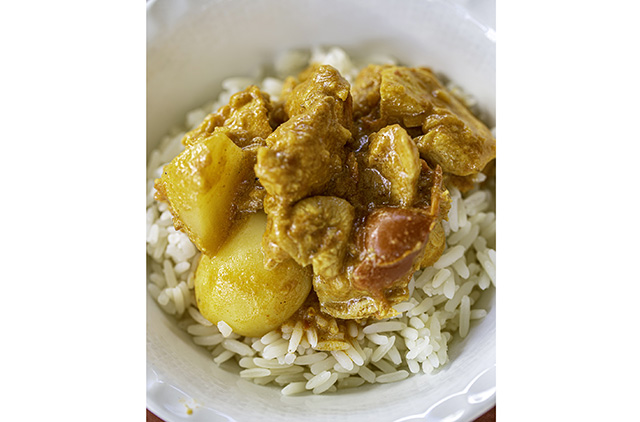
• 4 large chicken breasts
• 2 tablespoons curry powder (mild),
(or more to taste)
• 2 tablespoons garam masala, (or more to taste)
• 1 can tomatoes
• 2 large potatoes
• Salt and black pepper to taste