



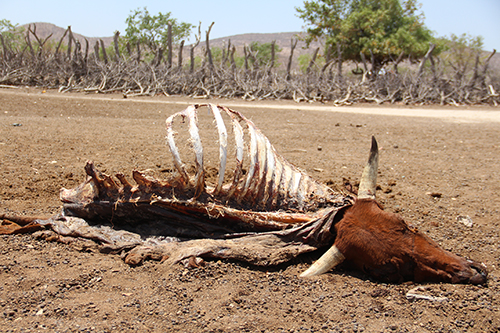
THE 2016/17 livelihood vulnerability report released on Monday says the drought currently ravaging Namibia has exposed 729 134 people to food insecurity.
According to the report, compiled by the Office of the Prime Minister and the agriculture ministry, 595 839 people out of the 729 134 need urgent assistance.
About 50% of those who need urgent drought relief food are from the six regions of Omusati (110 388); Ohangwena (101 741); Oshikoto (76 903); Oshana (49 150); Kavango West (47 989); and Kavango East (44 107).
The report, titled ‘Namibia Rural Food Security and Livelihood Vulnerability Forecast’, stated that the government has to fork out more than N$655 million for drought relief until the next financial year.
Of this amount, food alone requires N$308 million, while water intervention programmes need N$242 million, with the rest earmarked for logistics and milling.
The drought has reduced maize production in the Zambezi and Kavango East and Kavango West regions by 91%, and reduced milk production in all livestock farming zones.
As a result, 80% of farm workers are out of employment, while prices of staple food have sharply increased. At the same time, there has been an increase in human-wildlife conflicts.
Prime Minister Saara Kuugongelwa-Amadhila on Monday said the government must raise N$655 million for the period August 2016 to March 2017.
She also said the current drought relief programme extended from March this year to the end of July cost government N$90 million. Omusati governor Erginus Endjala told yesterday that his region has the largest number of livestock affected by the drought.
“This year is the worst, with about 294 000 head of cattle adversely affected by the drought. This does not include donkeys and goats,” he stated.
Endjala said the region has water shortages for both human and animal consumption. They had, however, received assurances from agriculture minister John Mutorwa that water will be pumped from Olushandja to Etaka, and then to the Uuvudhiya canal.
“This is good news, and mostly animals should be able to get sufficient water after that process. Underground water, which people depend on now, is a little salty because there has been no recharge due to a lack of rainfall,” Endjala said.
Oshikoto governor Henock Kankoshi said his region has been experiencing drought for the past six years.
“Boreholes dried out, and there is no underground water. I was at the Evale village on Friday, and people wake up at 03h00 to fill the animals’ troughs with water from the wells. By 07h00, the wells will have dried up,” he explained.
Kankoshi cautioned people not to panic as his office will work around the clock to deliver the water which government would be distributing to affected communities and schools soon.
The director of parks and wildlife in the ministry of environment, Colgar Sikopo, told in May that there have been 109 recorded cases of livestock killed; an average of 218 hectares of crops destroyed; and four people killed this year in growing incidents of human-wildlife conflict.
Last year, the ‘2015 Crop Prospects, Food Security and Drought Situation’ report released by the agriculture ministry showed that about 370 000 people were estimated to be vulnerable to hunger in the country.
In an age of information overload, Sunrise is The Namibian’s morning briefing, delivered at 6h00 from Monday to Friday. It offers a curated rundown of the most important stories from the past 24 hours – occasionally with a light, witty touch. It’s an essential way to stay informed. Subscribe and join our newsletter community.

The Namibian uses AI tools to assist with improved quality, accuracy and efficiency, while maintaining editorial oversight and journalistic integrity.
Stay informed with The Namibian – your source for credible journalism. Get in-depth reporting and opinions for
only N$85 a month. Invest in journalism, invest in democracy –
Subscribe Now!