




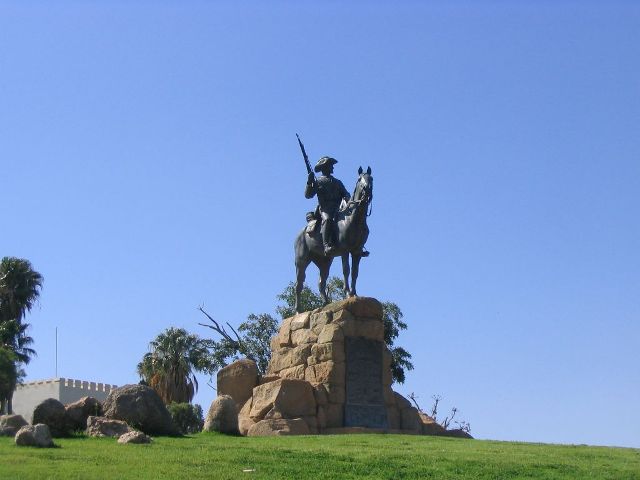
PREPARATIONS for the Reiterdenkmal, to be removed from its current location, seemed to be in full swing late Wednesday night.
Police Inspector General, Sebastian Ndeitunga confirmed to The Namibian, on Christmas night, that he was asked by the National Heritage Council of Namibia to remove the bronze statue, of a German cavalryman overlooking Windhoek, from in front of the Alte Feste.
According to him, the Heritage Council asked for security to assist if there were people who might want to interrupt the removal process.
The Namibian could not confirm whether the statue was already removed as the newspaper's photographer, other journalists and residents were not allowed to see or record any activity around it, as all access to the controversial statue was blocked off.
The top cop says he understands the monument's removal is temporary, as plans might exist to find another place as he believes that the statue "is part of history".
At this year's Heroes' Day celebrations President Hifikepunye Pohamba said, “this monument is a symbol of victory on the side of the Germans. This monument means ‘we have defeated them’. The horse rider must be removed,” Pohamba added that the government would not have any objections if the statue is to be taken back to Germany.
“If they want to take it back to Germany it is also fine, we will not have any objections,” the President said.
In addition to the statue of former President Sam Nujoma, which was unveiled at Omugulugwombashe on 26 August 2013, another statue of the founding president will be erected in Windhoek.
The Reiterdenkmal statue was inaugurated on 27 January 1912, and erected in honour of German soldiers and civilians who died in the 1904-1908 Namibian genocide on the birthday of Kaiser Willhelm II.
Sculptor Adolf Kurle from Berlin designed the monument. It was made in Berlin and the finished bronze monument was transported per ship to Swakopmund in 1911. From there it was sent by train to Windhoek and erected between the Christuskirche and the Alte Feste.
The monument is 4,5 metres tall and stands on a plinth of granite stones from Okahandja. In January 1969 it was proclaimed a national monument. In August 2009 it was moved to a new spot in front of the Alte Feste to make way for the new Independence Museum.
In November 2010 it was unveiled at its new site.