





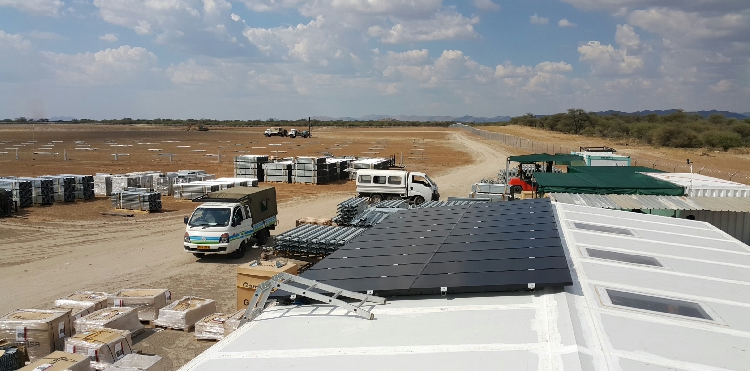
JESSICA BROWNA NEW solar farm being built on the outskirts of Okahandja is going up rapidly and will soon be contributing to the national grid. Construction of the Osona plant started in February this year and will be completed in August.
Behind this renewable energy project is independent power producer Innosun, a Namibian registered company made up of French and Namibian shareholders and a subsidiary of French company Innovent.
This is the second solar farm InnoSun has developed in Namibia.
Last year they completed the Omburu plant, a 15 hectare plot outside Omaruru.
InnoSun are building Osona as part of NamPower’s Renewable Energy Feed in Tariff (REFIT) programme. Under the programme, 14 companies were selected through stringent checks to sign power purchasing agreements with the government.
Each of these companies will build renewable energy plants generating 5 megawatts each when operational. Under the terms of REFIT InnoSun need to start producing power by April 2017, but they are running ahead of schedule and will likely be contributing to the national grid by September this year.
Developments are moving quickly on site. Namibian contractors are assembling the solar panels. Once up and running the plant requires little further financial input. Namibian staff local to the area will do the maintenance of the panels and surrounding land. Osona is also 15 hectares.
Namibia is a haven for solar power. With sun hours per month averaging 300, the amount of power generated on a day without cloud is close to the national daytime base load. Solar power is quiet, clean and relatively affordable. Once constructed, running costs are very low. The solar panels at Osona tilt to track the sun’s movement. Tracking systems make solar plants 22 25% more efficient than conventional ones.
InnoSun project engineer Alexandre Matton tells The Namibian that small power plants are well suited for Namibia. He adds that small localised plants set up across the country are able to service their local areas, while reducing losses through power transportation. These plants would also be beneficial for rural areas and would reduce the risk of nation wide blackouts.
In his statement at the EAN Conference on Energy finance minister Calle Schlettwein stated “Renewable energy facilities are very relevant for a sparsely populated country like Namibia where grid connectivity may not be a feasible option for all locations. ”
Presently Namibia imports between 40% and 80% of its energy requirements. Energy security is based on trade partners’ willingness to sell. Schlettwein added, “Without an affordable and reliable supply of energy, it is a daunting task to attract investment. ”
However Matton is confident that in the future Namibia could operate independently with a mix of renewables.
Namibia has good wind conditions at the coast and long hours of sunlight. Although these power sources are inconsistent over a 24 hour cycle, biomass plants and/or concentrated solar power developments could provide reliable future base loads. Namibia is also in an advantageous position; any surplus could be sold to SADC neighbours.
InnoSun have been working closely with NamPower on this initiative. Matton feels that this is a great example of a successful public private partnership. He says “we are happy to be working with NamPower and would like to thank them for their support. We are seeing great progress. ”
The Namibian spoke to Kandali Iyambo, from the Energy Trading Department of NamPower. Iyambo is happy with the outcomes of InnoSun’s projects, stating, “The performance of the [completed Omburu] plant to date is very good. We are seeing more energy being produced than anticipated. ” She added that the REFIT programme is going well and said “Renewables are good for every country as they reduce dependence on carbons. ”
Renewables have a real potential for energy provision in the not too distant future. Once approved, they can be up and running in a matter of months. There are currently six more solar plants in the development stage. InnoSun is also involved in the development of a vast wind farm near L uuml;deritz.
Once given the go ahead the farm could produce 150 200 megawatt. InnoSun worked closely with the Ministry of Environment and Tourism to secure land. The plot has been identified as an area with little scope for negative environmental impact. Every 10 turbines operating contribute 4% of Namibia’s energy needs to the National Grid.