



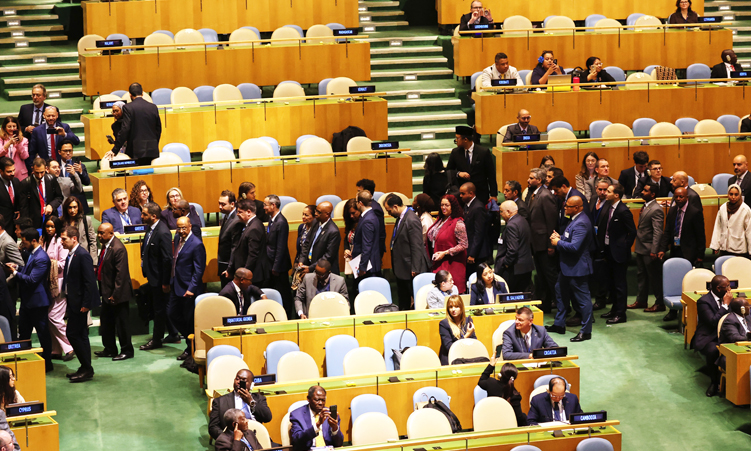
Namibia has defended its decision to join a walkout during Israeli prime minister Benjamin Netanyahu’s address to the 81st United Nations General Assembly (UNGA), saying its position on Palestine is longstanding and will not be altered by diplomatic pressure or disagreement.
State House press secretary Jonas Mbambo, who confirmed president Netumbo Nandi-Ndaitwah and the Namibian delegation’s walkout, yesterday said Namibia’s position was informed by international law and the country’s history as a people who experienced oppressio
“Yes, Namibia participated in the boycott of the address by the Israeli prime minister.
Our position on Palestine is well known and has been consistent over many years,” he said.
The comments follow a mass walkout at the United Nations General Assembly in New York on Thursday, during which dozens of delegates left the chamber as Netanyahu began his address.
Netanyahu responded by calling those who walked out “moral cowards” and challenged any remaining delegates who shared their position to leave.
“If there are any other moral cowards who haven’t yet left this hall, please do so now,” he said.
The Palestinian delegation had called on other missions to participate in the protest, according to reports.
Mbambo said Namibia remained a sovereign country whose foreign-policy positions were guided by its own principles.
“We are a sovereign and principled nation, and our positions are informed by international law and our own history as a people who know what oppression means,” he said.
He said principles may sometimes come at a price.
“The possibility of pressure or disagreement cannot prevent us from standing by what we believe in,” he said.
Mbambo said Namibia respects the right of other countries to pursue their own foreign-policy positions.
“We respect that other countries have their own foreign policy positions, just as Namibia has its own,” he said.
However, he said it does not prevent them from continuing to engage one another respectfully and constructively.
Former ambassador Pius Dunaiski, however, cautions that Namibia’s longstanding solidarity with Palestine should be weighed against its wider national interests.
Dunaiski says the walkout may satisfy Namibia’s historic commitment to the Palestinian cause, but argues that foreign policy should remain pragmatic and informed by the country’s position in an increasingly contested geopolitical environment.
He says Namibia, as a small state, needed to carefully read the changing international landscape, particularly amid growing competition between major powers such as the United States (US) and China.
Dunaiski argues that Namibia’s foreign policy should ultimately serve its national interests rather than become centred on symbolic gestures.
“The walkout has again highlighted the tension between Namibia’s liberation-era foreign-policy traditions and the diplomatic calculations facing the country in a changing global order,” he says.
Political analyst Ndumba Kamwanyah says the walkout could have some diplomatic consequences, but was unlikely on its own to seriously damage Namibia-US relations.