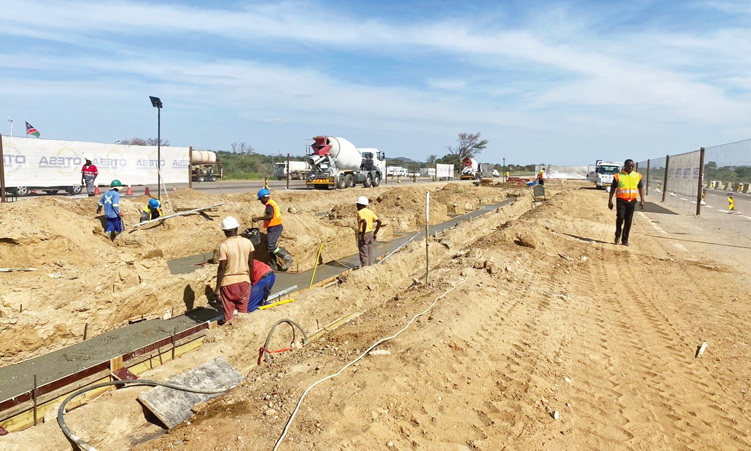
The police have defended the decision to build a N$56-million Okahandja-Windhoek checkpoint that will include features such as holding cells and staff offices.
The government has over the years splashed money on buildings at roadblocks across the country – a move seen by some as unnecessary.
This has attracted criticism that the government is trying to create an ‘apartheid’ system, which would divide towns instead of promoting crime control.
Upgrades to the Oshiko roadblock in the Oshana region, worth N$12 million, and the Onhuno roadblock in the Ohangwena region, worth N$8.3 million, have attracted public scrutiny.
The Namibian understands the Okahandja-Windhoek checkpoint upgrade has been delayed for some time due to a lack of funds, but has since commenced.
The tender, for what is formally known as the Okapuka roadblock, was awarded to Otesa Civil Engineering – the company that constructed the second and third phase of the main road from Windhoek to Okahandja.
HOLDING CELLS
The upgrades will also contain holding cells.
Police holding cells are primarily designed for the short-term detention of individuals awaiting legal proceedings or transfer to a longer-term facility.
According to the scope of work, the checkpoint will include the construction of police staff offices and overhead steel structures.
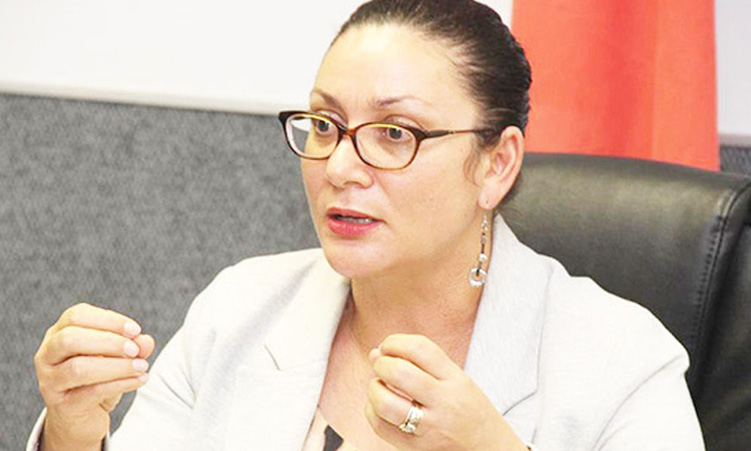
The client is the Ministry of Home Affairs, Immigration, Safety and Security. National police spokesperson deputy commissioner Kauna Shikwambi this week said road traffic checkpoints are set up in accordance with existing laws and statutes.
“The setting up is done with the definite purpose to fulfil the police mandate, which include the preservation of internal security, maintenance of law and order, investigation of crime and alleged offences, the prevention of crime, and the protection of life and property,” she said.
Shikwambi said law-enforcement officers have the right to erect traffic barriers and cordons, to search any person or vehicle, and the right to seize any prohibited articles at these checkpoints.
“Additionally, it is constructed to ensure our officers are protected and are operating in a conducive working environment,” she said.
Shikwambi said the financing of these projects is done in partnership with the Road Fund Administration (RFA). The RFA is a state-owned body that relies on collecting money through levies.
“No external donors are involved. And should there be any further construction of road traffic checkpoints, that will be planned and budgeted accordingly,” she said.
Shikwambi said the overall cost of the Okahandja-Windhoek checkpoint will be determined once the project is completed, and the public will be provided a detailed cost breakdown upon completion “if needed”.
“Just know that the procurement process was completed in accordance with the Public Procurement Act, and that construction is underway. The police anticipate the completion of the structure,” she said.
RFA chief executive Ali Ipinge told The Namibian “we make contributions in the form of traffic law enforcement, but the project falls under the police”.
MORE ROADBLOCKS TO COME
At its peak, the Windhoek-Okahandja checkpoint reportedly recorded about 1 000 cars per hour inbound to Windhoek.
Shikwambi this week denied that the police are enforcing an apartheid system, saying most of the current static roadblocks have been in existence even before independence and continue to be used to execute the police’s mandate effectively.
The police have been splashing millions on upgrading roadblocks. In 2024, the police inaugurated the Oshiko roadblock at a cost of N$12 million, and the Onhuno roadblock at N$8.3 million.
Shikwambi said construction methods and specifications of the biggest and busiest roadblocks differ due to roads’ layout, the positioning of office buildings, and services, among others. “The cost of the Onhuno checkpoint and the Oshiko checkpoint differs due to specifications that vary – the Onhuno checkpoint’s structure is smaller than that of Oshiko,” she said.
The two checkpoints have attracted criticism from the public due to their perceived high costs.
‘MAKING NO SENSE’
Official opposition Independent Patriots for Change spokesperson and parliament chief whip Immanuel Nashinge says the cost of some roadblock structures makes no sense.
“How can such a simple structure cost N$8.3 million? There is nothing extraordinary there. Even the one that is on the road to Hosea Kutako International Airport is better than that, but it did not cost such an amount,” he says.
The N$8.3-million Onhuno roadblock was constructed by August 26 Construction, a military-owned company, which has been accused of controversial dealings.
“Are there scanners, or what’s fancy there?” Nashinge asks.
He says there are not enough facilities to justify the amount spent on the checkpoint, such as offices and temporary custody facilities for those apprehended at the checkpoint.
“What does this infrastructure have that is so costly? This project is overpriced. As a taxpayer, I must see the value of my money.
“That structure cannot even be compared to some fire brigade stations at some towns that cost less for more,” he says.
Analyst Ndumba Kamwanyah says while the idea might be good, the government should not prioritise the upgrade of roadblocks over pressing needs.
“Is it really a priority right now over the country’s socio-economic needs? Why prioritise that over the challenges we are currently facing? From a policy issue, can this not wait?”
Popular Democratic Movement leader McHenry Venaani yesterday said the additional infrastructure is necessary for security, but is overpriced.
“We must remember our people are sleeping on empty stomachs. We must balance costs and what is needed.”
In an age of information overload, Sunrise is The Namibian’s morning briefing, delivered at 6h00 from Monday to Friday. It offers a curated rundown of the most important stories from the past 24 hours – occasionally with a light, witty touch. It’s an essential way to stay informed. Subscribe and join our newsletter community.

The Namibian uses AI tools to assist with improved quality, accuracy and efficiency, while maintaining editorial oversight and journalistic integrity.
Stay informed with The Namibian – your source for credible journalism. Get in-depth reporting and opinions for
only N$85 a month. Invest in journalism, invest in democracy –
Subscribe Now!