




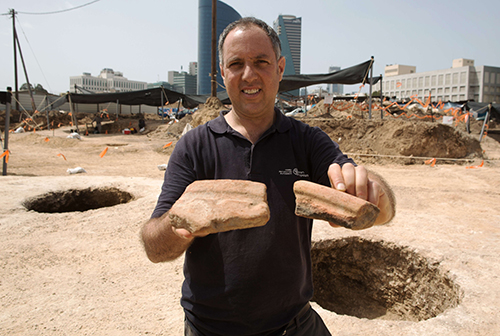
Tel Aviv’s reputation as a party city for expats might have started 5 000 years ago.
During the Bronze Age, Egyptians were making beer in what is today downtown Tel Aviv, new archaeological evidence suggests.
When archaeologists were conducting salvage excavations ahead of construction on new office buildings along Hamasger Street, they found 17 ancient pits that were used to store produce, according to an announcement from the Israel Antiquities Authority (IAA).
These pits held Egyptian-style pottery that dated back to the Early Bronze Age I, a period that lasted from 3500 BC to 3000 BC.
“On the basis of previously conducted excavations in the region, we knew there is an Early Bronze Age site here, but this excavation is the first evidence we have of an Egyptian occupation in the centre of Tel Aviv at that time,” Diego Barkan, an archaeologist who was conducting the excavation on behalf of the IAA, said in the statement.
Barkan and his colleagues found hundreds of pottery fragments, including broken pieces of large ceramic basins traditionally used to prepare beer.
According to the antiquities authority “beer was the Egyptian national drink and was a staple along with bread”.
It said beer was consumed by the entire population of Egypt, regardless of age, gender or status.
“It was made from a mixture of barley and water that was partially baked and then left to ferment in the sun. Various fruit concentrates were added to this mixture in order to flavour the beer,” the statement added.
Previous excavations carried out in Egypt’s Delta region uncovered breweries that indicate beer was already being produced in the mid-fourth millennium BC, the Israeli authority said.
The clay that was used to create the ceramic basins had been mixed with straw or other organic materials as strengthening agents.
This method wasn’t used in the local pottery industry in Israel, but straw-tempered vessels have been found before at other Egyptian sites – notably, the Egyptian administrative building that was excavated at En Besor in southern Israel, Barkan explained.
“This is also the northernmost evidence we have of an Egyptian presence in the Early Bronze Age I,” Barkan said. “Until now, we were only aware of an Egyptian presence in the northern Negev and southern coastal plain, whereby the northernmost point of Egyptian occupation occurred in Azor. Now we know that they also appreciated what the Tel Aviv region had to offer and that they too knew how to enjoy a glass of beer, just as Tel Avivians do today.”
The archaeologists report that they also found 5 000-year-old bones from wild boar, sheep and goat at the site, as well as a bronze dagger and stone tools dating back 6 000 years, during the Chalcolithic period. – LiveScience, Nampa-AFP
In an age of information overload, Sunrise is The Namibian’s morning briefing, delivered at 6h00 from Monday to Friday. It offers a curated rundown of the most important stories from the past 24 hours – occasionally with a light, witty touch. It’s an essential way to stay informed. Subscribe and join our newsletter community.

The Namibian uses AI tools to assist with improved quality, accuracy and efficiency, while maintaining editorial oversight and journalistic integrity.
Stay informed with The Namibian – your source for credible journalism. Get in-depth reporting and opinions for
only N$85 a month. Invest in journalism, invest in democracy –
Subscribe Now!