Nestled at the end of a street in the Cypriot village of Lefke is a house to which an elderly Sufi Muslim sage draws disciples with a message of love to counter the radical face of Islam.
Sufism traces its roots back to the origins of Islam and focuses on the inner, mystical dimension of the faith and a personal relationship with God, especially through meditation.
It is made up of many orders. Among the most prominent are the Naqshbandi, renowned for their austerity and scrupulous observance of sharia, or Islamic law.
Sheikh Nazim, now very frail at the age of 91, leads a group known as the Naqshbandi-Haqqani, which is more flexible in its teachings, and “is one of the best known Sufi masters in the West”, says Thierry Zarcone, a French historian and specialist in Sufism.
“It’s an Islam that is more flexible, with an acceptable vision. At the same time, (Sheikh Nazim) is playing on the danger of radicalism in the US and Europe… by showing that Sufism is a kind of instrument against radicalism.”
The door is open to all, with a cheerful greeting of “welcome to the house of love”, and visitors are invited in to share one of the day’s two meals.
Inside, the shady arched veranda looks out on a courtyard brimming with flowers and fruit trees. There’s a steady flow of people into the house in the breakaway Turkish Republic of Northern Cyprus, from residents to visiting pilgrims and locals who have come to ask for prayers or to seek a favour.
Among them are Germans, Italians, Swiss, Americans, Russians, and of course Turks and Turkish Cypriots, who converge on the tiny mosque to attend prayers followed by a sermon on “true love”, the love of God.
Papal Embrace
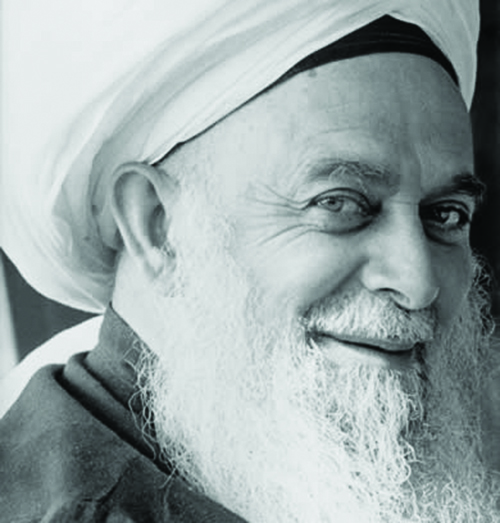
At the centre of it all is Sheikh Nazim, whose blue eyes, though dimmed by age, still radiate gentleness and affection.
Nazim, who is now mostly confined to a wheelchair and has difficulty talking, was not up to an interview, but he still preaches sermons that are later uploaded to the web by the Internet savvy community.
Three years ago, already bent with age and walking with difficulty, he came to the attention of the wider world when the former pope, Benedict XVI, visited Cyprus.
He travelled from Lefke to the Roman Catholic church in the UN-patrolled buffer zone that divides Nicosia.
Benedict was heading into church, but stopped when Sheikh Nazim approached him, and the two shared a few poignant moments in quiet conversation.
“God bless you,” Sheikh Nazim said, before adding: “Pray for me. I am so old,” to which the Pope replied with a twinkle in his eye: “I am also old.”
To some, it might have seemed incongruous to see a Muslim cleric embracing the Pope, but the message of love, of tolerance is at the centre of Sheikh Nazim’s teachings.
In his book entitled simply ‘Love’, Sheikh Nazim says that “in every religion, love is the primary force. When you love, you respect.”
Sheikh Nazim’s son, Bahauddine, said: “If you love the human and you love the nature and you love the people and you love the animal, that means you are in the right way.”
Bahauddine explained that “we have here people who are originally Muslim, others are converts. We do not make any separation.”
“Our most active communities are in Europe, particularly in London,” he says, while also mentioning others in Istanbul, Los Angeles and the US state of Michigan.
One of Sheikh Nazim’s sons-in-law, Sheikh Hisham Kabbani, has actively promoted the order in the United States in 1990.
And, after a terrorist bombing in London in 2005, he spearheaded the creation of a council of Sufis to get out the “voice of the silent majority” to counter that of radical Islam.
As Bahauddine put it: “We have to explain Islam to foreigners, especially these days as there are so many ideas that are violent.”
“If you look back into the history of Islam, what are the rules? You cannot kill women or children or old people or burn a house. There is no excuse for suicide.
“This is our religion; it is the most beautiful religion. But it is coming into the wrong hands. I am deeply sorry to say this.”
Nestled at the end of a street in the Cypriot village of Lefke is a house to which an elderly Sufi Muslim sage draws disciples with a message of love to counter the radical face of Islam.
Sufism traces its roots back to the origins of Islam and focuses on the inner, mystical dimension of the faith and a personal relationship with God, especially through meditation.
It is made up of many orders. Among the most prominent are the Naqshbandi, renowned for their austerity and scrupulous observance of sharia, or Islamic law.
Sheikh Nazim, now very frail at the age of 91, leads a group known as the Naqshbandi-Haqqani, which is more flexible in its teachings, and “is one of the best known Sufi masters in the West”, says Thierry Zarcone, a French historian and specialist in Sufism.
“It’s an Islam that is more flexible, with an acceptable vision. At the same time, (Sheikh Nazim) is playing on the danger of radicalism in the US and Europe… by showing that Sufism is a kind of instrument against radicalism.”
The door is open to all, with a cheerful greeting of “welcome to the house of love”, and visitors are invited in to share one of the day’s two meals.
Inside, the shady arched veranda looks out on a courtyard brimming with flowers and fruit trees. There’s a steady flow of people into the house in the breakaway Turkish Republic of Northern Cyprus, from residents to visiting pilgrims and locals who have come to ask for prayers or to seek a favour.
Among them are Germans, Italians, Swiss, Americans, Russians, and of course Turks and Turkish Cypriots, who converge on the tiny mosque to attend prayers followed by a sermon on “true love”, the love of God.
Papal Embrace
At the centre of it all is Sheikh Nazim, whose blue eyes, though dimmed by age, still radiate gentleness and affection.
Nazim, who is now mostly confined to a wheelchair and has difficulty talking, was not up to an interview, but he still preaches sermons that are later uploaded to the web by the Internet savvy community.
Three years ago, already bent with age and walking with difficulty, he came to the attention of the wider world when the former pope, Benedict XVI, visited Cyprus.
He travelled from Lefke to the Roman Catholic church in the UN-patrolled buffer zone that divides Nicosia.
Benedict was heading into church, but stopped when Sheikh Nazim approached him, and the two shared a few poignant moments in quiet conversation.
“God bless you,” Sheikh Nazim said, before adding: “Pray for me. I am so old,” to which the Pope replied with a twinkle in his eye: “I am also old.”
To some, it might have seemed incongruous to see a Muslim cleric embracing the Pope, but the message of love, of tolerance is at the centre of Sheikh Nazim’s teachings.
In his book entitled simply ‘Love’, Sheikh Nazim says that “in every religion, love is the primary force. When you love, you respect.”
Sheikh Nazim’s son, Bahauddine, said: “If you love the human and you love the nature and you love the people and you love the animal, that means you are in the right way.”
Bahauddine explained that “we have here people who are originally Muslim, others are converts. We do not make any separation.”
“Our most active communities are in Europe, particularly in London,” he says, while also mentioning others in Istanbul, Los Angeles and the US state of Michigan.
One of Sheikh Nazim’s sons-in-law, Sheikh Hisham Kabbani, has actively promoted the order in the United States in 1990.
And, after a terrorist bombing in London in 2005, he spearheaded the creation of a council of Sufis to get out the “voice of the silent majority” to counter that of radical Islam.
As Bahauddine put it: “We have to explain Islam to foreigners, especially these days as there are so many ideas that are violent.”
“If you look back into the history of Islam, what are the rules? You cannot kill women or children or old people or burn a house. There is no excuse for suicide.
“This is our religion; it is the most beautiful religion. But it is coming into the wrong hands. I am deeply sorry to say this.”
In an age of information overload, Sunrise is The Namibian’s morning briefing, delivered at 6h00 from Monday to Friday. It offers a curated rundown of the most important stories from the past 24 hours – occasionally with a light, witty touch. It’s an essential way to stay informed. Subscribe and join our newsletter community.

The Namibian uses AI tools to assist with improved quality, accuracy and efficiency, while maintaining editorial oversight and journalistic integrity.
Stay informed with The Namibian – your source for credible journalism. Get in-depth reporting and opinions for
only N$85 a month. Invest in journalism, invest in democracy –
Subscribe Now!