



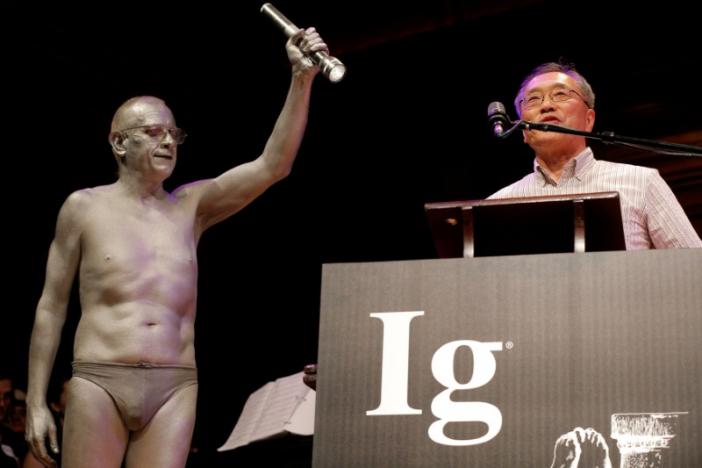
•SCOTT MALONEScientific research into how polyester pants affect the sex life of rats, what it’s like for a human to live like a badger and how different the world looks when viewed through your legs was honoured at this year’s Ig Nobel spoof awards.
The group also took a dig at Volkswagen AG, lauding it in chemistry for engineering its vehicles to produce fewer emissions “whenever the cars are being tested”.
The prizes wer awarded for a 26th straight year at Harvard University last Thursday by a group of actual Nobel Prize winners, and are intended to honour accomplishments in science and humanities that make one laugh, then think.
“The prizes are for something pretty unusual,” said Marc Abrahams, editor of the Annals of Improbable Research, and host of the awards. “Almost any other kind of award is for the best or worst. Best or worst is irrelevant to us.”
Timeliness is also of limited consideration: The Ig Nobel Reproduction Prize went to the late Ahmed Shafik of Egypt, who died in 2007, for a 1993 paper documenting that rats who wore polyester or polyester-cotton blend pants were less sexually active than those who wore cotton or wool pants or conformed to rat norms and wore no garments of any kind.
The paper suggested that ‘electrostatic fields’ created by polyester pants could play a role in impotence.
“We have never heard of anybody else who carefully spent time examining what happens sexually to rats if you put pants on them,” Abrahams said.
Two Britons split this year’s Biology Ig Nobel. Oxford University fellow Charles Foster was honoured for his book ‘Being a Beast’, chronicling his experiments in living as a badger, including digging a den to sleep in and eating worms.
Countryman Thomas Thwaites’ work was in a similar vein; he built a set of prosthetic leg extensions to try living like a goat in Switzerland.
Japan’s Atsuki Higashiyama and Kohei Adachi were granted the Perception Ig Nobel for a paper on how objects look different when one bends over and views them through one’s legs.
The 2016 Ig Nobel Prize in Physics went to Susanne Akesson of Sweden for work “discovering why white-haired horses are the most horsefly-proof horses, and for discovering why dragonflies are fatally attracted to black tombstones”.
Volkswagen’s award was more ignominious, going to the company for equipping its vehicles with a “defeat device”, which activated the emission controls of an engine undergoing government tests and deactivated them afterward.
VW has already agreed to spend up to US$16,5 billion to address US environmental, state and owner claims. – Nampa-Reuters
In an age of information overload, Sunrise is The Namibian’s morning briefing, delivered at 6h00 from Monday to Friday. It offers a curated rundown of the most important stories from the past 24 hours – occasionally with a light, witty touch. It’s an essential way to stay informed. Subscribe and join our newsletter community.

The Namibian uses AI tools to assist with improved quality, accuracy and efficiency, while maintaining editorial oversight and journalistic integrity.
Stay informed with The Namibian – your source for credible journalism. Get in-depth reporting and opinions for
only N$85 a month. Invest in journalism, invest in democracy –
Subscribe Now!