The Kavango West police have acknowledged strange killings occurring in the region but say they cannot confirm if these murders can be traced to rituals due to a lack of evidence.
Both Kavango regions have over the years reported killings with ritualistic patterns such as missing limbs. Six cases suspected of being ritual killings have been reported at Nkurenkuru this year.
“We cannot confirm that there is ritual killing going on. But yes, the two bodies we retrieved had some external missing parts,” Kavango West regional commander commissioner Julia Sakuwa told The Namibian this week.
Sakuwa says of two recent cases at Nkurenkuru reported in September and July this year, a leg, foot, nose, parts of flesh on the skull, eyes, ears, hands and some private parts were notably missing on the bodies.
“A post-mortem examination was done but the bodies were found to be in a decomposed state so the doctor could not really tell whether the people were murdered or not,” she stated.
Sakuwa emphasised that the police investigate each and every case they come across.
“The problem with these cases is they are very complex. There were names that were mentioned, but when we followed up with those names, everybody just kept on saying, ‘I also heard about it’,” she said, noting that many alleged ritual murders are based on rumours.
Sakuwa called on the community to calm down and assist the police with any information to apprehend the suspects.
“All the cases are still very fresh. We are following up and the investigation continues with each and every piece of information we get,” she said.
She urged the community not to lose faith in the police, adding that they have arrested many suspects and solved many cases.
In 2023, The Namibian reported that 21 people went missing at Mukwe, in the Kavango East region, over six years, with some later being discovered with their bodies dismembered.
NOT CONVINCED
However, some Kavango West residents are fed up, accusing law enforcement of failing to act decisively against the wave of suspected ritual killings that has left communities living in fear.
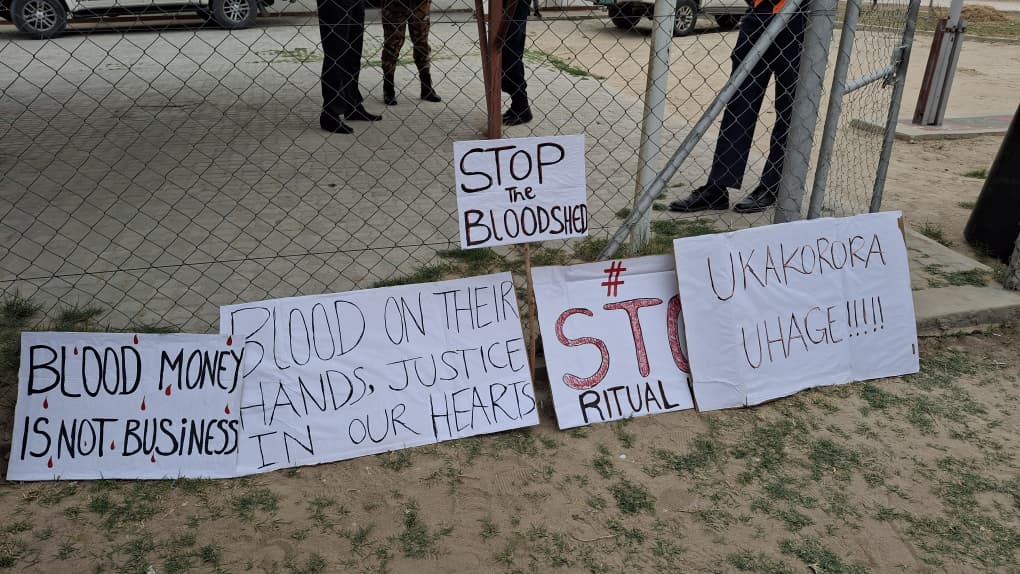
During a demonstration on Tuesday, community spokesperson Gabriel Tenga criticised ongoing investigations, saying they often reach dead ends.
“We have lost confidence in the Namibian police and their credibility is compromised when they are unable to account for crimes committed in our communities,” Tenga said.
People at Nkurenkuru, Kakuro, Kahenge, Siudiva and surrounding areas say they can no longer move freely, fearing they could be next.
“It is time you win our trust back. The residents are saddened by the repetitive acts of killings and mutilation. We cannot tolerate this. In six months, we have lost a significant number of people from Ukakorora,” Tenga said.
He accused authorities of negligence and questioned the lack of arrests.
“The killers may be hiding within households. Fighting crimes should start at home because these vakakorora (ritual killers) live in our houses, eat on the same plates and drink with us at shebeens. Let us condemn these barbaric acts at the household level,” said Tenga.
Residents called on the police to do more to remove the alleged killers walking freely in society.
JOIN HANDS
Kavango West governor Verna Sinimbo appeals to the community to work with the police in fighting crime.
“Whoever has information with regards to this issue of suspected ritual killings or any other crime, even the slightest information, your identity will be kept confidential. Please come through and assist the police,” Sinimbo says.
She urges families to act quickly when loved ones go missing.
Meanwhile, Kavango West activist Modestus Kupembona says the alleged ritual killing cannot be treated as normal crimes.
“Enough is enough! Ritual killings in Kavango West cannot be treated as normal crimes. We demand the police step up with real investigations, not empty promises,” he says.
“Communities must expose perpetrators hiding among us, and families of victims deserve justice, not delays, not silence,” Kupembona says.