Some political analysts have questioned president Netumbo Nandi-Ndaitwah’s appointment of deputy ministers in some ministries, arguing it may increase government costs and duplicate existing administrative roles.
They say the U-turn by Nandi-Ndaitwah to appoint seven new ministers and a minister in the Presidency is not cutting costs but rather bloating the treasury.
This has sparked debate about efficiency, cost-saving, and whether all ministries truly require deputy ministers to function effectively.
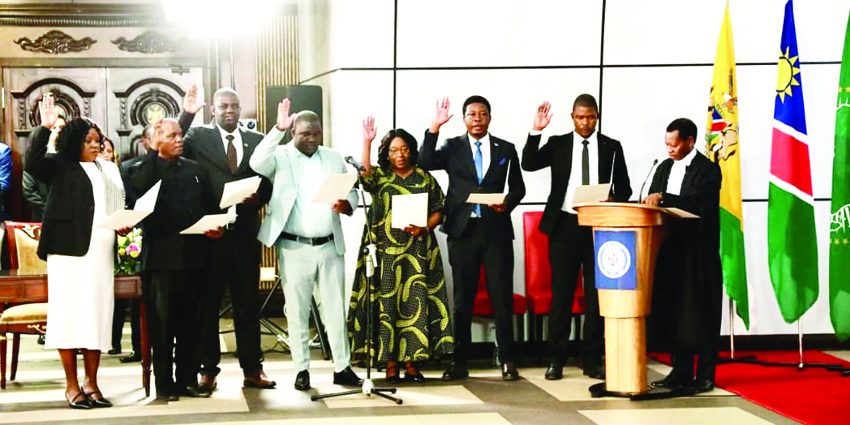
“These changes were deliberate. Some functions were merged, others reassigned, all with the singular aim of strengthening governance, improving coordination, and enhancing service delivery,” Nandi-Ndaitwah said during the deputy minister appointments on 2 April.
She added that certain ministries were not assigned deputy ministers, hence the appointments.
All People’s Party parliamentarian Ambrosius Kumbwa yesterday said not all ministries need deputy ministers, questioning what informed the president’s decision.
“Not all the ministries need deputies. Other ministries like education, justice and health for example, we can look at how they underperformed maybe due to staff shortages.
She ought to look at where the need is and not all.
I do not think deputy ministers are necessary because this contradicts her previous stance that she wants to cut costs due to our economy not doing well.
This was not a good move by the president,” he said.
REWARDS
Political analyst Rui Tyitende yesterday said like any political leader, the president operates in a political environment that is premised on compromises, loyalty and patronage.
“The appointment of deputy ministers has punctured her narrative of ‘business unusual’ as we know that deputy ministers are known for only drinking coffee and reading newspapers in office.
What fundamental role do they play in the policy making process that a minister and the bureaucrats cannot execute?” he asked.
Tyitende said these appointments have nothing to do with service delivery but everything to do with rewarding those who supported Nandi-Ndaitwah’s presidential campaign.
He said it will be an unnecessary burden on the government’s moneybag.
Political commentator Erika Thomas argues that certain ministries cannot be headed by a minister alone despite the role of executive directors.
“Some ministries were merged, such as the Ministry of Agriculture, Fisheries, Water and Land Reform and the Ministry of Justice and Labour Relations, both of which need a deputy minister to focus on other departments.
“Those proposing that executive directors should run this department must keep in mind that they do not go to parliament to answer questions, but a deputy minister has that luxury,” she says.
Thomas also argues that costs will always be involved in delivering quality services by appointing best-in-class expertise and skills, adding that some appointed ministers lack experience in running ministries and, therefore, need a helping hand.
She said fisheries should be left alone and that the issues of Fishrot and fishermen should be addressed separately and merged only after they have been resolved.