





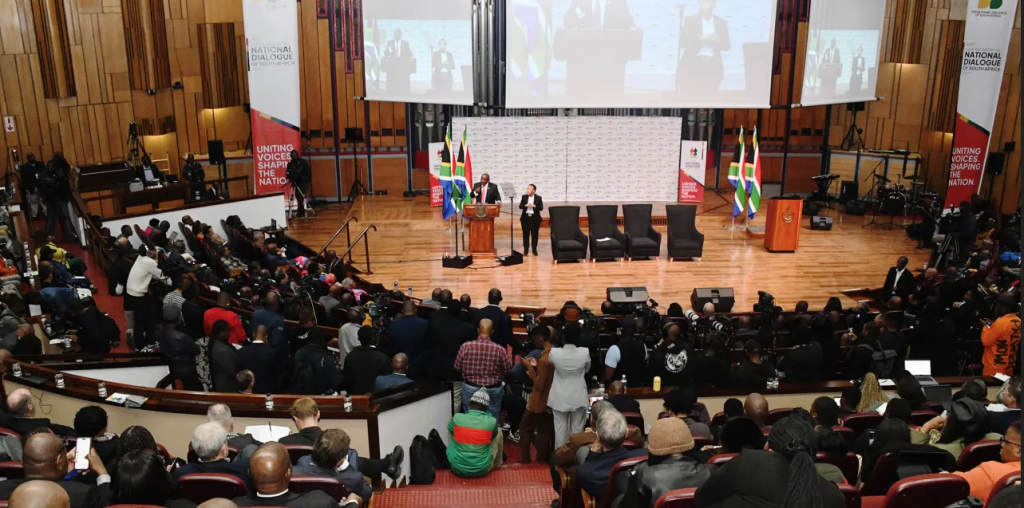
President Cyril Ramaphosa and his deputy, Paul Mashatile, came under intense scrutiny at the National Convention in Pretoria, where citizens demanded more than promises. Ramaphosa was challenged directly by delegates accusing the government of shutting down grassroots voices and using the platform for electioneering.
The National Convention in Pretoria over the weekend was intended to begin shaping a shared national vision and create a space for forthcoming dialogues. However, the event revealed a clear disconnect between government officials and ordinary citizens.
Before the official opening on Friday, protesters had already gathered outside the venue, expressing frustration at being left out of the process, saying they only learnt of the convention through the media.
Inside, proceedings quickly became tense. A delegate collapsed, prompting confusion and a brief scuffle on stage, while protesters remained outside, continuing to voice concern about their exclusion.
Although the convention was meant to foster collaborative problem-solving, discussions were often marked by strong emotions. Much of the focus shifted from future goals to immediate frustrations with crime, corruption, inequality in education and perceptions of a weak justice system.
In a breakout session on “Crime and Corruption” a facilitator asked a simple question: What is the South Africa you dream of? Responses reflected everyday concerns rather than lofty aspirations.
“I dream of a South Africa where education matters, where rural children are given the same tools as those in Gauteng,” said Qophumlando Dlangamandla, a teacher from North West.
“You give one child a laptop and internet access, and another nothing, yet expect them to compete equally, that’s not a dream, that’s a nightmare.” Many in the room murmured in agreement. Tension continued to build.
When a facilitator pointed out that South Africa’s murder rate was “30 times worse than Ukraine, a country at war”, there were audible gasps from the audience.
Personal stories followed. Bonginkosi Zwane spoke emotionally about his young grandson, who had recently been a victim of rape. “His life will never be the same again,” he said. “All that I dream of is the return of Scorpions. Back then, we saw real and swift action against criminals.”
Others echoed Zwane’s call for tougher law enforcement, community policing and quicker legal action. One woman asked: “We always boast about our Constitution, but when will it become real for us? When will we see the consequences? The Zondo Commission told us everything we need to know, but where are the prosecutions?”
Delegates raised concerns about the need for both restorative and retributive justice, stronger protection for victims and more political accountability.
Tensions came to a head in the main plenary, where President Cyril Ramaphosa was present. Activist Sihle Lubisi addressed the hall directly: “We are the foot soldiers. We know what’s happening on the ground. All of you here have bodyguards and we don’t. You say it’s a National Dialogue, but you shut us down!”
Lubisi continued: “You are here because the 2026 elections are coming. You’re trying to buy our silence.”
Another delegate, representing the Rastafarian community, shared a similar view: “You don’t come here to talk us down. Stop telling us what to do. We are here to speak!”
By the second day frustration among attendees had escalated. When facilitators presented summaries from the breakout sessions, delegates interrupted, accusing them of misrepresenting the discussions. “This is not what we said!” one woman shouted.
Nomalanga Ngwenya of Sonke Gender Justice added: “Our voices are not there. The deliberations were diluted and I would not be comfortable with that being the report that is published on our behalf.”
Some delegates expressed disappointment with the entire process. Felicity Poho said: “It felt like a box-ticking exercise. They say they want to listen, but they already know what they want to hear.”
Acting President Paul Mashatile, who stood in for Ramaphosa on Saturday, left the room temporarily during proceedings. His absence did not go unnoticed.
Delegates voiced their dissatisfaction, with some seeing it as a sign of disrespect. When the programme director asked if attendees wanted an explanation for Mashatile’s absence, many responded with a clear “no”.
The programme director then committed to issuing formal communication to all delegates. The convention was presented as the beginning of a national reset. Now, attention turns to whether that reset will materialise in practice or remain a government-led initiative without broad public trust.
Dr Imtiaz Sooliman, founder of Gift of the Givers and a member of the Eminent Persons Group, acknowledged the intensity of the emotions throughout the convention. “Nobody said this was going to be an easy process. South Africans have been upset for a long time, so yes there is a lot of emotion, lots of anger. People feel they haven’t been heard.”
Sooliman said although tensions were high, it was important to have the dialogue, and if it had gone relatively smoothly, it would have not achieved what it was meant to do.“It’s a trial-and-error process. Nobody is dictating to the people what to do.” DM