




•Laura GeggelDotting the arid grasslands of Namibia, fairy circles have long baffled scientists as to how these round grassy patches form and why they disappear for seemingly no reason.
Their mysterious nature has perhaps deepened with a new finding that the circles share a mathematical pattern with the skin cells of zebrafish.
“It’s a completely amazing, strange match,” one of the study’s researchers, Robert Sinclair, a professor of mathematical biology at the Okinawa Institute of Science and Technology Graduate University in Japan, said in a statement.
It’s unclear how these fairy rings, which are different from mushroom rings, form in the desert. But they’re impossible to miss; each barren patch of earth is surrounded by short grass, and they speckle the desert like craters on the moon.
Scientists are racing to figure out this strange phenomenon, and have offered several still-unproven theories, including that of rolling zebras, differences in soil nutrients and termites.
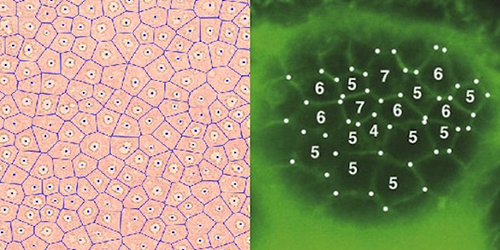
The researchers of the new study took a different approach. They realised that like skin cells, fairy circles have a life cycle (they are born, grow and then die) and could be affected by competition for space-related resources. So they decided to look at the macroscopic pattern of fairy circles that dot the landscape and compare it with the microscopic distribution of skin cells, finding the two share a remarkably similar pattern.
A pattern that appears on both macroscopic and microscopic levels in nature is virtually unheard of, they said. “It is still difficult to say why exactly they are similar, but the fact that they are similar is already very important,” Sinclair said.
For the study, Sinclair and his colleague compared the number of neighbours surrounding each fairy circle with those of skin cells. They used satellite images of the fairy circles along with a computer programme to draw lines halfway between each pair of circles to give them invisible boundaries, like cell walls. The programme then counted how many neighbours bordered each dusty circle.
The researchers also used an analysis from a 2014 study published in the journal Biology Open that examined the cell geometry of the skin covering a zebrafish lens.
The results were virtually indistinguishable. The majority of both the fairy circles and the cells had six neighbours. What’s more, the percentage of fairy circles with four, five, six, seven, eight and nine neighbours is almost identical for both the fairy circles and skin cells, the researchers found.
“I didn’t expect it to be so close,” Sinclair said.
The patterns may be similar because both skin cells and the circles in the Namib Desert are fighting for space, the researchers said. If this is true, it may help scientists learn more about systems by analysing their geometric patterns, they added. For instance, such patterns might help them look for signs of life on other planets.
Examining patterns could also help researchers studying ecology and biology. For example, understanding a large pattern, such a spiralling galaxy, may help scientists understand a similar one on a smaller scale, such as a honeycomb. “Otherwise, we need a whole new theory for each type of system we study, and may miss general principles, or not see the forest for the trees,” Sinclair said. – Live Science
In an age of information overload, Sunrise is The Namibian’s morning briefing, delivered at 6h00 from Monday to Friday. It offers a curated rundown of the most important stories from the past 24 hours – occasionally with a light, witty touch. It’s an essential way to stay informed. Subscribe and join our newsletter community.

The Namibian uses AI tools to assist with improved quality, accuracy and efficiency, while maintaining editorial oversight and journalistic integrity.
Stay informed with The Namibian – your source for credible journalism. Get in-depth reporting and opinions for
only N$85 a month. Invest in journalism, invest in democracy –
Subscribe Now!