



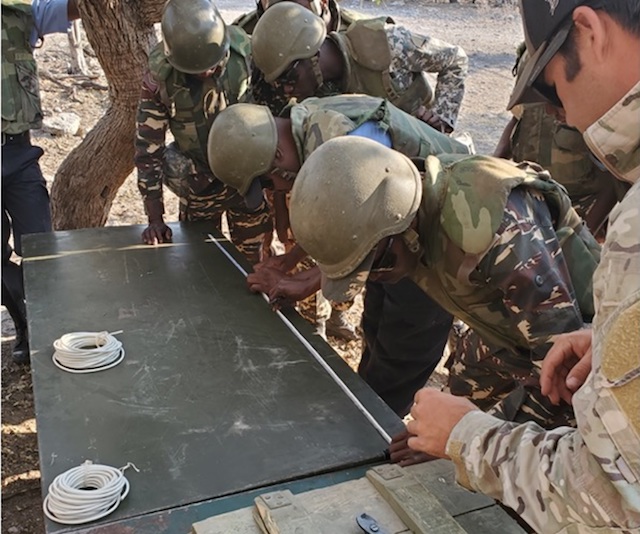
THE United States (US) Command recently facilitated the training of 15 Namibian personnel in the identification and disposal of unexploded ordnance, as part of the US government’s Humanitarian Mine Action (HMA) programme.
Unexploded ordnance are explosive weapons (bombs, bullets, shells, grenades, mortars, landmines and naval mines) that did not explode when they were employed and still pose a risk of detonation, potentially many decades after they were used or discarded. A global survey by Landmine Action suggests that Namibia is one of the countries most affected by the socio-economic effects of such munitions, also called ‘explosive remnants of war’.
These dangerous items are present in Namibia as a consequence of the country’s independence struggle until 1980. Contamination jeopardises people and livestock, especially in the northern regions of the country.
Namibian Police spokesperson Edwin Kanguatjivi said unexploded ordnances are mostly located around former army bases as a result of conflict in those areas.
“There are those just left around these bases recklessly, mostly as a result of training. Other explosives will be in the war zones in the northern parts of Namibia,” he told The Namibian yesterday.
He added that the threat of unexploded ordinance in Namibia has significantly decreased since independence. This is thanks to major detection and clean-up operations conducted with the assistance of the international community, as well as consistent awareness programmes with communities over the identification and dangers of these items, and what to do when they are discovered. The Namibian Police’s awareness slogan ‘Don’t Touch It, Report It’ is still relevant, said Kanguatjivi.
“The threat may have decreased, but there are still some of those items hidden around. With the expansion of communities into the war zone areas, it can still be very dangerous. So, if anyone sees something suspicious, don’t touch it, report it”, he advised.
As for the US Command exercise, training was provided to 10 members of the Namibian Defence Force (NDF) and five members of the Namibian Police.
A statement issued yesterday by the US embassy in Namibia stated that the training took place at the NDF military base at Otavi at the end of September. Three US Navy instructors facilitated the training, with the main focus placed on the detection, identification and disposal of explosive remnants of war to include landmines, grenades, rockets and artillery shells. Medical training, including first aid, self-aid and buddy care, was also provided. Each participant received a certificate of completion for the Explosive Ordnance Disposal (EOD) Level 1 Course of Instruction.
“The HMA programme provides humanitarian mine action assistance to countries suffering from the presence of persistent landmines, which maim and kill innocent people, obstructs emergency assistance activities, hampers economic development, and impedes [the] free movement of citizens,” the statement read.
The extreme danger of unexploded ordnance in Namibia was seen at the end of May 2018 when an 11-year-old boy died in the Ohangwena region after a grenade that he and other children were playing with exploded. Three other children between the ages of four and seven were injured.
The US Africa Command, headquartered in Stuttgart, Germany, is one of six of the US defence department’s regional military headquarters, and has administrative responsibility for US military support to US government policy in Africa, to include military-to-military relationships with 54 African nations.
A ‘Demining’ report from the United Nations in 2017 showed that 78 countries are contaminated by landmines, which kill 15 000 to 20 000 people every year, while severely maiming countless more. Approximately 80% of casualties are civilians, with children the most affected age group.
In an age of information overload, Sunrise is The Namibian’s morning briefing, delivered at 6h00 from Monday to Friday. It offers a curated rundown of the most important stories from the past 24 hours – occasionally with a light, witty touch. It’s an essential way to stay informed. Subscribe and join our newsletter community.

The Namibian uses AI tools to assist with improved quality, accuracy and efficiency, while maintaining editorial oversight and journalistic integrity.
Stay informed with The Namibian – your source for credible journalism. Get in-depth reporting and opinions for
only N$85 a month. Invest in journalism, invest in democracy –
Subscribe Now!