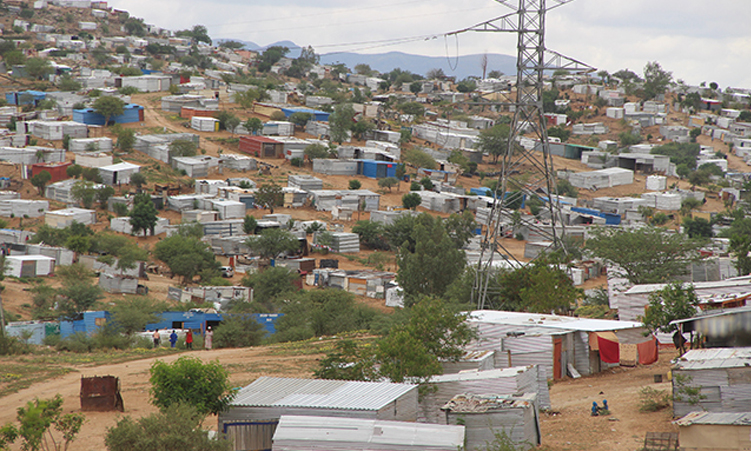
A severe housing shortage is pushing property prices out of reach for average Namibians, leaving thousands with little choice but to live in informal settlements.
According to a new affordability report by Simonis Storm Securities, a home buyer now needs a monthly salary of nearly N$44 000 to afford an average house.
In the second quarter of 2026, the average house price hit N$1.46 million, requiring a monthly income of about N$43 765 to secure financing for a home at that level.
Housing expert Namene Kalili says the underlying issue is simple supply and demand: Namibia is building far too few houses to keep pace with population growth.
“More and more people are moving into shacks. The houses that are existing are being re-traded so their value keeps going up and up and up,” Kalili says.
He says Namibia needs to service thousands of plots every year to increase housing supply.
“40 houses here, 40 plots there, a hundred plots there – that’s not enough. So they should be servicing around 5 000 plots a year and they are nowhere near that.”
Kalili says problems in the building supply industry are also making it difficult to increase the number of houses.
“Even if you had to build a hundred houses today, you’re going to struggle to source building supplies. It starts with servicing 5 000 houses every single year. That will add so much to the gross domestic product.
“It will grow this economy, it will create jobs but we’re just not getting to it,” Kalili says.
CALCULATIONS
The calculation assumes the buyer pays a 10% deposit, takes a home loan over 20 years at an interest rate of 10.5% and spends no more than 30% of their gross income on the mortgage.
Someone earning N$22 000 a month could afford a property worth about N$734 524, while a person earning N$11 000 could afford one worth about N$367 262.
At an income of N$5 000 a month, the affordable property value falls to about N$166 937. Someone earning N$2 000 a month could afford a property worth only about N$66 775 under the same conditions.
This means only the N$44 000 monthly income level used in the report is enough to afford the current average house price.
Data from the 2025 Namibia Financial Inclusion Survey cited in the report shows that 54.1% of adults earn N$2 000 or less a month.
About 19.1% earn between N$2 001 and N$9 000, while 2.2% earn between N$9 001 and N$11 000.
In May, The Namibian reported that less than 10% of the working population owes banks N$45.1 billion in home loans.
At that time it was reported that 70% of the population cannot afford formal housing because of low incomes and limited access to mortgages.
At a housing seminar in the same month, Bank of Namibia deputy director of policy research Abigail Nainda said average house prices have more than doubled over the past two decades.
Economist Almandro Jansen says house prices are rising much faster than what most Namibians earn, mainly because of higher construction and land costs and a shortage of serviced land.
“Materials for a standard three-bedroom house now cost roughly N$301 000 to N$380 000, while land prices have increased by between 20% and 38%, depending on the region,” he says.
Jansen says this means the cost of putting a new house on the market is increasing faster than the cost of living for households hoping to buy one.
“That gap isn’t a recent wobble. It is structural and nothing in the income data we could verify suggests it is closing,” Jansen says.
He says rising house prices do not appear to be caused by a surge in people buying homes.
Housing transaction growth slowed to 2.8% year on year from 10.4%, while household mortgage credit grew by only 2.1%.
The number of plots sold nationally also fell by 26.7%.
“That’s not the signature of runaway demand. It’s far more consistent with a market where supply, specifically serviced land, has been constrained for long enough that even soft demand is enough to keep pushing the price of what little is available higher,” Jansen says.
The Ministry of Urban and Rural Development has set a target of servicing 10 000 plots a year until 2029/30.
However, the latest figures cited by Simonis Storm show that only 1 772 plots were fully serviced during the 2024/25 reporting period.
Another 1 064 were partially serviced.
This means the delivery of fully serviced plots reached only about 18% of the annual target.
“Prices didn’t need strong demand to outrun incomes. They just needed supply that consistently failed to arrive,” Jansen says.
The Mass Housing Development Programme has delivered 4 826 houses since it started in 2014, averaging fewer than 500 houses a year.The National Housing Enterprise (NHE) estimated Namibia’s housing backlog at about 300 000 units in 2025.
Simonis Storm estimates it would cost about N$76 billion to clear the backlog.
The government has confirmed N$1.5 billion for housing in the 2026/27 budget, leaving a gap of about N$74.5 billion against the NHE estimate.
The Simonis Storm report also shows that most Namibians who own homes did not use mortgages to get them. About 64% of homeowners built their homes, while 24.4% bought them.
Only 6.9% used a bank loan to buy or build a house.
Just over half of homeowners, or 52.6%, have official ownership documents. Overall, 65.3% of households report owning their homes, while 13.9% rent and 16.9% live rent-free.
Simonis Storm says controlling house prices or rents alone will not solve the problem. It recommends that the government should publish quarterly figures showing how many plots are planned, funded and fully serviced in each town.
Simonis Storm says Namibia could make progress in reducing the housing shortage within three to five years if implementation starts immediately.