



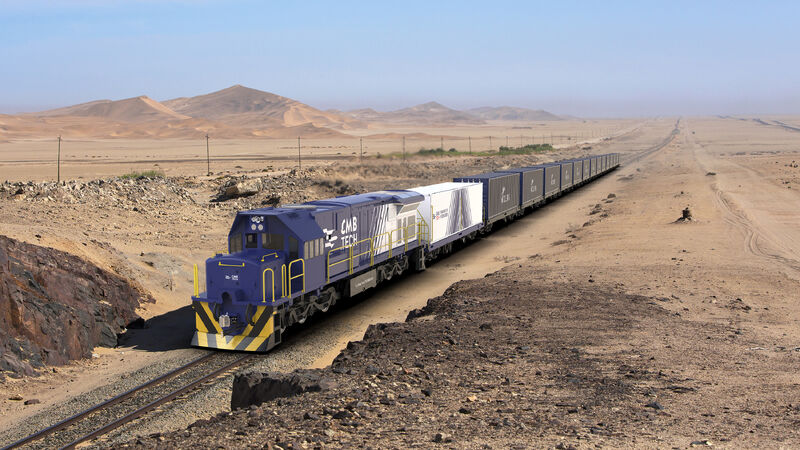
Namibia is preparing to launch its first heavy-duty freight locomotive powered by locally produced green hydrogen later this year.
The project could position Namibia as one of the first countries in Africa to operate a heavy duty freight train powered by green hydrogen.
The project is a partnership between CMB.Tech Namibia, TransNamib and Africa Global Logistics.
According to a statement by CMB.Tech issued this week, the locomotive is currently being assembled in South Africa and is aimed at modernising Namibia’s rail sector while reducing carbon emissions.
“Namibia has a large fleet of idle locomotives that can be repowered with this cost-effective and future proof technology.
By converting an operational locomotive, the initiative aims to show how hydrogen can be integrated into freight rail without the need for new rolling stock or major infrastructure changes,” the company says.
The hydrogen-powered locomotive will operate between Walvis Bay and Windhoek for a trial period.
Initially, the train will complete 50 round trips between the Port of Walvis Bay and the container depot near Windhoek.
The hydrogen used for the project will be produced off-grid at CMB.Tech’s hydrogen plant at Walvis Bay.
TransNamib says the project forms part of its broader efforts to modernise rail operations.
“As a central player in the country’s transport infrastructure, TransNamib is actively exploring modernisation pathways, including the repowering of its existing locomotive fleet through innovative technologies such as dual fuel hydrogen systems,” the rail operator’s statement reads.
The locomotive has a dual-fuel hydrogen engine, meaning it can operate on both diesel and green hydrogen.
Hydrogen will be stored in a fuel tender behind the locomotive.
Each tender can carry two 20-foot hydrogen storage units, with up to 360kg of compressed hydrogen per unit.
According to the project partners, the locomotive can continue operating on diesel if the hydrogen system is unavailable.
“The locomotive remains fully functional at all times. If hydrogen is not available, it automatically switches to diesel.
This ensures service continuity and reliability.”
The Walvis Bay-Windhoek corridor stretches 414km and climbs from 6m above sea level to 1 601m in the highlands.
The project partners say this makes it an ideal testing ground.
In an age of information overload, Sunrise is The Namibian’s morning briefing, delivered at 6h00 from Monday to Friday. It offers a curated rundown of the most important stories from the past 24 hours – occasionally with a light, witty touch. It’s an essential way to stay informed. Subscribe and join our newsletter community.

The Namibian uses AI tools to assist with improved quality, accuracy and efficiency, while maintaining editorial oversight and journalistic integrity.
Stay informed with The Namibian – your source for credible journalism. Get in-depth reporting and opinions for
only N$85 a month. Invest in journalism, invest in democracy –
Subscribe Now!