



Analysts say the new budget will not allow for the economy to grow as it is focused on operations and too little has been left for development projects.
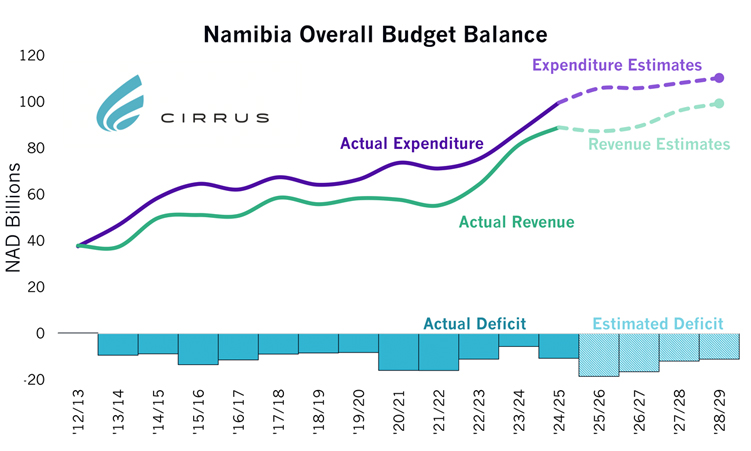
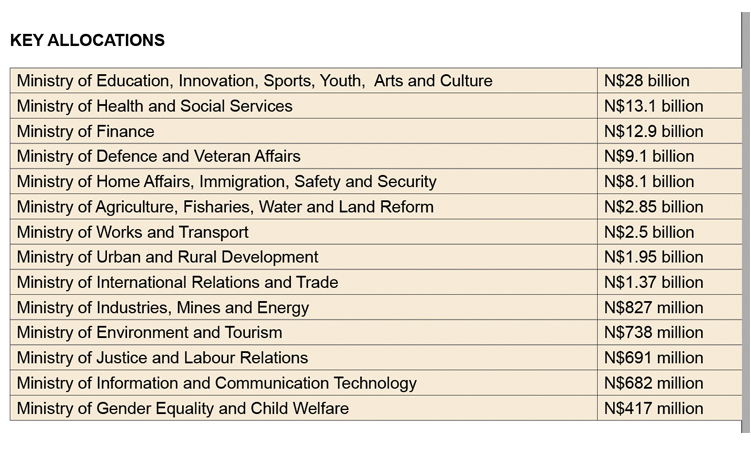
Minister of finance Ericah Shafudah yesterday tabled a budget of N$104 billion for the 2026/27 financial year. According to Shafudah, the government was able to collect revenue of N$89.8 billion with about N$15 billion expected to be borrowed to meet all obligations. The majority of this money will be going to operations, which has a budget of N$81.3 billion. The development budget received only N$6.5 billion.
Interest payments are expected to be around N$16.2 billion.
“This budget is about restoring balance between ambition and affordability, between growth and stability, and between today’s needs and tomorrow’s obligations. The choices before us are difficult, but they are necessary,” said Shafudah.
Former minister of finance Calle Schlettwein says the budget focuses too heavily on operations and not enough on development.
“I believe the capital budget with its six-odd billion is far too low to stimulate economic growth. The operational budget is sucking up too much and the capital budget is used as a valve to regulate that,” he told The Namibian.
He says the defence budget and the education budget are overfunded, and money from those sectors could be used to fund productive sectors of agriculture, manufacturing and service provision. In this budget, subsidised tertiary education received an allocation of N$2.8 billion.
“You cannot grow an economy if the basic infrastructure is missing, including power, water and internet provision,” he says.
But he adds that he was unsurprised by the budget given Namibia’s economic situation.
“We’re going in the wrong direction, but we do this all the time,” he says.
Economist Omu Kakujaha-Matundu calls the spending on the operational budget “customary”.
“Such a lopsided budget won’t achieve job creation through the construction of crucial infrastructure such as refurbishment of the railroad and investment in green schemes,” he says.
Economist and Economic Association of Namibia director Klaus Schade similarly brings up the lack of a capital budget.
“There is very little in the budget that stimulates economic growth. We need to invest in productive infrastructure. Investors have already raised the issue of insufficient infrastructure. The minister mentioned investment in road transport, but there was no word of rail, which is crucial for these new industries,” he told the Namibian Broadcasting Corporation yesterday.
But like others, he says Namibia is in a difficult fiscal space.
“There is no space for an expansionary budget. The budget deficit has increased, public debts are shooting up and interest payments are reaching 17% of the gross domestic product, which is far behind our own targets of 10%,” he said.
Other economists also raise the issue of high debt repayments.
“The budget is fiscally responsible but growth-constrained,” economist Josef Sheehama says.
“Rising interest payments, from N$14 billion to N$16 billion and exceeding the development budget, are crowding out productive investment and limiting fiscal space,” he says.
Economist Salomo Hei told The Namibian that the rising interest payments could be driven by the rollover of debt from the Eurobond to local debtors.
But he believes the budget is fair in the context of the country’s revenue decline.
“They have gone further than before with the development budget. The development budget has been cut because of the low execution rate. You cannot get more money if you’ve not been spending the money,” he says.
N$100 OLD AGE GRANT UNACCEPTABLE
Pensioners are set to receive an N$100 increase effective 1 April. This means pensioners will now earn N$1 700 per month, up from the current N$1 600.
Independent Patriots for Change member of parliament Michael Mwashindage describes the increase as unacceptable and a drop in the ocean.
“The elders were promised N$3 000 during the election campaign but with this N$100 it is clear, they lied. How do we solve social problems and unemployment if we keep lying to our people?” he asks.
Mwashindange says he is disappointed that only 700 jobs were created under the National Youth Fund, arguing that the 500 000 target will not be reached.
“What are we seriously doing? It was on this promise that young people went to cast their votes and after the elections these promises are not satisfied. There is a serious problem,” he says.
Leader of the official opposition Imms Nashinge also says the old-age grant increase is too little.
He says life has become expensive and the government needs to do more to produce its own products and improve people’s lives.
He, however, commends the government on responding to some issues.
Body of Christ Party leader Festus Thomas says the government has robbed its citizens, adding that it does not care about the plight of the people.
He says the increase is too little and an insult to elders who have put their trust in the government.
HOUSING CRISIS
Landless People’s Movement chief whip Dawid Eigub says the government has failed to fulfill its promise of constructing 10 000 houses a year, based on the numbers announced by the minister.
With the current trajectory of construction, he says, the government will not reach even half of its targets.
Eigub says housing has been a big problem in the country, but with the lack of funding on the development budget, many Namibians may not realise their dream to own a house.
He says the development budget creates jobs and that agriculture must become a priority if Namibia is to address unemployment.
“Our councillors at Mariental just constructed 57 units valued at N$100 000. Are you telling me this government cannot do this? No, the government must get serious,” he adds.
Affirmative Repositioning leader Job Amupanda commends the government for not enlisting projects onto the development budget until feasibility studies of ongoing projects have been conducted.
“There have been too many projects sitting for 10 years. The move is one that is very welcomed. But we are going to interrogate the budget,” he says.
EMPLOYMENT
Shafudah’s budget has allocated N$259 million for the recruitment of health professionals.
Meanwhile, N$108 million has been allocated for recruitment in the Namibia Correctional Service.
There is also an allocation of N$158 million for the translation of 2 033 police cadets in training, and the recruitment of 2 000 cadets.
The judiciary will receive N$78 million to address personnel shortfalls for judges and magistrates.
The Anti-Corruption Commission will be receiving N$10 million to fill critical positions within the commission
Shafudah has allocated N$1.7 billion for the 2026/27 fiscal year to improve the salary structure of civil servants.
Lower grades (15 and 14) will receive a standardised monthly increase of N$700. Other grades (13 to 1) will receive a 5% increase in basic salaries, effective 1 April.
Political office bearers have been allocated N$58 million for improvements to their basic pay and benefits.
The minister also announced that for the 2027/28 financial year, a further 5% boost in base salaries is planned, along with a 7% increase in transport allowances for non-management positions.
In an age of information overload, Sunrise is The Namibian’s morning briefing, delivered at 6h00 from Monday to Friday. It offers a curated rundown of the most important stories from the past 24 hours – occasionally with a light, witty touch. It’s an essential way to stay informed. Subscribe and join our newsletter community.

The Namibian uses AI tools to assist with improved quality, accuracy and efficiency, while maintaining editorial oversight and journalistic integrity.
Stay informed with The Namibian – your source for credible journalism. Get in-depth reporting and opinions for
only N$85 a month. Invest in journalism, invest in democracy –
Subscribe Now!