Next week on 22 October, minister of finance Ericah Shafudah will table the mid-year budget for the 2026/27 financial year.
In light of this, it is worth examining what the national budget actually covers.
The national budget is essentially a plan for how much the government will collect and how that money will be spent over the financial year.
Tax income and payments from the Southern African Customs Union revenue sharing pool make up the majority of the income, and when total revenue is depleted, the government borrows the deficit.
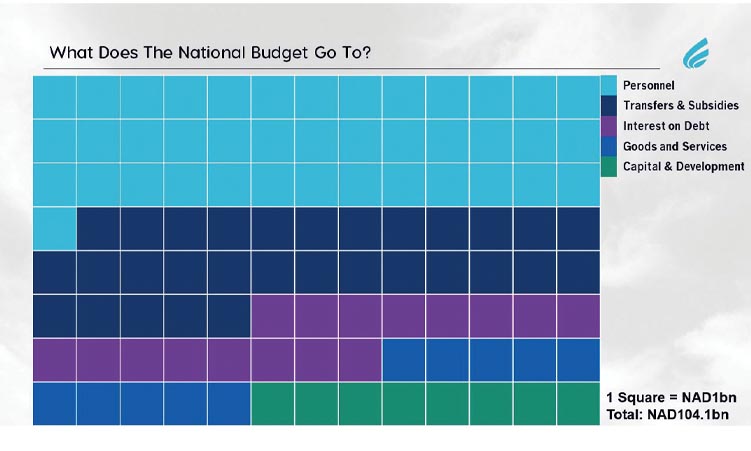
In the 2026/27 budget, the government planned to spend N$104.1 billion.
Broken down in simple terms, of every N$100 spent by the government, N$38.50 goes towards paying the salaries of teachers, nurses and other public servants.
N$28.70 is transferred to state-owned enterprises, regional and local councils and to individuals through social grants.
N$9.60 covers goods and services required for operations from electricity to consulting services.
This leaves about N$7.60 for capital spending, meaning investment into assets that serve the public long term such as roads, schools, clinics and equipment.
What is concerning is that for N$100 spent by the Namibian government, N$15.60 goes towards interest and borrowing expenses.
This year has been plagued by externalities, with two major ongoing conflicts, an expected drought, and an outbreak of foot-and-mouth disease in the country.
This means the mid-year budget is likely to contain significant revisions as funding will be needed to address the impact of externalities on the domestic economy.
– Ida Williams is an economist at Cirrus Capital.