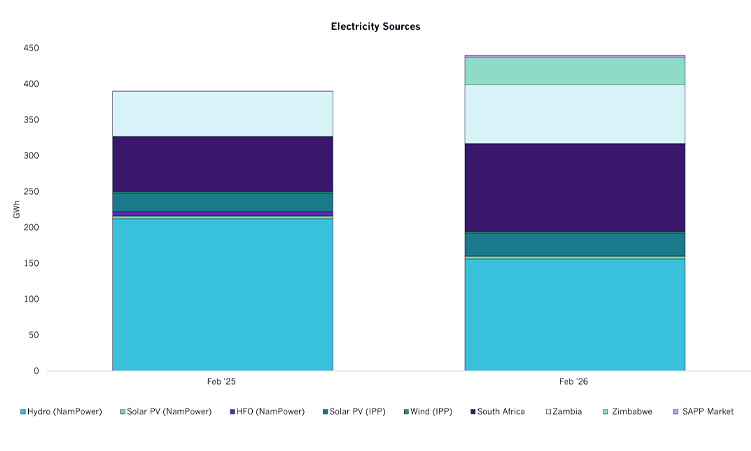
Namibia consumed 440GWh of electricity in February, up 13% from 390GWh in the same month a year earlier. Imports accounted for 56% of supply, with the balance generated domestically.
Ruacana, the Namibia Power Corporation’s (NamPower’s) hydroelectric station on the Kunene River and the country’s largest domestic generator, produced 156GWh during the month. That compares to 212GWh in February 2025 and 165GWh in January 2026. As a hydroelectric plant, Ruacana’s output depends on rainfall and river flows, which vary from month to month and season to season.
This variability is a long standing feature of Namibia’s energy mix, and the country has historically relied on imports to balance demand, with local generation averaging around 38% of supply over the past 15 years.
Imports flowed in through the Southern African Power Pool (Sapp), a regional electricity market that gives Namibia access to a wider and more diverse pool of generation capacity. In February, South Africa supplied 123GWh, up from 77GWh a year earlier, while Zambia contributed 82GWh, up from 63GWh.
Independent power producers (IPPs) continue to grow as a part of the picture. IPPs supplied 34GWh in February, up from 28GWh in February 2025 and contributing 8% to the total. The growth reflects the gradual expansion of privately developed renewable capacity, predominantly solar, feeding into the national grid under Namibia’s Modified Single Buyer Model, which allows IPPs to sell electricity directly to large consumers and distributors.
Deeper access to regional markets through Sapp and a growing domestic IPP base act as buffers against the variability of Ruacana’s output. NamPower has set a target of generating 80% of consumed electricity locally by 2028, backed by a pipeline of solar, wind and biomass projects in various stages of development.
– Ida Williams is an economist at Cirrus Capital.