




Namibian inflation and oil prices
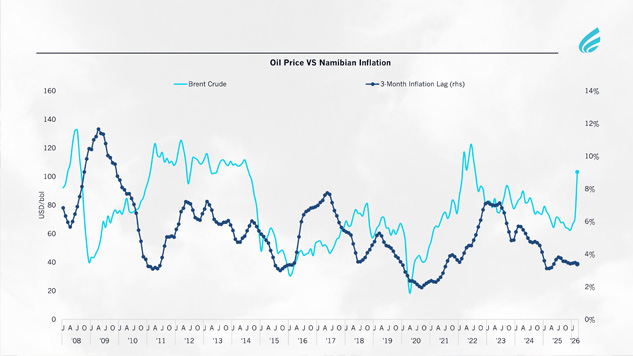
ON 28 February, Israel and the United States launched a joint attack on Iran, escalating a conflict that has pushed oil prices above US$100 (about N$1 600) per barrel, with more than a third of global oil supply unable to transit the Strait of Hormuz, which remains closed as the conflict continues.
As a result, there has been much discussion surrounding the inflationary effects of the war, even though most of these effects have yet to reach our shores.
This is because inflationary spikes usually arrive in waves.
The first wave’s effects are the pump price increases, as seen in April when the government raised the petrol price by N$2.50/l and the price of both diesel variants by N$4/l.
While the price raise increased pressure on households, fuel prices remain well below cost-reflective levels.
To shield consumers from higher fuel costs, the government temporarily cut fuel levies by 50% for three months and allowed the National Energy Fund to absorb part of the fuel under-recoveries.
The remaining under-recoveries absorbed by the fund were estimated at approximately N$500 million for April this year alone.
However, levy cuts and price dampening are not a sustainable solution, and the government will likely be forced to restore the full fuel levies or raise prices to avoid accruing massive losses.
More concerning are the second round of inflationary effects, as prices linked to food and logistics are set to spike.
These effects are delayed by a few months and will likely be in full force from June onwards if the conflict persists and oil prices remain elevated.
This could be especially devastating for Namibia, as the country is completely dependent on fuel imports and a substantial portion of the food we consume is sourced from outside our borders.
As oil prices rise, fuel costs rise with them, driving up transportation costs as logistics companies pass the burden on to consumers.
It is also worthwhile keeping tabs on input costs that could affect final goods prices.
For example, roughly one third of the world’s fertiliser trade passes through the Strait of Hormuz, and following Iran’s closure of the strait, fertiliser costs jumped from US$464.14 (about N$7 700) per tonne to US$587.88 (about N$9 700) per tonne (urea free on board Middle East) three days after the escalation.
While Namibia may not feel the first-round effects of higher fertiliser prices directly, foreign and local farmers reliant on fertiliser for a good harvest will undoubtedly feel the impact.
This will translate into much higher crop prices being passed on to consumers months after the initial shocks.
The urea fertiliser that passes through the strait is used to grow a wide range of crops, most notably rice, wheat and corn, staples that will see knock-on price increases globally.
As negotiations between the United States, Israel, and Iran struggle to make headway, Namibians should brace for significantly higher inflation in the months ahead, potentially echoing the price pressures felt in 2022 following Russia’s invasion of Ukraine, when domestic inflation peaked above 7%.
– Ida Williams is an economist at Cirrus Capital.