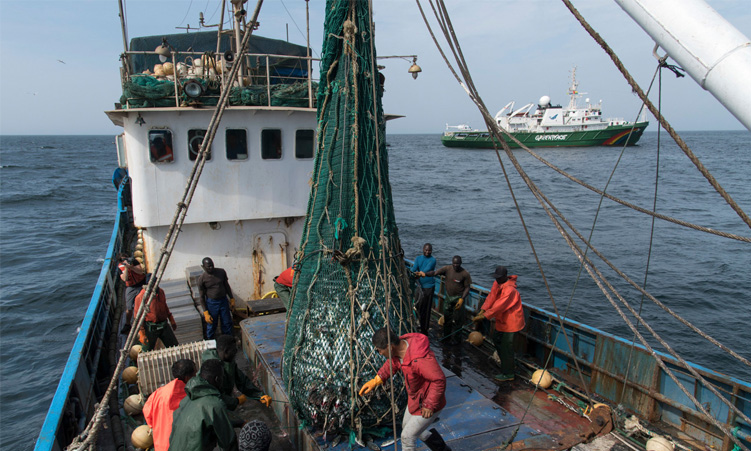
The fishing industry is divided over Cabinet’s decision to relax the 200-metre isobath rule.
Cabinet last week approved the temporary relaxation of trawling limits for the wet-landed horse mackerel subsector from 200 metres to 150 metres for a 12-month period starting 1 May.
The wet-landed sector this year received 78 800 metric tonnes of the 197 000-tonne horse mackerel total allowable catch (TAC). Of this TAC, a further 10 519 metric tonnes of wet-landed quota has been reserved for governmental objectives.
Gendev Fishing and Princess Brand are the only companies that do wet-landed horse mackerel which is further processed in their land-based factories where they employ about 1 300 workers.
The two companies own four vessels.
Confederation of Namibian Fishing Associations chairperson Matti Amukwa warns that more than 90 vessels could be excluded from these fishing grounds.
These are 10 freezer vessels, 66 hake vessels and 14 monk vessels.
“This relaxation grants exclusive access to a very small group of wet-landed horse mackerel vessels to fish as shallow as 150 metres,” he says.
Amukwa says the area affected is large and represents almost one-third of the horse mackerel fishing zone.
He adds that the decision could leave many vessels without access, creating an uneven system.
“Equally worrying is that this decision contradicts repeated warnings from government scientists. The 150 to 200 metre zone is a recognised breeding and nursery area. There is no scientific study supporting this relaxation or previous relaxations and opening this zone risks long‑term sustainability for short‑term gain,” he says.
Amukwa questions how far the fishing area will extend and says the decision could affect trust in how fishing resources are managed.
“The government must clarify where other vessels are supposed to fish. This decision creates a two-tier fishing industry,” he says.
Amukwa adds that the issue may need to be reviewed by regulators.
“This is an anti-competitive practice. The competition commission needs to look into this issue,” he says.
Over the years, freezer vessels have caught excessive amounts of bycatch. This has caused concern within the ministry, which suggests that these high volumes appear deliberate, with non-target species being landed specifically for their economic value.
Pilchard and hake species are the most targeted.
Wet Landed Small Pelagic Association chairperson Johnny Doeseb welcomes Cabinet’s decision to temporarily relax the trawling restriction.
Doeseb says the decision supports both economic activity and resource management.
“This reflects the government’s commitment to balancing economic development and sustainable resource management,” he says.
He says the change could improve operations.
“It creates an environment for better efficiency and onshore value addition.”
Doeseb says the impact will be felt across the industry.
“The benefits extend across the value chain, including processing, logistics and distribution,” he says.
He says this measure must be implemented with a focus on scientific monitoring and compliance.
The 200-metre isobath rule has been used to protect fish and marine areas closer to shore.