



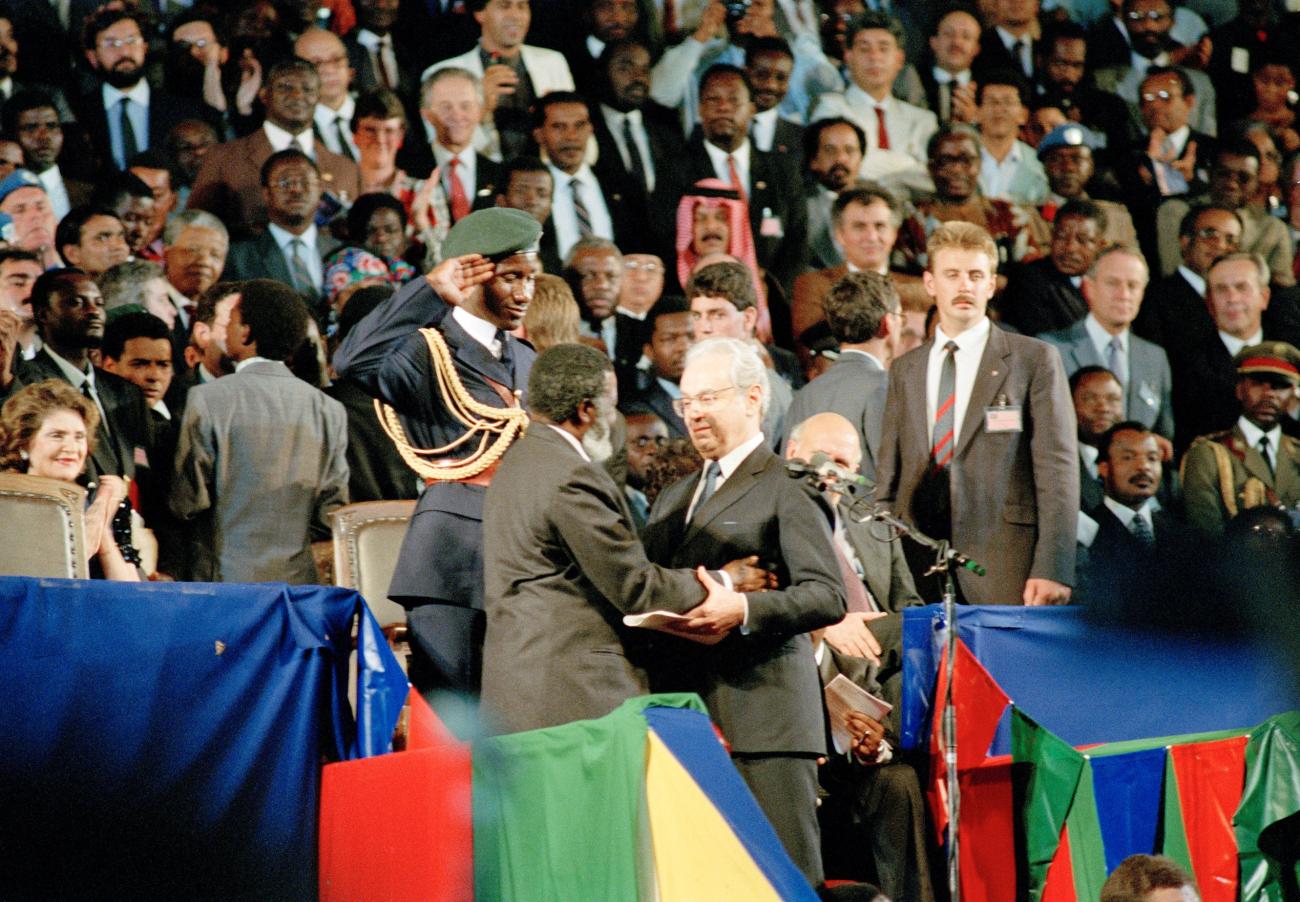
We shouted “down, down, down”, when at midnight of 21 March 1990 the South African flag was finally lowered. It was a jubilant, euphoric mood. Nelson Mandela was with us. Released only a few weeks before, Madiba received thunderous applause when entering what is now Independence Stadium.
Fittingly, Ziggy Marley played at the Independence Day concert there. His late father had performed at Zimbabwe’s independence 10 years before. In an iconic song, Bob Marley once diagnosed:
“Babylon system is the vampire
Sucking the children day by day
I say, the Babylon system is the vampire, falling empire
Sucking the blood of the sufferers
Building church and university
Deceiving the people continually
I say they are graduating thieves and murderers
Look out now, they are sucking the blood of the sufferers.”
This echoes in my mind and memory, when taking stock of then and now.
What Then
We embraced a new era under Swapo’s slogan ‘Solidarity, Freedom, Justice’. But the writing was on the wall – literally speaking, at the dilapidated remnants of what had been the old contract workers compound. Abandoned, parts were used by local non-governmental organisations. Murals celebrated the end of a settler colonial regime. One of the walls in the inner yard displayed a poem titled ‘Roses in Namib’:
“Now that the Namib sings
And the tear of the Katutura child washed away
Who will keep
The fire burning.”
The visual testimony by ordinary Namibians at a turning point in history was however not preserved. The spirit of the new Namibia on the old compound walls was not protected from destruction. It had to make room for new shops and businesses, a sign of “postcolonial modernity”.
The evening of 20 March 1990 was a prelude to what would come. An official banquet took place at the hall of the SKW, then still at Tal Street. When entering, Sam Nujoma and Werner List walked hand in hand over the red carpet. List was the biggest individual businessman of the time. He had co-sponsored the event. Just months before hundreds of workers were on strike at South West (now Namibia) Breweries, part of his business empire. Many of them were sacked. Maybe some of them were among the curious lookers gathered outside of the venue?
At the same time, members of the international solidarity movement celebrated with local activists at the Khomasdal Centre of the Rössing Foundation. Andimba Toivo ya Toivo spent the evening there. He enjoyed the company of his close friends, the exiled South African couple Jack and Ray Alexander Simons. And Nahas Angula passed by to mingle with some of the less important folks.
Looking back, this contrast was indicative of what was to come. Namibia’s decolonisation was a negotiated transitional process from controlled change to changed control. It reassured the haves, that the collapse of a racist minority regime is not the end of business as usual.
What Now
Namibia and South Africa remain the most unequal countries in the world. Blaming apartheid for this denies the failures of governance under the former liberation movements. It closes the eyes in denial of a transactional elite pact. The emerging species of “fat cats” was black.
More than 20 years ago, Kavevangua Kahengua summed it up in the following poem:
“When developments create
cities with no space
for the poor
It hurts
When developments issue
water bills
that flush out the poor
from the dwellings
It hurts
When developments uproot existence
and replace it with magnificent storeys
It hurts.”
“The system is a joke” sang Elemotho around the same time, “all they give us is Coke”. Forty years earlier, Frantz Fanon’s manifesto ‘The Wretched of the Earth’ was like a prophecy. Its chapter on ‘The Pitfalls of National Consciousness’ criticises the party governing the independent state. It “controls the masses, not to make sure that they really participate in the business of governing the nation, but in order to remind them constantly that the government expects from them obedience”.
Namibia under the continued rule of Swapo is bordering on a textbook example of Fanon’s painful diagnosis. Despite liberal democracy, civil rights and liberties, the rule of law, and the absence of any politically motivated violence as considerable achievements: too many people feel left behind.
What to come?
Indications suggest no change of mind by those in government. They praise their heroic deeds during the struggle days while in denial of the failures then and now. Their patriotic history knows no regrets. Own crimes committed are declared heroic acts. The true meaning of “Solidarity, Freedom, Justice” was sold out and betrayed for its own privileges and benefits. Entitlements claimed for sacrifices made during the anticolonial resistance were perverted into self-enrichment by greed galore.
But as Frantz Fanon warned: “The national government, if it wants to be national, ought to govern by the people and for the people, for the outcasts and by the outcasts.” No leader, he warns, can substitute for the popular will. A government, he demands further, “ought first to give back their dignity to all citizens, fill their minds and feast their eyes with human things, and create a prospect that is human.”
In contrast, the slogan “a luta continua” (the struggle continues) translated into the perverted notion of the looting continues. A racist system of oppression turned into a more “colour blind” class society. At the bottom remains a black underclass. Due to the daily deprivation, its members are hardly aware of nor able to appreciate the liberties and rights of a constitution. They continue to bear the brunt of a “Babylon system”.
But Bob Marley gave the answer in his song:
“We refuse to be
What you wanted us to be
We are what we are
That’s the way it’s going to be, if you don’t know
You can’t educate us
For no equal opportunity
Talking about my freedom
People freedom and liberty.
We’ve been trodding on the winepress much too long
Rebel, rebel
Yes, we’ve been trodding on the winepress much too long
Rebel, rebel.”
Henning Melber was a member of Swapo from 1974 to 2025. He was heading the Namibian Economic Policy Research Unit (1992-2000), research director of the Nordic Africa Institute (2000-2006) and executive director of the Dag Hammarskjöld Foundation (2006-2012), in Uppsala, where he remains associated with both institutions. He is extraordinary professor at the University of Pretoria and the University of the Free State in Bloemfontein and a senior research fellow with the Institute for Commonwealth Studies of London University.
In an age of information overload, Sunrise is The Namibian’s morning briefing, delivered at 6h00 from Monday to Friday. It offers a curated rundown of the most important stories from the past 24 hours – occasionally with a light, witty touch. It’s an essential way to stay informed. Subscribe and join our newsletter community.

The Namibian uses AI tools to assist with improved quality, accuracy and efficiency, while maintaining editorial oversight and journalistic integrity.
Stay informed with The Namibian – your source for credible journalism. Get in-depth reporting and opinions for
only N$85 a month. Invest in journalism, invest in democracy –
Subscribe Now!