



•PETER CURSONOn Monday, 109 years ago, amidst the dunes and salt pans near Holpan in southeastern Namaland, a young Australian gave up his life, killed by a Baster irregular attached to a German schutztruppe patrol.
For Edward Presgrave it was a very short life. Barely 23 years old, in a small way he played a part in the Nama uprising against the German colonial authorities between 1904 and 1906 in the Karasberge and along the German border with the Cape Colony north of Upington.
In 1948 Lawrence Green could write that Presgrave’s death was “The blackest deed ever encountered on this border… and that Presgrave was an Australian adventurer who ran guns and other supplies to the Hottentots…”
Leaving aside Green’s lack of consideration for the many Nama killed, imprisoned or indentured during or after the war, there seems little doubt that Presgrave’s untimely death engendered considerable emotion and that his contribution should not be forgotten.
A considerable amount of material exists in the official records of the Cape Colony, Britain, Germany, Namibia and Australia about Presgrave. Most of this material was assembled between 1905 and 1910 partly in response to his parents’ claim for compensation from the German government for what they saw as the unlawful killing of their son and partly in response to concerns expressed by members of the Cape Government.
Presgrave’s death, allied to the arrest and imprisonment of Frode Sahlertz, a young Dane who accompanied him on that fateful day, produced something of a diplomatic storm between the Cape and British authorities and the German government with the exchange of numerous diplomatic dispatches, notes, and reports.
Much of this was due to the honesty and dedication of a young policeman, Sub-Inspector Attwood based at Rietfontein, who pursued the circumstances of Presgrave’s killing with great vigour despite the opposition of his immediate superiors.
Ironically, not one word of all this reached the Australian government until almost 16 months later when the British Colonial Office wrote formally to Presgrave’s parents and an edited official report was later sent to the Australian Prime Minister. In some ways Attwood’s official reports of Presgrave’s death, allied to the campaign of his parents, proved to be a tiny spark which helped ignite a broader conflagration focusing attention on the German war against the Herero and the Nama, border transgressions, cattle raiding, local support for the rebels, refugee flows, as well as many other issues in the years after 1903.
Relatively little is known about Presgrave other than that he left Sydney in 1900 aged 18 and made his own way to South Africa where he enlisted in two irregular regiments during the Boer War. Following his discharge in late 1901 he seems to have drifted around South Africa until eventually making his way up to Upington in the Northern Cape.
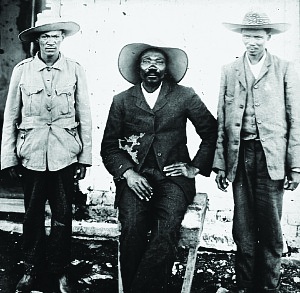
It was here that he established himself as a minor trader in foodstuffs and livestock, and it was here that in 1904 he would ally himself to Jakob Morengo and be swept up in the ebb and flow of events along the German/Cape border as the Nama rose in revolt.
It would appear that Presgrave spent some months living with Morengo and his supporters in the Karasberge Mountains early in 1905. He may have even acted as a ‘secretary’ for Morengo, as well as supplying him with arms, ammunition and cattle. He is also reported to have taken photographs while in the Karasberge, but no records of these seem to have survived. Presgrave fought alongside Morengo in battles against the Germans at Narudas and Narus in 1905 as well as in a ‘patrol fight’ at Leeukop near Bisseport.
Following this engagement he returned to the British side of the border and continued to supply Morengo with cattle and supplies. There is little doubt that his activities attracted the attention of both the German and British authorities and that there were many on both sides of the border that would have been glad to see the back of him.
In late September 1905, a Lieutenant Beyer in the German forces at Klipdam paid two Boers to entice Presgrave over the border on the pretext of selling him some cattle. Once across the border they shot him and left him for dead. Shot in the stomach, Presgrave survived for the next 18 hours only to be finally killed the following morning when the German patrol arrived.
Despite a long campaign by his parents and some unease among members of the Cape government, as far as the British and German authorities were concerned, Presgrave’s death was simply an ‘official killing’ – a just retribution for his regular transgressing of the border and his active support for the rebels.
Officially Presgrave’s death was consigned to the ‘dead past’. For Attwood, some members of the Cape Cabinet as well as Presgrave’s parents, their son was brutally murdered.
In the final analysis, Jakob Morengo fought passionately for what he believed in – land, life and liberty. We do not know what motivated Presgrave and why he allied himself to the Nama. Perhaps it was the spirit of adventure, support for the underdog, or a deep hatred of the Germans. Whatever it was, he deserves to be remembered.
In an age of information overload, Sunrise is The Namibian’s morning briefing, delivered at 6h00 from Monday to Friday. It offers a curated rundown of the most important stories from the past 24 hours – occasionally with a light, witty touch. It’s an essential way to stay informed. Subscribe and join our newsletter community.

The Namibian uses AI tools to assist with improved quality, accuracy and efficiency, while maintaining editorial oversight and journalistic integrity.
Stay informed with The Namibian – your source for credible journalism. Get in-depth reporting and opinions for
only N$85 a month. Invest in journalism, invest in democracy –
Subscribe Now!